




Dashboard Analyzes Credential Earnings Premiums by State

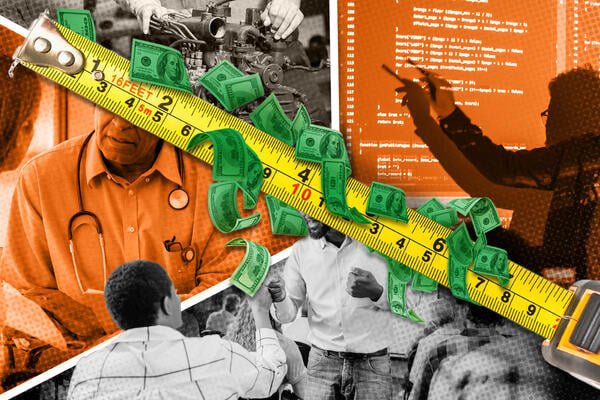
Under a new federal test, college programs will have to show their graduates earn at least more than an adult with a high school diploma in order to access federal student loans.
Photo illustration by Justin Morrison/Inside Higher Ed | andriano_cz, choness, gorodenkoff and kali9/iStock/Getty Images | andreswd and SDI Productions/E+/Getty Images
Four years after graduation, Delaware’s median undergraduate credential earner made double what the median Delaware high school graduate did, according to a new online data tool. But Colorado’s undergrad completers only made 55 percent more than high school diploma or equivalent earners.
The HEA Group, a higher education research and policy firm, published a dashboard today that takes data compiled to show the potential impact of the upcoming federal earnings test for college programs and breaks it down by state, field, credential level, and more. The website allows the public and policymakers to compare, both within and among states, the median earnings four years after graduation for completers of various undergraduate degrees and certificates.
The site also shows how much those salaries exceed the median pay for high school diploma earners in each state, a figure called the earnings premium. And it reveals the rarer cases where those who didn’t go to college at all made more.
“It’s very nuanced within these data, but you do have some very interesting numbers when it comes to how much of a premium does a college degree provide,” said Michael Itzkowitz, the HEA Group’s founder and president. “And sometimes it’s very encouraging.”
The federal “Do No Harm” earnings test, which was finalized this past summer, generally requires certificate and degree programs to show their graduates earn more on average than high school diploma earners. Otherwise, students in those programs will no longer be able to receive federal student loans. The first round of results of the test are expected next year. In the meantime, this new dashboard provides states with, among other information, an early look at which of their programs may lose federal support.
The HEA Group says the federal data includes information from nearly three million graduates across roughly 38,100 college programs and 309 fields of study. But it also has multiple limitations. Major ones include that it doesn’t take into account what students paid for the degrees, only analyzes earnings from those who graduated in 2017–18 and 2018–19 and looks at their pay four years later—not taking into account whether their earlier undergrad degrees were stepping-stones to more lucrative graduate degrees.
“Fields where pay climbs later, or where people go on to graduate school, will show lower earnings here than if they were measured 10 years out, as some states do,” the HEA Group notes in a frequently asked questions document.
The dashboard also counts the earnings of someone who graduated in one state and left toward the state in which they graduated.
Delaware’s median undergrad credential earner made roughly $70,300, compared with $34,800 for high school graduates. Behind Delaware was Utah, where the undergrad earnings figure was higher, at $74,200, but high school completers also made more—$37,100—meaning Utah had a slightly lower earnings premium than Delaware.
Geoffrey Landward, commissioner of the Utah System of Higher Education, said the state’s No. 2 earnings premium in the country could be due to a mix of factors, the biggest likely being the state’s “very good” economy and its incentivization of programs with relatively high wages.
Third nationally for earnings premiums was Alabama, where the undergrad figure was $61,300 but the median high school completer wages were only $30,900. That meant the median undergrad still almost doubled the median high school graduate in earnings.
Colorado’s earnings premium was only 55 percent because, while its median undergrad completer made $60,800, its median high school completer made $39,200—significantly more than high schoolers in those other states. Colorado’s earnings premium was far below the national earnings premium of 76 percent and ranked 49 out of 50 states.
Alaska came in last, with only a 28 percent premium. But that’s partly because the state’s high school graduates had the highest median salary in the country: $41,400. The median Alaska undergrad completer made $52,800. Kerry Thomas, executive director of the Alaska Commission on Postsecondary Education, told Inside Higher Ed that “Alaska has a number of high-paying jobs that don’t require more than a high school education,” primarily in oil and gas, but also some mining and construction jobs.
Nationally, the highest-paying undergrad credential was a bachelor’s degree in math and computer science. The median pay was $125,500, or $90,600 above the median high school diploma earner. And, with the exception of Minnesota, holders of “cosmetology and related personal grooming services” credentials earned less than high school graduates in every state.
Money isn’t the only way to judge a degree’s worth. Joy Connolly, president of the American Council of Learned Societies, a group of 86 scholarly organizations including the American Historical Association and the National Council of Teachers of English, said such dashboards “can’t capture the larger social value, community value—I would say planetary value of our fields of study.”
Connolly noted teachers and others help people and build communities. She also noted that the workplace now includes artificial intelligence, which threatens many entry-level jobs in coding.
“I would just emphasize the durability of humanistic skills by contrast … to preparing students for a particular moment in technological evolution that then quickly passes them by,” Connolly said.
You may be interested

Greggs annual favourite makes an 'incredible' return beating all-time sales record
new admin - Oct 28, 2026Greggs says the return of one item has smashed an all-time sales record within just 24 hours of its launch.…

On New Album ‘Crybaby,’ Touring and More
new admin - Oct 28, 2026[ad_1] O ver the course of his career, Vince Staples has been a reliable source for insightful discourse about basically…

Deadly high-speed train collision in Spain, dozens killed
new admin - Oct 28, 2026A high-speed train collision in Spain has killed dozens. CBS News' Imtiaz Tyab reports. Source link