

Research Universities Spend Less in Q3 Lobbying Congress

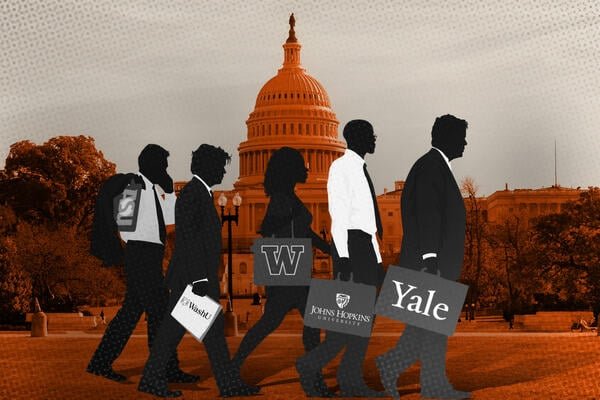
Top research universities dialed down their federal lobbying efforts over the last several months.
An analysis of federal lobbying expenses at major research institutions found that Association of American Universities members spent less in July through September than either of the prior two quarters of 2026.
Altogether, those universities and systems that lobby on behalf of AAU members spent nearly $7 million. That total is likely lower than the actual expenses, since some did not meet legally mandated filing deadlines. Comparatively, they spent just under $8 million in the second quarter of the year.
That figure, which comes ahead of midterm elections next month, is the lowest amount that AAU members have spent on federal lobbying since Inside Higher Ed began tracking the data in early 2025. Some institutions noted that congressional recesses also fell during the third quarter, which accounts for part of the decline.
But many of the top spenders remain the same as in previous quarters.
Among AAU member institutions, Johns Hopkins University is tied with Yale University at the top spot after spending $340,000 on federal lobbying in the third quarter of this year. The university lobbied on multiple issues including changes to the federal student loan program, accreditation reform, various health-care priorities, federal research funding, immigration policy and more.
“Johns Hopkins continues to advocate for our mission of research, education, and patient care,” a university spokesperson wrote in an emailed statement to Inside Higher Ed.
Yale—which is locked in negotiations with the Trump administration after the Department of Justice alleged it violated a Supreme Court ban on the consideration of race in admissions—significantly increased its lobbying expenditures between quarters. The university spent $340,000 in the third quarter up from $240,000 the quarter before. However, Yale averaged $310,000 a quarter in lobbying expenditures last year, so Q3 reflects a return to typical spending levels. Yale lobbied on federal funding, grant management, international student visas and other issues.
“Yale’s policy priorities have been consistent across reporting periods, namely protecting the university’s core missions of teaching and research, and the expenditures reported in any single reporting period vary naturally due to a number of factors,” a spokesperson wrote by email. “Since last year, Yale has opened an office in Washington, D.C., as part of its work to communicate higher education’s impact to legislators on both sides of the aisle.”
While Inside Higher Ed tracks spending by AAU members to better understand how top research universities are engaging with lawmakers, the overall top spender for the quarter is outside the AAU.
The University of Phoenix led all individual institutions in federal lobbying, racking up $410,000 in expenses. Phoenix has spent nearly $1.3 million on federal lobbying so far this year and totaled $1.9 million in 2025. The university has led on total lobbying expenditures since Inside Higher Ed began tracking the data. Lobbying priorities for Phoenix in the third quarter included bills to improve student financial aid verification processes, student veteran benefits and artificial intelligence, among other topics.
Here’s a look at the top spenders on federal lobbying among AAU members in the third quarter. The list includes individual universities only, not systems that lobby for multiple institutions.
Some institutions trended up in Q3 while others spent less on lobbying compared to previous quarters.
The University of Pennsylvania had the steepest drop among all AAU members. Penn spent $100,000 on federal lobbying in the third quarter, down from $280,000 in the previous period. (Penn officials did not respond to a request for comment from Inside Higher Ed.)
Cornell University also cut lobbying expenditures. While the university spent $360,000 in the second quarter, that number fell to $220,000 in Q3. Cornell’s spending tends to fluctuate; the university spent $180,000 in the first quarter of 2026 and the same amount in the fourth quarter of last year.
According to a spokesperson, Cornell recently “expanded our engagement with policymakers and federal agencies to restore research funding and prevent regulatory changes that would harm our educational programs and land-grant mission.” They added that the second quarter increase “was driven by reimbursement of AAU-led federal lobbying efforts.”
The University of California system, which lobbies on behalf of its member institutions, which includes AAU and non-AAU members, also spent significantly less in Q3 compared to other quarters. The UC system spent $250,000 compared to $840,000 in Q2 and $740,000 in Q1.
UC officials noted that congressional recesses accounted for part of the fluctuation.
“The University of California regularly engages with federal policymakers on a variety of issues in service to our education, research, health care, and public service mission,” UC spokesperson Rachel Zaentz wrote in an emailed statement to Inside Higher Ed.
“This includes advocating for legislation, policies, and programs that improve people’s lives—whether through world-class education, research that addresses our nation’s most pressing scientific and technological challenges, or high-quality health care. The associated costs may vary from quarter to quarter based on a variety of factors, including the timing of congressional recesses.”
You may be interested
Anthropic’s business plan: Build God or die trying
new admin - Oct 29, 2026The Anthropic S-1 seems to have provided the financial justification for the company to spend as much as it possibly…

OK! Beauty & Wellness Christmas glossy magazine is on sale now!
new admin - Oct 29, 2026Get yourself Christmas ready with our brand new glossy magazine featuring Olivia Attwood, Vogue Williams, Hannah Martin and Charlotte Tilbury!…
Institutional Decay Compelled a Reckoning
new admin - Oct 29, 2026[ad_1] Education Secretary Linda McMahon declared President Donald Trump’s 2024 election “a turning point for higher education” during a speech…