




“Situated” and Higher Ed Staff

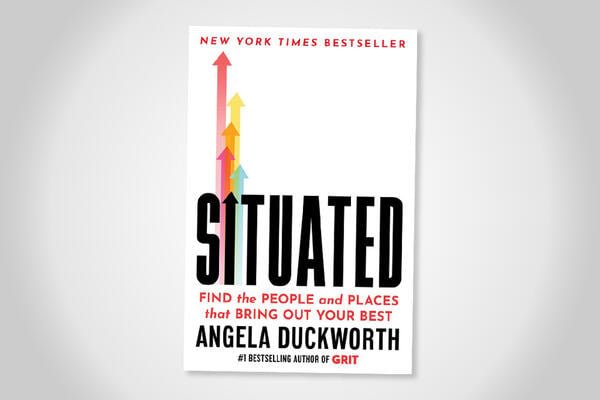
Situated: Find the People and Places That Bring Out Your Best by Angela Duckworth
Published in September 2026
Just as I was finishing Angela Duckworth’s marvelous new book, Situated, a piece by Kevin McClure called “Needlessly Insensitive Terminations in an Increasingly Volatile Higher Ed Workplace” crossed my radar. McClure, a professor of higher education at the University of North Carolina at Wilmington and author of The Caring University (2025), writes,
“The notion that jobs in higher ed are reasonably stable has been around for decades. It’s often cited as the flip side of lower pay: Yes, in higher ed you might not see private-sector paychecks, but nor will you be subject to private-sector fickleness. Now we’re increasingly seeing unimpressive paychecks paired with seismic volatility. This volatility is a product of resource constraint, as campuses scramble to balance budgets in the face of enrollment challenges and federal policy whiplash.”
Situated is Duckworth’s companion piece and maybe somewhat of a correction (or at least an evolution) from her influential 2016 book, Grit: The Power of Passion and Perseverance. While I take no credit for Duckworth rounding out her thinking in Situated, I was gratified to read back to my 2016 piece “Could Grit Thinking Drive Inequality?”
“My question—and I guess my (friendly) challenge to Dr. Duckworth—is that those larger structural and policy forces don’t seem to be mentioned in her presentation of her research on grit.
“What is left unspoken and unarticulated is the context in which success occurs.”
In that critique, I was approaching Grit as a sociologist (my training), whereas for the psychologist Duckworth, context is more personal than structural. Still, nobody writes better about personal context than Duckworth. Situated is maybe the best book I’ve read about how we can exercise our individual agency to alter our immediate circumstances and environment and how effective these actions can be in shaping our life outcomes.
Throughout Situated, Duckworth offers numerous research-based stories and some deeply personal reflections about how our circumstances influence our thinking and behavior and how and where it is often more possible than we think to change our situations. The advice in Situated tends to focus on choices we can make in our immediate surroundings (including our work and home spaces), as well as on effective strategies for cultivating mentors, collaborators and reliable supporters.
None of the advice Duckworth offers is particularly radical. What is noteworthy, and one of the reasons why the book is so compelling, is Duckworth’s ability to integrate a broad range of research findings in showing how large a small change in context can have on individual flourishing.
All of this brings me back to the McClure piece. For higher ed staff, what might be the takeaways from reading Situated as they try to navigate an increasingly volatile employment environment? As McClure points out, most staff are at-will employees, meaning that “they can be let go for any reason or no reason at all.” How can a university staff member protect themselves from the vagaries of an insecure job if being gritty is ineffective—you can’t work your way into keeping a job if there is no money in the university budget—and there is no way to alter the situation of their institution’s declining financial situation?
One piece of advice Duckworth has is that we should all think about moving more—that finding a better situation sometimes requires changing one’s location, job and network. But is that really an option for most academic staff? Putting aside that households are not always portable—as partners have jobs and kids have schools and folks have caregiving obligations and community ties, etc., etc.—it is not clear that anyone would be safe moving to another university in another city or state. If McClure is right, and I expect he is, we are at the beginning of a trend toward both structural academic staff dislocations, accompanied by quiet firing techniques adopted from the corporate sector.
It may be that the best we can take from Situated is that higher ed staff should do whatever they can at their current institutions to influence their local environment. This means prioritizing work arrangements that reduce stress while increasing productivity, even if these changes require significant alterations to one’s daily routines and environment. If no higher ed staff job is secure, continuing to work in ways that prioritize the institution above the individual work makes less and less sense.
Would Duckworth—who, of course, has tenure—recommend to her academic staff colleagues that they should endeavor to build their work around their lives, rather than the other way around?
What are you reading?
You may be interested

Ohio State Civics Center Prof Who Tackled Cameraman Resigns
new admin - Oct 27, 2026[ad_1] Ohio State University placed Luke Perez (center) on paid leave after the February incident. D. J. Byrnes/The Rooster The Ohio…

Menopause skincare hailed a 'facelift in a bottle' drops to £10 in one-day deal
new admin - Oct 27, 2026As part of Boots £10 Tuesday deal, shoppers love the No7 Menopause Overnight Cream that "does exactly what it says…

Til Death (or Retirement) Do Us Part | Money Moves with Jill Schlesinger
new admin - Oct 27, 2026How do you plan for not just one retirement, but two? Jill and Mark break down the financial planning every…