


Professor Watchlist Goes Dark, but Its Legacy Lives On

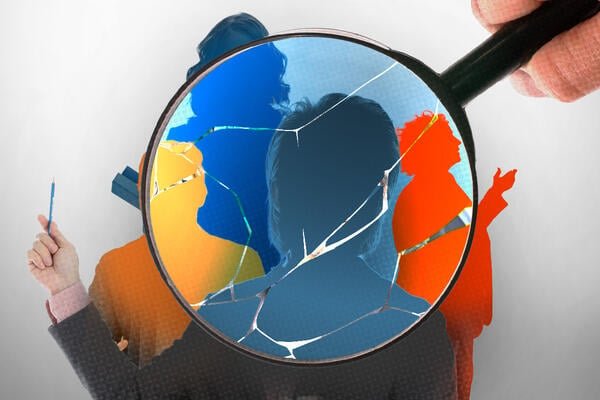
On a November Monday in 2016, two weeks after Donald Trump was elected president for the first time, the conservative campus organization Turning Point USA published a list of nearly 200 academics who, according to the site’s stated mission, “discriminate against conservative students and advance leftist propaganda in the classroom.”
The registry, called Professor Watchlist, was met with teasing and concern. Some users on what was then Twitter joked about submitting tips on Indiana Jones, Gilderoy Lockhart and Professor Plum for their fictional offenses. Others warned it was yet another example of an expanding effort on the political right to surveil and harass academics who research and teach about topics they don’t like. Earlier this year, more than 1,100 professors and institutions were listed on the website, including Georgetown Law professor Gary Peller, who criticized the “unmitigated praise” in a law school news release mourning Justice Antonin Scalia; University of Iowa anthropology and women’s studies professor emerita Ellen Lewin, who wrote, “Fuck you, Republicans” in an email to the university Republicans’ club; and civil rights activist Al Sharpton, who has guest lectured at Tennessee State University.
Today, the infamous website has vanished; professorwatchlist.org instead redirects to Turning Point’s home page. A Google search for the list returns its Wikipedia entry and news articles about professors who were once cataloged on the site. According to Wayback Machine snapshots, the site started to return consistent 404 errors in March. The last successful snapshot was taken in February. Turning Point has not publicly discussed the apparent end of the list, and spokespeople did not return Inside Higher Ed’s request for comment.
Professor Watchlist may be no more, but academic freedom experts don’t consider it a victory.
“They accomplished their goal,” said Jessie Daniels, a sociology professor at Hunter College who researches racism in digital media. “There’s now an army in place. There are lots of people who perceive professors as the enemy and have taken on the talking points of Turning Point USA and the rest of the far right.”
The Watchlist leaves in its wake a network of far-right online news sites and social media accounts dedicated to exposing, doxing and harassing professors whom they accuse of liberal indoctrination. The Foundation for Individual Rights and Expression—which has cataloged attempts to sanction scholars since 2000—noted in its 2023 Scholars Under Fire report that such attempts have “increased dramatically over time,” from four in 2000 to 145 in 2022. The foundation observed a record 213 attempts in 2021, the year Turning Point called on students and parents to contact the institutions of 61 faculty listed on the Professor Watchlist. (None of the resulting sanction attempts succeeded, FIRE noted.)
The people behind the Watchlist have won. They are now dictating policy at the Department of Education and the Department of Justice.”
—Joseph Kuilema, social work professor at Grand Valley State University
Conservative politicians have also increasingly painted professors as the enemy. For example, a Texas state representative’s viral post about a gender identity lesson led to multiple ousters at Texas A&M University last year. A September fundraising email from Florida Gov. Ron DeSantis with the subject line “FIRE the radicals!” boasted about new post-tenure review policies in Florida and asserted that “too many professions in this country let the radical Left run wild for far too long, unchecked and unaccountable, and our kids have paid the price for it.”
Perhaps the most impressive mobilization of this right-wing harassment network occurred in the days after Turning Point’s founder Charlie Kirk was shot and killed while speaking at Utah Valley University. Anonymous social media accounts, and later politicians, identified and amplified professors’ online criticisms of Kirk—and even posts as innocuous as directly quoting Kirk—and called for them to be fired. In many cases, they succeeded, though some of the fired professors have since sued and gotten their jobs back.
“The Professor Watchlist and other online lists have built up an ecosystem [in which] individuals who choose to target a professor—or videotape something in the classroom or something they do at a conference—can get those video clips out into the world and in front of politicians who might then continue the rhetoric,” said Kristen Shahverdian, director of higher education and free expression at PEN America, a nonprofit focused on protecting free speech. “The Professor Watchlist … may or may not be down permanently, but I don’t think that its coming down is going to actually change anything right now. Unfortunately, I think we’re going to continue to see these attacks.”
An ‘Obsolete’ Watch List
Joseph Kuilema, a social work professor at Grand Valley State University in Michigan, was one of the first 200 professors named to the watch list in 2016. A year prior, he had written an article for the campus newspaper at Calvin University, where he worked at the time, about two people who had written “white power” and drawn a swastika on a snow-covered car.
“What occurred was not an isolated incident, a freak occurrence in an otherwise loving and inclusive community. While few members of this community openly espouse white supremacy, many members of our community continue to deny white privilege,” Kuilema wrote. “It must be clearly stated that those who deny white privilege functionally believe in white supremacy, whether they have the courage to write it on a car or not.”
After the article was published, he “didn’t really think a whole lot about it,” Kuilema said. But then it got picked up by The Daily Caller, Tucker Carlson’s right-wing news site, and from there it spread to others like Campus Reform, The College Fix, the neo-Nazi white supremacist forum Stormfront and other white nationalist media websites.
“My sense is that when Charlie Kirk and Turning Point were putting [the watch list] together, they didn’t actually put a lot of legwork into it. They basically just trawled the existing coverage of faculty members who had said things they didn’t like,” Kuilema said. “I always thought it was kind of funny that I was included on the list, because I was this little-known social work professor at a small Christian liberal arts school in Michigan, and I was being listed as this indoctrinating person alongside scholars with a lot more reach than I had.”
Like many professors on the Watchlist, Kuilema was doxed. His cellphone number was posted on the internet, and he received many threatening messages.
“People were commenting online that they knew where my office was, that they were [Calvin] alumni and that they were going to come punch me in the face,” Kuilema said. “It was a scary moment. It didn’t last for the entire decade that the Watchlist was out, but in those initial days, it was pretty frightening.”
Kuilema said the Watchlist likely impacted the trajectory of his career. While teaching at Calvin, he repeatedly criticized the university’s treatment of LGBTQ+ individuals. He went up for tenure at Calvin in 2017, a year after the Watchlist went live, and was denied tenure by the Board of Trustees despite unanimous faculty and administrative recommendations. In 2023, he sued the university, arguing he was denied tenure because of his LGBTQ+ advocacy and dismissed after officiating a queer wedding. His case is currently before the Michigan Supreme Court.
“Part of what [the board members] said was ‘We can’t trust your tone. We think you’re more of an activist.’ And I can’t help but feel like being included on this list put me on the radar of the board members who overruled my faculty colleagues, the provost, the president, and said, ‘We don’t want this guy on this campus,’” Kuilema said. “I’m not entirely sure that would have happened without things like the Watchlist putting me on the radar of powerful people.”

Andrew Harnik/Getty Images
Like Daniels and Shahverdian, Kuilema isn’t encouraged by the end of the Watchlist.
“If the Watchlist is gone, it’s not because it was defeated by the defenders of free speech and academic freedom, but largely because it’s obsolete,” Kuilema said. “The people behind the Watchlist have won. They are now dictating policy at the Department of Education and the Department of Justice. It’s no longer necessary to warn conservatives about professors they may encounter on campuses when states are passing laws that allow them to fire tenured academics for using words like ‘diversity’ or ‘antiracism.’ In some ways, the Watchlist now seems kind of quaint.”
In the nearly 10 years it was live, the Watchlist had a chilling effect on professors’ speech, especially for younger academics who were finding their footing in their field, Shahverdian said. The list also disproportionately targeted professors of color “as somehow inherently incapable of or unqualified to be professors or intellectuals” because of their race, Daniels said.
“It did real material damage to people’s lives, people’s livelihoods,” she said.
To Daniels, the most telling consequence of the far-right doxing network is the recent death of Jason Arday, a Black University of Cambridge professor who was found dead just weeks after he was publicly accused of plagiarizing parts of his Ph.D. thesis and some journal publications. When Arday announced he was resigning from Cambridge in early August, he wrote that the “years since my appointment have also been marked by an unrelenting level of public scrutiny and personal attack. While criticism is an inevitable part of academic life, what I have experienced has gone far beyond scholarly disagreement. The relentless accusations, speculation and public commentary have taken a profound toll on me and on those I love.”
The tragedy of Arday is “what I think they want to have happen,” Daniels said. “It’s violence and it’s white supremacy.”
You may be interested

Ledger’s new hardware wallet is an Android phone without the phone
new admin - Oct 15, 2026Ledger has announced its latest crypto-centric hardware effort, the Android-based Atom, a device that resembles a phone but is instead…
Legal Advocate Decries “Coordinated Assault” on Noncitizens
new admin - Oct 15, 2026[ad_1] When Thomas A. Saenz first began working on the issue of tuition equity in 1993 at the Mexican American…

Amazon’s always-listening Bee wearable can now help you buy stuff
new admin - Oct 15, 2026Last year, Amazon bought Bee, a relatively unknown startup with a $50 always-listening AI wearable that summarized every conversation you…