

Uncivil Scrutinizes Civil Discourse Funding, Motives

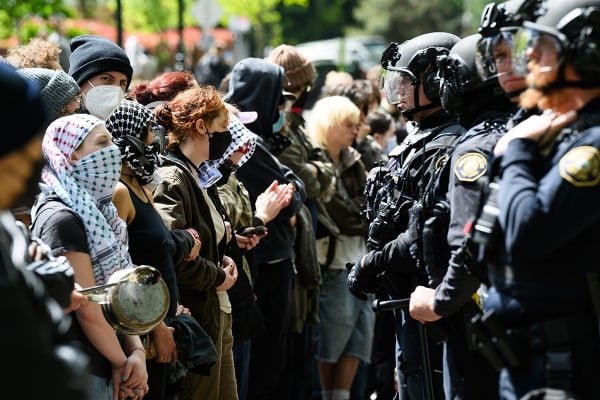
A group of scholars called Uncivil is doubling down on its argument that the push for civil discourse and viewpoint diversity is part of a conservative and pro-Israel agenda—not a nonpartisan campaign. This week, it published dossiers on a broad swath of programs, groups and higher ed institutions that have used similar terms, criticizing their leaders, their funders and more.
Inside Higher Ed reached out to more than 30 organizations featured in the report. Those that responded took issue with Uncivil’s characterization of their work, arguing that the group can’t back up its conclusions. They countered that Uncivil doesn’t mention some left-leaning funders, or the many nonconservative and non-Israel-related causes that funders support. They also dispute the methodology, including how the scholars identified some groups and funders as conservative or pro-Israel.
Interest in civil discourse programs surged after the Oct. 7, 2023, Hamas attack on Israel and the start of Israel’s war in Gaza. That violence spurred a wave of pro-Palestinian protests on college campuses nationwide. Organizations and colleges ramped up many efforts that were advertised as improving students’ ability to debate controversial issues.
Uncivil—a consortium of academics from multiple universities, including one who’s an Inside Higher Ed columnist and another who leads the American Association of University Professors’ Center for the Defense of Academic Freedom—argues that the “real goal is to silence dissent” and “suppress organic student organizing.”
The dossiers, which Uncivil calls the Civility Files, follow the group’s June report that said the private funders “most deeply committed to ‘bridge-building,’ ‘viewpoint diversity,’ and ‘depolarization’ projects are those that also hold a substantial stake in conservative and/or ‘pro-Israel’ causes.”
The new Civility Files includes information on 37 entities: seven “conservative and pro-Israel advocacy groups,” as Uncivil dubs them; 13 “civility nonprofits”; 16 colleges and universities; and the U.S. Education Department. Web pages for each list backgrounds on the groups or programs housed by them, along with “notable” funders and affiliated individuals, though Uncivil doesn’t claim it’s a comprehensive inventory.
Over all, the Civility Files cast as partisan a broad range of groups, institutions and funders—including some familiar in national higher ed policy—that claim to be nonpartisan. And the report makes overarching arguments about the true aim of this amalgamation of money and organizations.
“These files demonstrate that the recent proliferation of privately-funded centers, projects, and initiatives dedicated to ‘civility’ and ‘civil discourse’ in higher education is anything but politically neutral,” Uncivil wrote on its website. “It echoes and reinforces the Trump administration’s efforts to characterize leftist, pro-Palestinian, and anti-racist expression as inherently intolerant and threatening. The Civility Industry is dominated by billionaires who use the rhetoric of ‘pluralism’ and ‘viewpoint diversity’ to promote conservative viewpoints, vilify progressive activism, and justify the repression of political dissent.”
But Michael J. Murray, president of the Arthur Vining Davis Foundations, a group criticized in the Civility Files, accused Uncivil of pushing “guilt by association.”
“When you look at the efforts to try to tie individuals and organizations to these causes as motivations for doing what they’re doing, you only get insinuation,” he said.
Uncivil critiques the Arthur Vining Davis Foundations for funding Hillel International, the umbrella organization for the Jewish student groups, because it’s “an explicitly anti-BDS organization.” (Hillel says on its website that it doesn’t host or partner with speakers or groups that “support boycott of, divestment from, or sanctions against the State of Israel.”) It also criticizes the foundations for funding Tablet, a Jewish magazine that Murray acknowledges “has taken a decidedly pro-Israel turn.”
But Murray said the Hillel funding was for campus chapters to reach out to non-Jewish student ministries to work together across differences, while the Tablet funding supported a journalist who writes about non-Jewish religious groups so the magazine’s readers can learn about them.
“If someone wants to tell me how that’s pro-Israel, I’d love to hear,” Murray said. He said funders have motives, but added that “we’re in regular contact with many funders that support overlapping areas of work in this space, and the motivations for supporting this work vary widely.”
Regarding the Arthur Vining Davis Foundations, Uncivil said, “Two things can be true at once. AVDF’s officers can believe in the work they fund, and those grants can still sit inside a funding pattern with political effects nobody at AVDF had to intend. Our report is about the pattern.
“We encourage anyone interested in the motives behind this industry to read the statements of people leading this field,” Uncivil added. “The evidence and research we’ve documented suggests that these leaders and their programs coordinate massive amounts of funding to work against certain kinds of protest and dissent.”
Labels
In putting together the Civility Files, the scholars focused on what the people founding and running the various programs say publicly, their backgrounds, their groups’ positions and other affiliations. They also highlight connections between those people and the funders. The documents don’t examine what civil discourse or similar-sounding programs actually teach students on campuses.
The files put organizations into a few broad categories, some that those groups publicly disagree with. Uncivil placed Heterodox Academy, for instance, in its “conservative and pro-Israel advocacy groups” section. That put it alongside organizations such as the Heritage Foundation, the think tank that produced Project 2025, an influential blueprint for the second Trump administration.
The Civility Files criticize Heterodox for, among other things, publishing “frequent critiques of DEI-related efforts in education,” accepting $5 million from the Mike and Sofia Segal Foundation, and then renaming its research center after the couple. (The report further criticizes the Segal Foundation itself for funding an affiliate of the pro-Israel lobby group AIPAC.) Uncivil also noted that Heterodox President John Tomasi’s Political Theory Project at Brown University, where he was a professor, received more than $1 million from Koch network donors.
“Heterodox Academy is an ideologically diverse organization, with members, staff, and financial supporters of all political stripes,” Tomasi said in a statement to Inside Higher Ed. “Our members’ most common self-description is centrist or moderate. We advocate for no cause other than Open Inquiry, which requires the free exchange of ideas on all sides of contested topics.”
The American Council of Trustees and Alumni, or ACTA, is also placed among the conservative and pro-Israel advocacy groups. ACTA is more straightforwardly conservative than Heterodox. Uncivil notes that Lynne Cheney, former Republican Vice President Dick Cheney’s widow, founded the group in the mid-1990s. More recently, it was on the advisory board for Heritage’s Project 2025.
“The organization carries out advocacy that treats university trustees—not faculty—as the chief lever for changing higher education,” the Civility Files say of ACTA. They also note that ACTA, citing the University of Chicago’s recently influential Kalven report, has argued that institutional neutrality should include rejecting “pro-Palestine activists’ demands to divest from Israel.”
Michael Poliakoff, ACTA’s president, told Inside Higher Ed that the late U.S. Senator Joe Lieberman, a Democrat who eventually became an Independent, was also among ACTA’s founders. He said ACTA severed all relations with Heritage last year because its president embraced conservative podcaster Tucker Carlson after Carlson interviewed Nick Fuentes, whom Poliakoff described as “an antisemite, a misogynist, someone who airs racist viewpoints.”
Poliakoff said Uncivil appeared to be throwing a “temper tantrum” against “the restoration of core principles and the free exchange of ideas.” He said the group clearly considers conservatism and being pro-Israel undesirable concepts on campuses.
“Why can’t these things be included in a good-faith dialogue, afforded fair consideration?” Poliakoff said. “They’re just presenting themselves as exclusivist and anti-intellectual.”
Civility Nonprofits
While Uncivil labeled some groups as ideological advocacy groups, it didn’t spare what it considers “civility nonprofits” from criticism for pushing similar talking points. These include BridgeUSA, Disagree Wisely, the Jack Miller Center (which spun off from the conservative Intercollegiate Studies Institute think tank) and more. For BridgeUSA, the Civility Files note that Manu Meel, the co-founder and chief executive officer, interned for the conservative American Enterprise Institute think tank. (The files also include AEI, listed among the conservative and pro-Israel advocacy groups.)
Meel told Inside Higher Ed that, while he has nothing bad to say about AEI, he took the internship as an excuse to be in Washington, D.C., to network for BridgeUSA.
“I did that when I was a freshman looking for a job—and any D.C. job, I would take,” Meel said. He noted he also interned for the State Department. “Does that make me a deep-state activist?” he said.
BridgeUSA has concealed its contributors on its last two IRS annual reporting forms. But Meel said the roughly $1.4 million in donations that the Civility Files document only represent about a quarter of the group’s funding since it was founded, and the files leave out funding from left-leaning groups. If his organization stopped taking money from the left and the right, it would be broke, he said.
For years, Meel said, he’s been hearing similar progressive criticism that big donors use civility as a shield to silence viewpoints they don’t like. But, he said, “Money does not change intentionality.”
“We are calling for temperamental moderation, not ideological moderation,” Meel said. He applied this to his own comments on Uncivil: “Because I’m temperamentally moderate, I’m also going to ascribe good faith to them and listen to their arguments and questions.”
“You should have ideological convictions,” he said. “But are you pairing your ideological convictions with a desire to listen and to solve problems? That’s the key.”
Uncivil noted connections between Disagree Widely’s founders and Heterodox. Simon Cullen, co-founder of Disagree Wisely and co-creator of Sway, a program that uses AI to facilitate conversations between disagreeing students, wrote in an email that the Civility Files include multiple errors regarding his projects.
Cullen further said, “Uncivil uses many of the habits of argument that Disagree Wisely helps students learn to avoid: guilt by association, circumstantial ad hominem, and unsupported insinuations about people’s motives,” adding that it “invites readers to infer a political agenda without providing any evidence that our work serves that agenda.” He said, “We don’t celebrate civility for its own sake” but because it’s “often a precondition for learning from and working with those with whom we disagree.”
The Civility Files criticize Interfaith America because its founder and president, Eboo Patel, has, among other things, recorded videos with the Koch-supported Stand Together group, including one titled, “Society needs less critics. Here’s why.” Also, Uncivil notes, Patel wrote a Chronicle of Philanthropy op-ed titled, “Fed Up With How College Students Are Behaving? Fund a Campus Pluralism Center.” That was published less than a month after the Oct. 7, 2023, attack.
“Flattening any organization, foundation, campus or individual into a singular identity is neither helpful nor healthy to the important work that Americans need to do to shore up our democracy,” Interfaith America told Inside Higher Ed in an email. “We are proud of our partners and supporters across the country—big and small, left and right, old and new—who want to help us build an America that rediscovers the ability to respect, relate and cooperate across our differences.”
Uncivil criticizes the Jack Miller Center for, among other things, its pipeline of scholars to conservative-coded civics centers. Hans Zeiger, president of the Jack Miller Center and a former Republican state senator in Washington, told Inside Higher Ed in an email that the center does “nonpartisan work to advance the teaching of America’s founding principles and history.
“Scholars and educators who have gone through JMC programs come from many different viewpoints,” Zeiger wrote. “What they share is a commitment to teaching and studying the American political tradition.”
Methodological Arguments
Murray, of the Arthur Vining Davis Foundations, has taken issue with Uncivil’s methodology for the June report, conclusions from which feed into the Civility Files.
For the earlier report, Uncivil identified what it called the “top funders” of civil discourse programs. To reach that conclusion, the group analyzed “five years of publicly listed grants to 77 university centers, initiatives, and nonprofits tied to the Civility Industrial Complex,” as it calls this constellation of groups and programs. It found about 390 private foundations that gave to at least one of those entities. To identify the “23 top funders,” it filtered out foundations that gave to fewer than three entities, gave less than $25,000 or donated less than 1 percent of their total charitable giving to these groups.
“Grants from these top 23 funders accounted for approximately $82.3 million to Civility Providers during the audited timeframe,” the June report says. “Of that amount, roughly $80.1 million—about 97 percent—came from foundations that are heavily invested in conservative and/or ‘pro-Israel’ networks.”
But filtering out donors that gave less than 1 percent of total charitable giving to civility providers means Uncivil, according its own data, left out $39.8 million provided by the Lilly Endowment. Had Lilly been included, it would’ve been the top funder. (The new Civility Files do criticize Lilly, which funds religious and other programs, for providing money to conservative groups, including the Manhattan Institute in 2021. Uncivil told Inside Higher Ed that, if Lilly weren’t filtered out, it “would have been coded as a conservative funder in light of its support of right-wing groups.”)
The filtering also excluded $7.4 million from George Soros’s left-leaning Foundation to Promote Open Society. Murray has written that “a filter that excludes the majority of the money in a field before calculating what share of the remaining dollars is conservative is not a neutral filter.”
While Uncivil uses the phrase “civility industrial complex,” Maury Giles, chief executive officer of Braver Angels—another group Uncivil criticized—said Uncivil is part of the “industrial outrage complex” and involved in “conflict entrepreneurialism.” Giles accused it of “trying to pull out conspiracy theories” and “fueling the very thing that we’re trying to help people step out of.”
“For self-government to thrive,” Giles said, “we have to be able to get past the pure tribal warfare.”
You may be interested
Norah O'Donnell: The gender healthcare gap doesn't change until there's political activism
new admin - Oct 01, 2026Norah O'Donnell tells Katie Schubert, the president and CEO of Society for Women's Health Research, that the gender healthcare gap…

Cornell Agrees to Independent Investigation of Alleged Rape
new admin - Oct 01, 2026[ad_1] Cornell University has agreed to an external investigation into its handling of a 2024 sexual assault allegation from Jane…

What Sets High-Performing Pell Colleges Apart?
new admin - Oct 01, 2026[ad_1] Higher education has long been viewed as an avenue to economic mobility, but lower-income students continue to face disparities…