


Oregon eyes nation’s first universal healthcare system. Will it work?

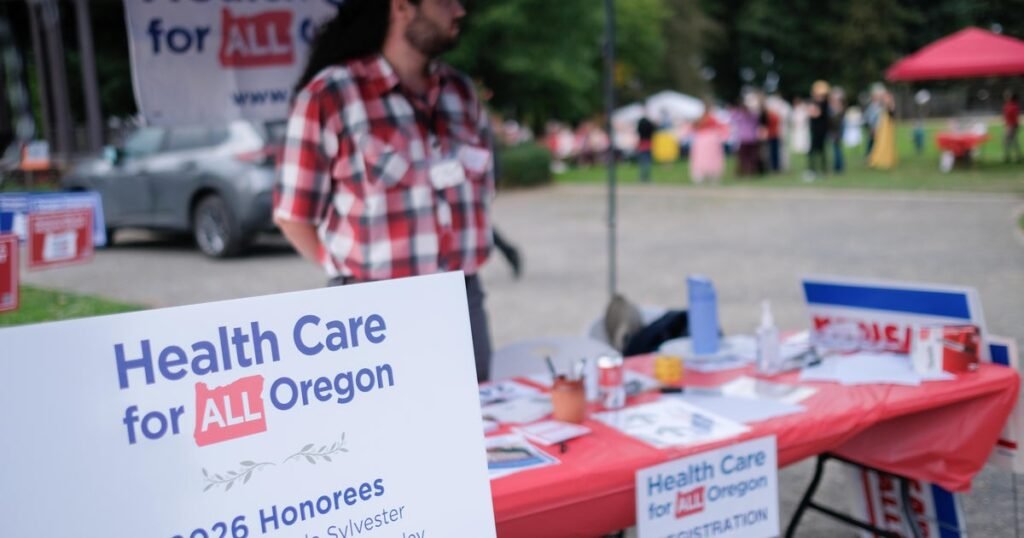
Democratic congressional members and candidates are already planning to use any midterm election gains to expand health coverage, including boosting Affordable Care Act subsidies, reversing Medicaid cuts, and lowering the Medicare eligibility age.
But Democratic strongholds across the country — including Oregon, California, New York, and Washington — have more ambitious goals: single-payer, universal healthcare systems.
No state is closer to that goal than Oregon. A panel created by the state legislature in 2023 is slated to send lawmakers its proposal for a universal health plan on Dec. 1. The nine-person Universal Health Plan Governance Board seeks to establish, starting in 2032, medical, vision, dental, and mental health benefits for every state resident from cradle to grave — with no premiums, deductibles, or copayments. Lawmakers could vote on the plan during the 2027 legislative session or refer it to voters as a ballot measure in 2028.
If approved, the state would be the first in the U.S. to implement what’s called a single-payer health coverage system. It could serve as a model for other states — and potentially the nation.
Christena Dowsett for KFF Health News 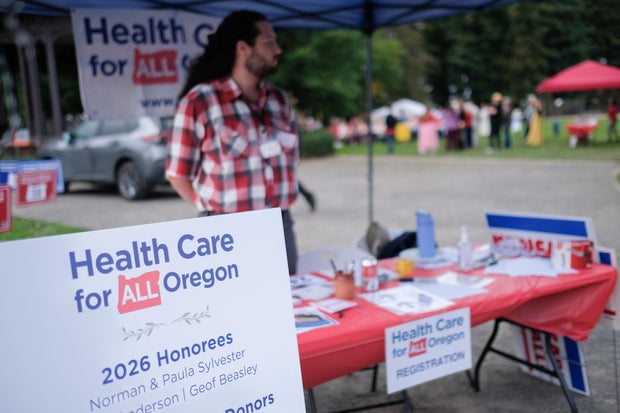
Proponents of the proposal argue that the public supports universal healthcare more than ever as healthcare spending and complexity grow. Surveys show patients often delay care due to out-of-pocket costs. And medical debt remains a leading cause of bankruptcy in the nation.
States have often served as laboratories to test health policies later implemented nationally. The Affordable Care Act was modeled after Massachusetts’ attempt to achieve universal health insurance coverage, once single-payer efforts there stalled. And Canada’s universal healthcare system began with a provincial plan in Saskatchewan.
“In the short to medium term, there is no chance that ‘Medicare for All’ can be passed at the national level,” said Jonathan Oberlander, a University of North Carolina health policy professor. “That’s where the states come in. A state like Oregon provides a more hospitable political environment and a more realistic path to single-payer reform.”
But advocates of the plan expect a significant fight from healthcare behemoths, including large hospital systems, seeking to sour public opinion on making such widespread changes. Nine of the Fortune 500 companies are health insurers. The industry’s deep pockets have helped derail myriad universal healthcare efforts at the federal and state levels.
In 2011, the Vermont Legislature voted to implement a universal healthcare plan but, three years later, Democratic Gov. Peter Shumlin, who had campaigned on the promise of single-payer, pulled the plug, citing “potential economic disruption.”
States that took the issue directly to voters have fared no better. Ballot measures in Colorado in 2016, Oregon in 2002, and California in 1994 all failed by large margins.
“The aspirations of progressive reformers usually run smack into sobering political realities,” Oberlander said. “Translating a slogan into a legislative and political reality is a daunting task.”
Redirected healthcare dollars
Oregon’s proposal seeks to maintain the current level of spending on healthcare by government, business, and consumers with new corporate and personal taxes to replace insurance premiums and other out-of-pocket costs. Those would be combined with federal and state spending to create a single fund from which all hospitals, doctors, and other practitioners would be paid.
Board members said savings from cutting red tape, reducing fraud, and negotiating drug costs should allow the state to provide better benefits to more people.
In examples prepared for consumer focus groups, the board estimated that a 30-year-old making $55,000 and purchasing a benchmark silver-level plan through the Affordable Care Act now pays $5,478 a year for insurance premiums in Oregon, but instead could pay $2,331 in taxes under the proposed plan.
Someone making $55,000 a year with coverage through their employer now pays $3,063 in premiums and out-of-pocket costs. Under the draft plan, that person could pay nothing for health services and could see any doctor in the state.
Currently, many employers pay much of the health insurance costs for their workers. The plan seeks to maintain those contributions by establishing a corporate payroll tax for companies whose payrolls exceed $500,000. Their employees could receive a partial tax credit for the taxes their employers pay. As a result, 31% to 60% of Oregonians wouldn’t pay anything for health benefits.
More affluent people, however, could end up paying more than they do now. The exact numbers would depend on how lawmakers set tax rates and payment thresholds.
“What we are proposing is something very different,” said Miriam McDonell, executive director of the Oregon board. “Everyone contributes based on the amount that they are able to contribute and not based on utilization.”
Messaging challenge lies ahead
The plan’s backers will try to convince hospitals and health systems that they would benefit from reducing red tape and eliminating unpaid bills. Currently, hospitals hire scores of workers to bill dozens of public and private health plans, each with its own coverage and billing rules. A single plan covering everyone in the state could streamline the process, saving billions.
Rural hospitals could gain financial stability. They now often struggle to stay afloat because they typically have higher rates of patients who are uninsured or on Medicaid, with its often low reimbursement rates.
Hospitals aren’t so sure.
“The universal health plan proposal preserves much of the broken, fragmented status quo and adds new taxes and complexity that Oregonians can’t afford,” said Becky Hultberg, president and CEO of the Hospital Association of Oregon. “With federal policy changes looming, we are entering a period of tremendous upheaval. This proposal could destabilize a system that is already struggling.”
Under the proposal, doctors and other practitioners would be paid somewhere between what Medicare pays on the low end and what private insurance pays on the high end. Although total payments to doctors would remain unchanged, rates would be negotiated with physician groups to shift more money into primary care and less into specialty services.
But it is unclear whether doctors would agree that more patient time, fewer administrative hurdles, and no more unpaid bills would be worth a payment structure that could cause specialists to lose out.
“There’s always winners and losers in designing something like this, and so how to distribute those is the hardest part,” said Rebecca Schoon, an associate health policy professor at Pacific University who is slated to join the Oregon board in January. “But the second-hardest part is, I think, messaging this.”
Courtni Dresser, vice president of government relations for the Oregon Medical Association, said her physicians group shares many of the board’s goals in improving access to care and reducing administrative burdens. But the group has yet to declare its support or opposition to the effort.
Health insurers haven’t formally weighed in on Oregon’s proposal either, but a single-payer system would, in essence, close off Oregon to any private healthcare plans.
“We expect insurance companies to put every ounce of money they can against this idea because our system is broken and they profit from it,” said Collin Stackhouse, communications coordinator for Health Care for All Oregon, a consumer group advocating for universal healthcare.
Wendell Potter, a former insurance company executive who now works to expose industry influence, said he expects health plans to hammer the Oregon proposal with claims of high taxes, loss of choice, and the specter of “socialized medicine.”
“Most people go year to year without testing the limits of their health insurance policy,” Potter said. “And so, they’re easily scared into thinking that something valuable will be taken away from them, and that they will have something that’s inferior in its place.”
Health insurers argue their health plans help shield consumers from the full impact of rising healthcare costs.
“Americans consistently report strong satisfaction with their health coverage, including more than 180 million covered through work and 36 million who choose Medicare Advantage,” said Chris Bond, a spokesperson for the health insurance trade group AHIP. “Policy solutions are needed to rein in the ever-higher prices charged by hospitals and drugmakers and make care more affordable for everyone.”
Federal approval needed
It’s unclear whether Oregon could secure federal approval to redirect Medicare and Medicaid dollars into its universal plan. Backers of the proposal do not expect the Trump administration to be receptive but say it will be years before approval is needed and hope the 2028 presidential election ushers in a more supportive administration. If federal waivers are not secured, Oregon could proceed in stages, starting with the non-Medicare population.
In California, Democratic candidates for governor are not debating whether to implement single-payer but how. New York lawmakers are debating a single-payer bill called the New York Health Act. And in Washington, state legislators have created a commission to design a universal healthcare plan.
The Oregon board has had regular contact with teams working on single-payer proposals in California and Washington, sharing approaches and looking for ways to collaborate, McDonell said.
Richard Bruno, an Oregon family physician and a member of Physicians for a National Health Program, said he could envision the other West Coast states joining Oregon in implementing single-payer, much as California, Washington, and Hawaii have in public health efforts to counter changes in federal vaccine recommendations.
“If our four states could do it,” he said, “that would be the momentum we would need to get it nationally.”
KFF Health News is a national newsroom that produces in-depth journalism about health issues and is one of the core operating programs at KFF — the independent source for health policy research, polling, and journalism.
You may be interested

Too many women face a “diagnostic odyssey” at the doctor’s office. This $20 billion plan could change things.
new admin - Sep 30, 2026Women live longer than men, but they also spend more time being sick. Why is that? One reason is that…

Higher Ed’s AI Integration Overhyped, New Data Shows
new admin - Sep 30, 2026[ad_1] The most popular tools related to content, collaboration or video. Despite widespread hype about integrating artificial intelligence tools into…

Apple’s ‘HomePad’ will reportedly launch on October 13th
new admin - Sep 30, 2026Apple’s long-rumored smart home hub will reportedly be revealed on October 13th. Bloomberg’s Mark Gurman reports that the smart home…