


Researchers Accuse NIH of Viewpoint Discrimination

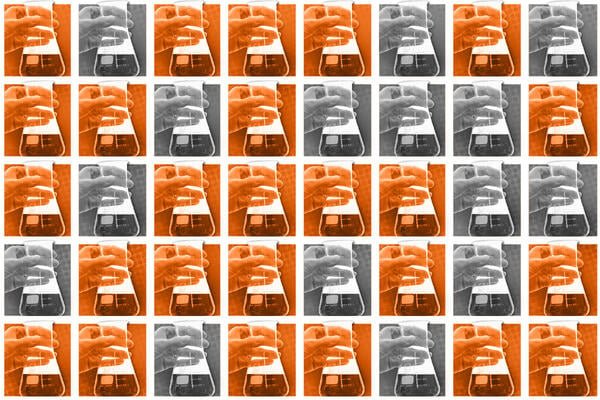
Researchers say they are self-censoring their grant applications because of a screening process that targets dozens of keywords related to DEI, climate change and other issues that the Trump administration opposes.
Photo illustration by Justin Morrison/Inside Higher Ed | CFranke CFranke/F1online/Getty Images
Andrea Rosso, an associate professor at the University of Pittsburgh, has spent four years studying whether structural racism can lead to increased rates of dementia among African Americans.
But in August, the National Institutes of Health canceled her nearly $10 million grant in its final year, even though Rosso had offered to revise the research terms to avoid including references to “racial disparities” and “structural racism” to pre-emptively align with NIH priorities under President Donald Trump. Now, she and 16 other researchers are suing the NIH, accusing the agency of violating their First Amendment rights.
“Plaintiffs recognize that the government may set funding priorities and decide among competing proposals consistent with the First Amendment,” the lawsuit states. “What the First Amendment does not allow is the government’s use of its funding power to target or silence the expression of disfavored viewpoints within the biomedical research community.”
The class action lawsuit, filed Wednesday, argues that the National Institutes of Health has illegally created “an ideological litmus test for NIH-funded research,” in part because agency policy now requires that grants be screened for hundreds of keywords and phrases—such as “diverse individual” and “fossil fuel”—as a way to identify research that doesn’t align with the president’s ideology. The plaintiffs aim to restore hundreds of canceled NIH grants and block the agency from using what they argue are viewpoint-based policies.
“We are seeing that NIH is systematically trying to silence research-related speech that it suspects will express views the administration does not like on everything from DEI to gender identity to climate change,” Olga Akselrod, senior counsel at ACLU’s Racial Justice Program, told Inside Higher Ed.
Other plaintiffs say they were asked to revise their project plans to change references to “pregnant people” to “pregnant women,” among other examples cited in the complaint. Some still lost funding after changing their grants’ language, while others remain concerned they could lose their awards in the future, particularly if they talk about their research in “a manner that is inconsistent with the language that the Administration forced [them] to adopt.”
“The new reality created by the challenged policies is negatively impacting researchers at every phase of the award process,” the complaint says, adding that several plaintiffs have self-censored their grant materials.
The initial complaint builds on previous lawsuits targeting grant terminations and cites records obtained in similar litigation, showing how efforts to fight the administration are evolving and informing one another. This lawsuit could have a broader impact if a judge rules in the plaintiffs’ favor; the American Civil Liberties Union is suing on behalf of “all researchers whose work was unjustifiably terminated but whose grants have not yet been reinstated by a court order, as well as all researchers currently being impacted by unlawful, viewpoint-based policies,” according to a news release. ACLU lawyers said it’s unclear how many researchers could be included in the lawsuit.
Based on previous lawsuits, the viewpoint-discrimination claim could prove successful. Researchers who challenged grant terminations at the National Endowment for the Humanities won their case after a federal judge found the government discriminated on the basis of viewpoint when it targeted projects associated with diversity and gender.
Screening Tool Targeted
Since Trump took office last year, the administration has terminated hundreds of NIH grants that officials said don’t align with the president’s priorities. A federal district judge ruled in June 2025 that NIH violated federal law and had to restore the grants, but the Supreme Court later said NIH didn’t have to do so. The district judge also blocked the guidance that led to cancellations, and the high court left that order in place.
The class action lawsuit argues that since the June 2025 order, the NIH has issued new directives, guidance, and policies to outline the agency’s priorities and shape how grants are awarded and reviewed. For instance, following a Dec. 12, 2025, directive, NIH staff who oversee grants were required to review their portfolio with “a computational text analysis tool to scan for terms that may be potentially associated with misalignment with the agency’s priorities.”
The tool flagged grants for further review if they included terms such as “DEI,” “queer,” “pregnant individual,” “climate change,” “transgender” or “vaccine hesitant,” according to the complaint, which notes that the list had at least 235 terms in February of this year.
Flagged grants are then subject to further scrutiny and renegotiation. Nature and other media outlets reported on the list over the summer, noting that senior appointees at NIH and its parent agency, the Department of Health and Human Services, are also reviewing grants before any final decisions are made.
The plaintiffs say the use of the tool to review grants runs afoul of federal law, in part because NIH hasn’t provided an explanation for why applications with the flagged terms should require more review or not be funded at all.
“Scientists should not have to scrub their research to receive federal funding, particularly after taxpayers have already invested years in supporting this work,” Arghavan Salles, a surgeon and clinical associate professor in the Stanford University Department of Medicine, who is one of the plaintiffs, said in the ACLU release.
Salles has studied gender equity and sexual harassment for more than 15 years, according to the complaint. When she applied for a grant in January 2026 that asked for her previous work, she had to describe it and research plans without using the words “gender,” “equity” or “sexual.”
“Without the freedom to precisely describe her past research, it was impossible to explain its relevance to her proposed future research, likely rendering her application significantly less competitive,” the complaint states.
Over all, the plaintiffs are bringing 10 claims against NIH. They want a federal judge to declare that the policies violate the First Amendment and block NIH from using them. They also are asking the court to force NIH to re-review applications that were denied or deferred because of the policies and restore all grants terminated in violation of the First Amendment.
You may be interested
Patrick Clancy’s wife: “I don’t understand how the story’s been so twisted”
new admin - Sep 18, 2026Patrick Clancy's wife: "I don't understand how the story's been so twisted" - CBS News Watch CBS News Sunday on…

'Check cupboards' alert after 'sharp rise' in precious metals prices
new admin - Sep 18, 2026An expert said it was time to see what's gathering dust Source link
Princess Diana’s brother says King Charles sounded ‘giddily elated’ after her death
new admin - Sep 18, 2026LONDON — King Charles III is facing more criticism from Princess Diana’s brother Charles Spencer, with Buckingham Palace bracing for…