
After Kentucky Banned DEI, Senator Called for Professor to Be ‘Fired or Worse’

Last October, a Kentucky state senator emailed the general counsel at the state attorney general’s office with a complaint concerning a family member.
“My granddaughter goes to a public institution,” Republican Sen. Gary Boswell wrote in an email obtained via a public records request. “She is being required to take a DEI course. The professor told the class without knowing she was my granddaughter that she ‘changed the title of the course to avoid the state law.’”
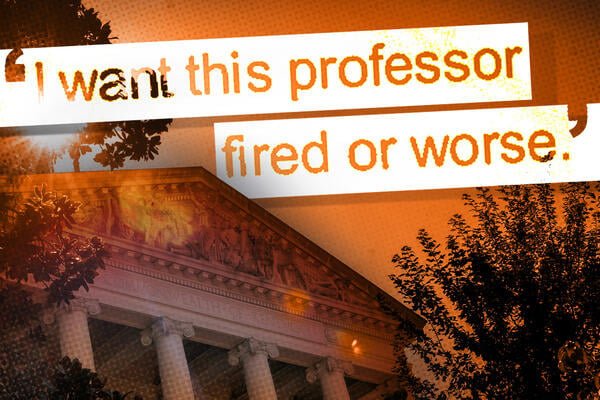
“I want this professor fired or worse,” Boswell wrote. He alleged that the Murray State University course was using a book from Howard University professor Ibram X. Kendi, author of How to Be an Antiracist.
Christopher Thacker, the general counsel for the Kentucky attorney general’s office, checked with the university. Murray State said the course was one of multiple that could satisfy a requirement for one degree. Thacker said he’d follow up with Boswell, and that’s where emails on the subject end. Boswell and the targeted professor didn’t respond to Inside Higher Ed’s requests for comment, and Murray State didn’t provide comment.
These are among a raft of communications and documents provided by James Orlick, a University of Louisville Ph.D. candidate who filed the records request, that open a window into what Kentucky universities and their employees have faced after Kentucky Republicans passed House Bill 4 last year. State legislators overrode Democratic Gov. Andy Beshear’s veto to enact the broad anti-diversity, equity and inclusion law during the 2025 legislative session.
HB 4 bans what it defines as DEI offices, employees and training in public colleges and universities. It also prohibits affirmative action in hiring, awarding scholarships and selecting vendors. And it affects curriculum, though only regarding required courses. The law bars institutions from requiring courses whose “primary purpose is to indoctrinate participants with a discriminatory concept,” which it generally defines as one that “justifies or promotes differential treatment” for people based on “religion, race, sex, color or national origin.” The law tasks the attorney general’s office with enforcing it.
Differing interpretations of HB 4—from state politicians, state and university lawyers, activists and others—are also part of ongoing debates and disputes across multiple states about what DEI bans actually do or don’t prohibit, and whether universities are under- or overcomplying. Orlick, who said HB 4 cost him his job at Louisville, said seeing the emails has been traumatizing.
“State monitoring, political oversight, institutional restructuring and restrictions on university autonomy are tactics that we associate with governments such as Orbán’s Hungary or Putin’s Russia,” said Orlick, who stressed he was speaking in his personal capacity. “And I think that seeing some of these same mechanisms emerge in public higher ed should concern us.”
Thacker’s emails show him investigating various allegations of noncompliance with HB 4 that the attorney general’s office received from lawmakers, activists and others. Last September, he invited university presidents and their lawyers to a meeting the following month, telling them that “our review identified a few areas of apparent non-compliance.” The attorney general’s office didn’t respond to Inside Higher Ed’s requests for comment for this article.
Ending Parking Passes for Ministers
Orlick said he received the hundreds of pages of documents, the vast majority from the attorney general’s office, as part of research for his dissertation. Many are repeated strings of email conversations and compliance reports that universities submitted to the attorney general’s office, but the documents include glimpses into how the ban has affected specific groups on certain campuses.
They show, for example, that Northern Kentucky University cited HB 4 when it shut off university email addresses, revoked parking passes, ended campus recreation center discounts and nixed other benefits for campus ministers connected to registered student organizations. Vice President for Student Affairs Brandon Thompson delivered that news in a June 2025 email, saying the benefits would end at the close of that month.
Someone complained to the attorney general’s office, which questioned the university about it. In an email last September, Thacker wrote to NKU’s general counsel that the office “received an allegation” that NKU “violated House Bill 4 by revoking privileges of Interfaith [registered student organization] advisors.” But NKU didn’t restore the benefits.
In a statement to Inside Higher Ed, NKU said it “supports the vibrant community of student organizations on its campus, including those affiliated with religious belief. However, as a public institution, NKU may not provide special benefits to religiously affiliated student organizations that are not available to other similar student groups.” It said it “adjusted its prior practice in order to align with both the First Amendment and HB 4,” adding that the attorney general’s office reviewed this “and required no changes.”
Lawrence Smith, a spokesperson for the Kentucky Baptist Convention, told Inside Higher Ed in a statement that NKU revoked its campus minister’s privileges.
“We believe this is an overreach and, to the best of our knowledge, no other public university in Kentucky has interpreted the legislation in this way,” Smith wrote. “We reached out to the Kentucky Attorney General’s office in an effort to gain clarification about the law and to explore what options might be available to us, but we are not aware of any ongoing investigation.”
The convention hopes NKU reverses course, Smith wrote, “but, regardless of the administration’s decision, we will gladly continue serving our students and proclaiming the hope of the gospel of Jesus Christ on our campus.”
Testing the Law’s Limits
While that was allegedly overreach, the documents also show a lead advocate of HB 4 stressing its limits.
In February, Republican state Rep. T.J. Roberts emailed fellow Rep. Jennifer Decker, HB 4’s lead sponsor, and Thacker. He introduced them via the email to Adam Guillette, president of Accuracy in Media (AIM), a conservative group that has released a string of edited undercover videos that allegedly show university employees in multiple states admitting to circumventing DEI bans.
Guillette then wrote to Decker and Thacker that “we’re more than happy to provide any information that may be of value, including the raw footage of these videos. I think we’ll be releasing three or four more from [University of Kentucky] along with investigations from several other Kentucky universities.”
Decker responded that while she looked “forward to reviewing more of the recordings,” she was “concerned about using the first video as evidence of UK noncompliance.”
“It appears the discussion is limited to coursework,” she wrote.
She told Guillette the law “carves out protections for academic instruction, course content, and faculty academic freedom, while only prohibiting universities from requiring academic courses whose primary purpose is to ‘indoctrinate’ with discriminatory concepts.”
“HB 4 was drafted intentionally to avoid First Amendment challenges regarding professors’ academic speech at public universities,” Decker warned. “If advocates overreach by flagging curriculum discussions as violations, it risks undermining credibility when we ask for enforcement to stop true noncompliance.”
Thacker thanked Guillette for sharing the raw footage, saying the attorney general’s office would analyze it “for possible violations of HB4 (or other law).”
In May, after that email exchange, AIM released a video targeting Louisville’s sociology department, allegedly showing a professor saying teaching hasn’t changed due to HB 4 because “all curriculum was excluded.” The video’s title starts with “DEI LOOPHOLE?”
Guillette told Inside Higher Ed he doesn’t know whether the attorney general’s office continued investigating AIM’s videos, or what changes they led to.
“Kentucky’s ban isn’t worth the paper it’s printed on,” Guillette said, calling for a DEI ban that impacts curriculum.
Roberts, the state lawmaker, said AIM initially reached out to him. While the group is based in Washington, D.C., he said “their viewers and their readers are also right here in Kentucky, including in my district.” When there are alleged violations of the law, he said pointing those with the complaints to those who can vet their claims is the least he can do.
“As a lawmaker, I’m not the enforcer,” Roberts said. He also defended the law, saying it “rests on the simple principle that no one should be treated differently on the grounds of race.”
The documents also show some of the Kentucky connections among those urging enforcement of HB 4. Local attorney Chris Wiest and an attorney for the conservative Goldwater Institute sent a joint letter in August 2025 asking the attorney general’s office to sue the University of Kentucky for allegedly violating HB 4 because its board didn’t adopt a viewpoint neutrality policy. (Wiest said he wasn’t paid for the letter.)
Roberts works for Wiest’s firm, though he said he hadn’t seen the letter and wasn’t involved with it. A month after Wiest’s letter, Thacker wrote to UK that the attorney general’s office received allegations that it “violated House Bill 4 because of language in the UK Creed and by failing to have a compliant viewpoint neutrality policy.”
A UK spokesperson told Inside Higher Ed that university president Eli Capilouto adopted a policy before HB 4’s passage, but the board then “did codify it as policy in compliance with the new law.”
You may be interested

Asbury Will Stop Taking Federal Loans
new admin - Sep 16, 2026[ad_1] Asbury Theological Seminary in Kentucky has announced it will change its financial model to “phase out” the use of…

New photos show widespread damage at U.S. positions caused by Iranian missile, drone attacks
new admin - Sep 16, 2026New photos obtained exclusively by CBS News reveal for the first time the widespread damage and destruction of buildings and…

College of Redwoods Passes on All 3 Presidential Finalists
new admin - Sep 16, 2026[ad_1] After publicly interviewing three presidential finalists, the College of the Redwoods has decided not to move forward with any…