



Auburn Faculty Protest Board’s Curricular Overhaul

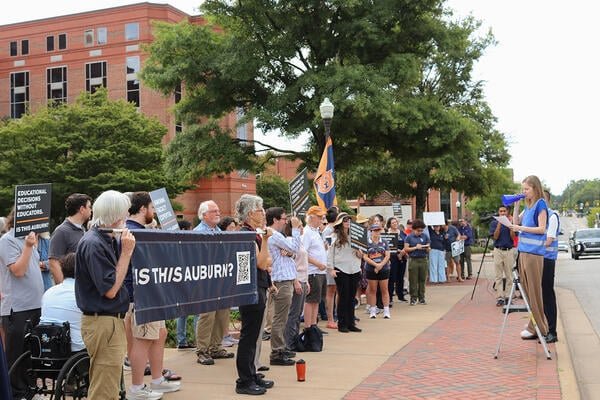
More than 160 faculty and community members attended a protest outside the board’s quarterly meeting on Friday.
With the fall semester now in full swing, Auburn University faculty members are protesting the Board of Trustees’ summer overhaul of shared governance and curricular decision-making at the public land-grant university in Alabama. More than 160 faculty and community members gathered outside the board’s quarterly meeting on Friday to make their objections visible to trustees and administrators, who faculty say have downplayed their disapproval of the new policies.
In early June, Auburn’s board abruptly dissolved the faculty senate and gave itself complete control over course offerings, curriculum, degree requirements and academic credentials, mirroring the actions of public university boards in other conservative states. At the time, some accused Auburn of preemptively overcomplying with a state law—House Bill 580—that doesn’t apply to the university.
“We really care about Auburn University, and I care about my students, and from what I’m seeing from the actions of the board—especially since June 5th—I’m worried about the future of the institution,” said Tracy Witte, a psychological sciences professor and member of United Campus Workers, the union that coordinated Friday’s protest.
Most faculty members—many of whom work on nine-month contracts that end in May—were not on campus when the board approved the sweeping changes, Witte said. UCW and the Auburn University Chapter of the American Association of University Professors (AAUP) have “made a lot of efforts over the summer to just catch people up on what exactly happened and what the ramifications are.”
Lisa Kensler, an educational leadership professor and former chair of the faculty senate, said she was “crushed” when she learned the senate had been dissolved.
Though not all faculty may realize it immediately, “it’s a pretty important organizational structure that we’ve lost,” Kensler said. “The staff maintain their shared governance structure. The administrative and professional employees maintain theirs. The students maintain theirs. It’s only the faculty that lost their structure for collective voice and contribution.”
Despite widespread disapproval of the changes, faculty members have been frightened to speak publicly against the policies, several professors told Inside Higher Ed. Witte described a “culture of fear” that’s infected Auburn over the past year. Kate Craig, an associate professor of history, said that faculty were scared into silence last fall, when Auburn fired several employees over their social media posts about the late conservative firebrand Charlie Kirk.
“That was a moment where all employees at Auburn realized that Auburn was willing to fire them within a week of making private statements and doing private actions on social media,” Craig said. “Since that moment, we’ve all been very aware of what the president is willing to do.”
Without an outspoken faculty body, administrators have assumed that professors largely support—or are at least indifferent to—the changes, Witte said.
“What we’re hearing from [administrators] is, ‘Oh, it’s only a few people that are concerned about this’ … but based on the conversations I’ve been having around campus, that is not the case,” she said. “Almost everyone I talk to is very concerned, but they [think] they can’t say anything.”

Auburn University faculty rally outside the Board of Trustees meeting.
Last week, UCW and AAUP leaders wrote a joint statement that they intended to read during Friday’s board meeting, but their request to speak was denied without explanation, said Heidi Hausse, an associate professor of history at Auburn. Instead, they delivered the statement to administrators on Friday morning.
“Over the past several months, the Board has made significant changes without faculty participation,” it read. “These actions represent a shift away from shared responsibility and toward increasingly centralized control. As faculty, we have found ourselves asking, ‘Is this Auburn?’”
“Is this Auburn?” was a common refrain during Friday’s visibility event, where faculty and supporters lined up along the sidewalk and held signs that read “Excellence taking a backseat to control,” “Educational decisions without educators,” and Putting politics in our classrooms,” all followed by a rhetorical, “Is this Auburn?”
UCW has also been circulating a “declaration of concern,” similar to the union’s statement, which union leaders sent to the provost and Board of Trustees after the event Friday. As of Monday afternoon, the declaration had garnered nearly 700 signatures.
UCW and AAUP haven’t received a response from administrators or trustees, said Hausse. All the faculty members who spoke to Inside Higher Ed said they were pessimistic that they would hear anything in response to the statement or declaration.
Auburn spokespeople did not return a request for comment Monday.
“I don’t think it’s Pollyanna of me to imagine that the president could have come by, shook hands, and said, ‘Hi, I appreciate what you’re here for, I appreciate that you’re working in service to Auburn,’” Kensler said. “I think he really missed an important leadership opportunity to help cultivate a bridge, but maybe that will happen in the future in some way.”
You may be interested

Voicemod’s new pocket-friendly device brings real-time voice changing to your phone
new admin - Sep 15, 2026Voicemod announced a new mobile device that expands the capabilities of the Voicemod Key dongle it launched in late 2024…
Mitch McConnell casts Senate vote after monthslong absence from Capitol Hill
new admin - Sep 15, 2026Mitch McConnell, the 84-year-old Republican senator from Kentucky, made his first appearance at the Capitol in months following a prolonged…

The premium AirPods 5 are the best open-ear earbuds Apple has made
new admin - Sep 15, 2026It’s almost a guarantee that the new version of a product will be, at best, the same price as the…