


What happens after a town de-Flocks

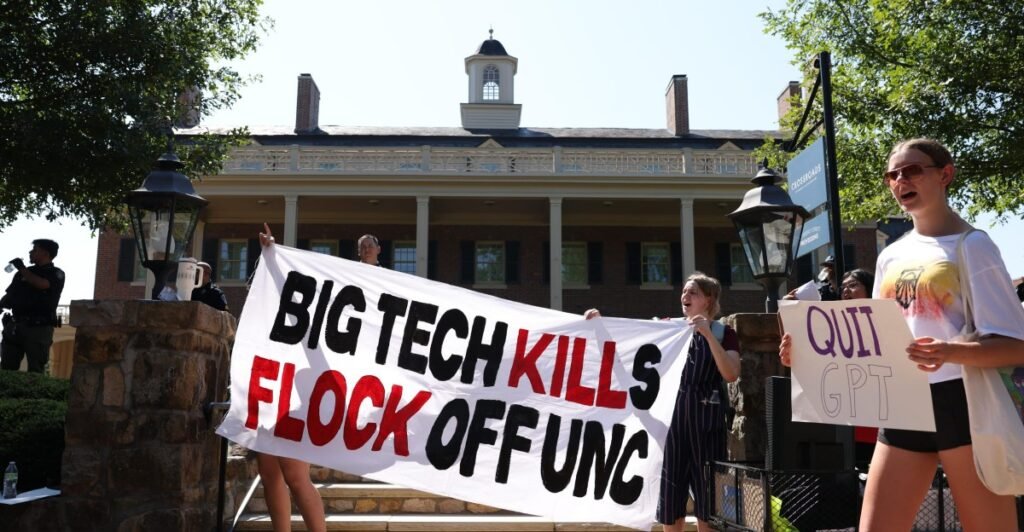
From Florida to Washington state, local governments across the country are canceling their contracts with Flock, the company behind the controversial AI-enabled license plate readers, in response to public outcry. But ending the contracts doesn’t necessarily mean the cameras will come down immediately — or that the information they’ve gathered will be deleted anytime soon.
Even as state and local governments decide to rein in their surveillance capabilities, uncertainty remains about what Flock can and will do with data that has already been collected. Each jurisdiction’s contract is different, but many of them let Flock retain data long after it’s been collected. “Let’s say they terminate,” said Saira Hussain, a senior staff attorney at the Electronic Frontier Foundation who has reviewed dozens of municipal Flock contracts. “What happens to the data, and how long is it able to be searched? That question appears to be unresolved.”
The backlash against Flock was slow to mount, but now it’s everywhere, and it’s bipartisan. Founded in 2017, Flock pitched its cameras — which are sold not only to local governments but to private businesses and citizens — as an unobtrusive tool to enhance public safety. Early in the company’s history, some cities even offered grants for homeowners associations that wanted to install Flock cameras in their neighborhoods. Flock’s footprint has grown quickly. The company has installed more than 120,000 cameras across the US.
This rapid expansion, along with alarming reports of misuses of Flock’s surveillance network, has fueled a new wave of opposition, making Flock a kind of shorthand for privacy invasion. In recent months, activists in big cities and small towns have urged local governments to end their contracts, citing concerns about privacy, harassment, and mass surveillance. Local leaders have said the public pressure — coupled with Flock’s data-sharing and retention policies, and what the company can do with the information its cameras collect — spurred them to end the contracts.
Lawmakers in Sheboygan, Wisconsin, unanimously voted to end the city’s Flock contract after learning that Flock reportedly tried to sell anonymized data collected in Sheboygan back to the city’s public works department. Elsewhere in the state, the mayor of Stevens Point not only ended its contract with Flock but also covered up the 10 cameras scattered throughout the city. “We really have no way of auditing where the Flock data goes once it’s collected,” Mayor Mike Wiza said on a local radio show. “Our community is not comfortable using these cameras without some assurances that it’s being used in a manner we have authorized.” (Flock maintains that it doesn’t sell consumer data.)
Local leaders across the country say they were misled about how Flock data could be used, and some have admitted that they didn’t realize the degree to which the data would be accessed by third parties.
In Bridgewater, Virginia, the town council put bags over its Flock cameras after voting to cancel its contract. Bridgewater is home to fewer than 7,000 people, but the Virginia Center for Investigative Journalism found that because of the town’s information-sharing agreement with Flock, data collected in the town was searched 7 million times by law enforcement in 12 months.
The EFF, which sued the city of San Jose, California, over its usage of Flock cameras, argues that these information-sharing agreements violate the Fourth Amendment’s protections against unreasonable search and seizure.
“Through these searches, police are able to identify patterns of where people live and work, where they may drop off their kids to school, who they associate with, where they worship, seek reproductive care, seek an immigration consult,” Hussain said. “What we’re talking about here is a mass surveillance technology that is by design intended to identify where people are going and track people’s movements.”
Like many movements against law enforcement overreach, the backlash against Flock began with stories about particularly egregious abuses. There have been several reports of law enforcement officers using Flock to track exes and romantic partners. In response to these and other concerns, Flock recently rolled out new guardrails, including a new requirement to run case codes — which were previously optional — for all searches. Flock is also mandating a feature called Audit Assistance, which flags “abnormal” queries.
“This is such an obvious way to curb abuse,” Flock CEO Garrett Langley recently told The Verge. “And I said, ‘Fine. You know what? I think that’s right, and we got this one wrong. We should make it a requirement.’”
Flock has also shortened its standard data retention period from 30 to seven days, though it will let individual jurisdictions lengthen these time frames. Agencies that use Flock will also be able to limit what kinds of information they share with other entities. For example, a city or police department could let other jurisdictions access its Flock data for homicide searches, but not for queries related to immigration enforcement.
But privacy advocates say Flock’s reforms don’t go far enough. The American Civil Liberties Union, which is suing San Jose alongside the EFF, said the changes are “more focused on addressing a perceived PR problem than the significant harms its products create.”
It’s unclear what would stop someone from falsely or incorrectly tagging a Flock search. For example, after sheriff’s deputies in one Texas county used Flock to track a woman suspected of violating the state’s abortion ban, the sheriff described the queries as a search for a missing person.
Flock has repeatedly emphasized that Immigration and Customs Enforcement doesn’t have access to its cameras. But local agencies that have deputized their officers under federal 287(g) agreements — which let local law enforcement conduct immigration arrests — can use Flock for immigration enforcement, and many do. Public recordsobtained by 404 Media revealed that Florida’s Fish and Wildlife Conservation Commission uses Flock to carry out ICE arrests. The agency is reportedly also using Flock to surveil and track its critics. Florida’s Department of Transportation has since banned Flock cameras from state highways, but law enforcement can still tap into city- and county-level Flock cameras, or to those installed on private property. Shopping centers, retail giants like Home Depot and Lowe’s, and homeowners associations have reportedly installed Flock cameras on their properties. Activists are urging beauty retailer Ulta to drop its Flock contracts, citing numerous reports of officers using the surveillance network to track women.
Privacy activists note that ending Flock contracts won’t be enough to stop mass surveillance. Some cities that have ended their relationships with Flock — including South Pasadena, California, and Durango, Colorado — are now considering alternatives. The Flock backlash has reportedly enriched Axon, the company that also makes Tasers and body-worn cameras. Hussain notes that Axon’s system is arguably more integrated than Flock’s.
“Axon has other technologies as well that they stack on top of their automated license plate readers. They have a bunch of other data streams, including coming from their body-worn cameras, so you’re able to build out quite a surveillance system,” she said. “You’re not going to be able to stop this mass surveillance technology by moving to another vendor. The only thing that is going to solve this whole problem is not relying on this technology.”
You may be interested
Royal Mail message for anyone posting envelopes
new admin - Sep 14, 2026The national service claims that this method is one of the best ways to avoid issues from happening to your…

Amazon halts use of 21 Air after plane overshot Miami runway in deadly crash
new admin - Sep 14, 2026Amazon says it has decided to suspend its operations with 21 Air after one of the carrier's planes overshot a…
Duchess Sophie’s 'gorgeous' cowboy boots are an autumn must-have and they're in stock
new admin - Sep 14, 2026[ad_1] Sophie's repeat-wear boots prove a great Western style can carry an autumn wardrobe from casual denim to smarter countryside…