



DOJ Sues All States With In-State Tuition for Noncitizens

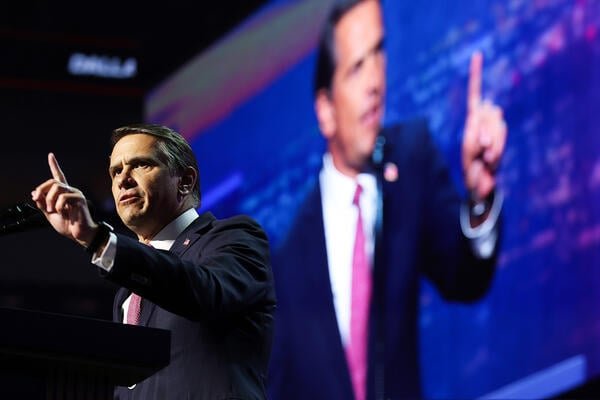
Attorney General Todd Blanche leads the Justice Department, which has filed 25 lawsuits over policies to make undocumented students eligible for in-state tuition.
Kevin Dietsch/Getty Images
For more than a year, the U.S. Justice Department has steadily worked its way through the list of states that allow eligible noncitizens to pay in-state college tuition. The agency sued first Texas and then Kentucky, arguing that the policies violated federal statute.
Now, DOJ has sued 24 states and Washington, D.C., in what advocates call a coordinated assault on the rights of undocumented students. The last batch of lawsuits was filed Thursday against Arkansas, D.C., Hawaii and Utah.
The DOJ, which began filing these lawsuits last summer, argues the policies incentivize illegal immigration and disadvantage Americans from other states who don’t qualify for in-state tuition. The lawsuits have ended in-state tuition for undocumented students in Kentucky, Illinois, Nebraska, Oklahoma, Texas and most recently Kansas. Florida, which passed a bipartisan in-state tuition bill in 2014, pre-emptively eliminated its policy in February 2025 and, last week, barred undocumented students from enrolling in any selective public university.
Of the roughly 525,000 undocumented college students in the United States, more than 180,000 go to school in the seven states that already ended the discounted rates, and 220,000 others live in states where litigation is ongoing, according to data from the Higher Education Immigration Portal.
“No more placing illegal aliens over American citizens on this Department of Justice’s watch,” Associate Attorney General Stanley E. Woodward Jr. said in a statement. “We have now sued every state across our nation that has a state law or regulation granting illegal aliens in-state tuition. We look forward to favorable court rulings and will continue to deliver on President Trump’s promise: illegal aliens will not receive benefits denied to American citizens.”
A federal judge in Minnesota dismissed the department’s lawsuit against that state, ruling that the policies for in-state tuition didn’t violate federal law. Other judges have sided with the DOJ. Legal experts have said that how states set the eligibility criteria for the tuition benefit will likely be key to determining how different judges rule.
Thomas A. Saenz, president and general counsel of the Mexican American Legal Defense and Educational Fund, said during a meeting with journalists Wednesday that advocacy groups like MALDEF are likely to petition the Supreme Court to take up the issue in the coming months. It’s unclear whether advocates would ask the court to review the lawsuits en masse or the situation in an individual state.
“The Supreme Court can’t responsibly leave it to each of the different circuits to decide on their own how this gets resolved. So, guarantee this case gets to the Supreme Court,” Saenz said. “When it gets there and what case is really the key consideration. We can’t control all of that.”
Some of the policies have been in place for more than 20 years, most of them were established with bipartisan support and none of them has been challenged by a previous administration, Saenz said.
“The federal government has no authority to tell any state that it has to give a particular tuition rate to U.S. citizens of other states. That has nothing to do with the immigration power in the federal government, has nothing to do with the regulatory power in the federal government,” Saenz said. “That’s the state decision … and that’s why the law can survive.”
MALDEF previously sought to intervene in lawsuits on behalf of students in Kansas, Kentucky, Oklahoma and Texas, with mixed results. Saenz said the spate of lawsuits is part of a “nationwide campaign and assault by the administration on the rights of these students.”
Eliminating the policies affects not only current and future students for whom public higher education will become prohibitively expensive, but also institutions, which will lose members of their community and the tuition dollars they were paying, Saenz added.
“They will see their applications drop. And they will see their applications drop particularly from cohorts of students who can make real contributions to the diversity of students and to the diversity of class from discussion,” Saenz said. “This is going to have an impact on education for years to come at these institutions.”
Miriam Feldblum, president and CEO of the Presidents’ Alliance on Higher Education and Immigration, said in a statement that the policies expand access to education and strengthen state workforces by giving people skills to give back to their communities and their country.
“Twenty-five lawsuits in less than two years is a tragic milestone and should be a wake-up call for all of us in higher education,” Feldblum said. “The administration’s sweeping effort to shut off higher education access and affordability to Dreamers defies all educational, economic and common sense.”
Alejandra Vázquez Baur, director of immigrant students’ policy, advocacy and partnerships at the nonprofit EdTrust, said in an interview that affordable access to higher education is part of the American dream.
“It’s a key pillar of the education system in the United States to extend the opportunity to all people regardless of their background, race, ethnicity, language and citizenship status,” she said.
Taking that away, Vázquez Baur said, “will deepen disparities and opportunity and access to certain career paths—you know, who sits in CEO seats, who is representing communities because of limited opportunity to higher education and degrees that are necessary for so many different career pathways. That, I think, is a big tragedy.”
You may be interested

Brokers are offering felons a path to Trump pardons — at a steep price with no guarantees
new admin - Sep 14, 2026Brokers are offering felons a path to Trump pardons — at a steep price with no guarantees - CBS News…

When Are Students Better Off Offline?
new admin - Sep 14, 2026[ad_1] Mikael Murphy-Rendón, a third-year environmental engineering student at Cornell University, starts his day watching YouTube videos over breakfast before…

Makeup artist explains reason brown mascara is taking over black right now
new admin - Sep 14, 2026Aimee Connolly has shared the reasons why brown mascara should be a staple in your makeup bag, but you perhaps…