




90% of Colleges Don’t Require Test Scores for 2026–27

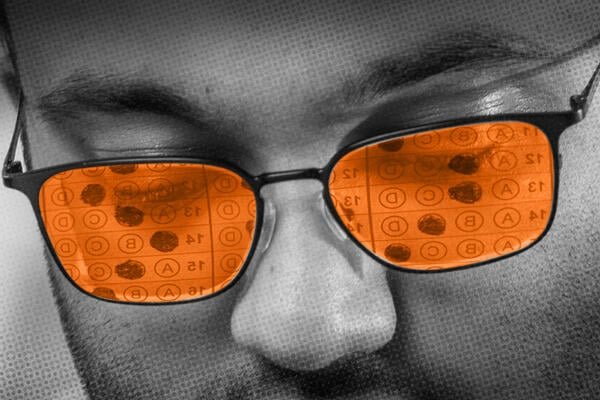
Nationwide, just 161 colleges require test scores in admissions.
Photo illustration by Justin Morrison/Inside Higher Ed | Izusek and Spiderplay/E+/Getty Images
In the six years since most colleges and universities suspended admissions testing requirements amid the COVID-19 pandemic, many have reinstated the requirement or announced plans to do so, including all of the Ivy League universities. But data collected by FairTest, an organization that advocates against the use of tests in admissions, shows that the requirements have not, in fact, had a major resurgence.
In the organization’s analysis of 2,247 admissions policies for the 2026–27 admissions cycle, only 7 percent—or 161 colleges—require test scores for admission. The vast majority, 86 percent, are test optional—students may submit scores if they so choose—while 4 percent are test free, meaning they will not look at test scores. Only 11 institutions introduced new testing requirements for this admission cycle, but another 10 switched from test required to test optional this year. The total number of colleges requiring test scores increased by just one.
Those numbers shift only slightly when looking at top-ranked institutions. Among top institutions—any university that U.S. News & World Report has included in its top 100 ranking—11 percent require scores, versus 82 percent that are test optional. Two Ivy League institutions, Columbia University and Princeton University, remain test optional for this admissions cycle but will switch to requiring scores next year; two other Ivy-Plus institutions, Duke University and the University of Chicago, are remaining test optional indefinitely.
The data, which FairTest releases annually, comes amid widespread debate over whether more colleges should reintroduce these requirements. Some faculty members in the University of California system have argued in favor of the requirements, saying that a significant portion of their students are not cut out for college coursework and considering SAT or ACT scores in admissions could weed out unprepared students. And with all eight Ivy League institutions reinstating the requirements, some higher education experts question whether other selective institutions plan to follow suit.
The Trump administration has also placed a heavy emphasis on the use of tests in admissions. The administration’s higher education compact, an agreement the government asked institutions to sign in exchange for preferential treatment in research funding last October, would have required institutions to make admissions decisions based on “objective criteria” and mandate all applicants to submit scores. Recent Department of Justice investigations into alleged discrimination against white and Asian students in medical and law school admissions have centered around disparities in MCAT and LSAT scores by race.
But Harry Feder, FairTest’s executive director, said the discourse around test requirements distracts from the fact that the vast majority of schools are continuing with test-optional admissions.
“The narrative that is being put forward … says, ‘Oh, the world is going back to testing.’ But it’s just not true, and it’s a story that is essentially being driven by what the Ivy Plus are doing or have done, which is going back to testing for their own reasons,” said Feder.
Advocates for the use of test scores in admissions argue that the tests are better predictors of college academic performance than high school GPA and that grade inflation in high schools makes the scores even more valuable. But critics cite recent research showing that GPA is a much better predictor at public colleges. Other research shows massive disparities in how students perform on the SAT based on race and familial income, in part because wealthier students can afford test-preparation materials and tutoring that others cannot.
The debate also embroils public institutions that have tightened their testing policies. The university systems in Florida and Tennessee are the only public systems that require standardized test scores at every campus. But the University System of Georgia increased the number of institutions where scores are required from three to seven for this admissions cycle; for consideration at some of the remaining 19 colleges, students must submit test scores if their grade point average falls below a certain threshold.
Three other flagship universities—Ohio State University, Purdue University, and the University of Texas at Austin—also require scores. But generally, public institutions require tests slightly less frequently than colleges over all (6 percent).
Among private colleges, it’s not just highly selective institutions that require test scores; of the institutions that require SAT scores, about half are religiously affiliated institutions and about 30 are seminaries, rabbinical schools, yeshivas or Bible colleges.
Lisa Carlton, president of the Independent Educational Consultants Association, which represents independent college counselors, said that, even though 90 percent of colleges do not require test scores, most counselors encourage students to take the tests anyway. Test-optional colleges all consider test scores differently, and some admit very few students who don’t submit scores despite not requiring them. In the 2025–26 application cycle, the portion of applicants who sent in test scores (51 percent) surpassed those who did not for the first time since 2020, according to Common App data.
“What we’re seeing is, because of grade inflation, it’s very hard for the colleges to get a full academic read and some of them really want to see that score as a validator, if you will,” she said. “But on the other hand, there are schools that are genuinely test optional and have found a way to evaluate candidates without test scores.”
You may be interested

State Senator Chalks Sidewalk at Ohio State, Protesting Ban
new admin - Aug 28, 2026[ad_1] An Ohio state senator wrote a message in chalk Wednesday on Ohio State University’s campus, protesting the chalking ban…

Nepal flash flood rescue efforts intensify as death toll rises
new admin - Aug 28, 2026Kathmandu, Nepal — Rescuers pulled out survivors caked in dark brown mud and helicopters lifted stranded people to safety Friday as…
M&S shoppers 'love' new £28 trousers that are a 'go-to for autumn wardrobes'
new admin - Aug 28, 2026[ad_1] The trousers have been labelled as 'very comfortable'. [ad_2] Source link