


Pearl Jam Interview: The Making of ‘Ten’

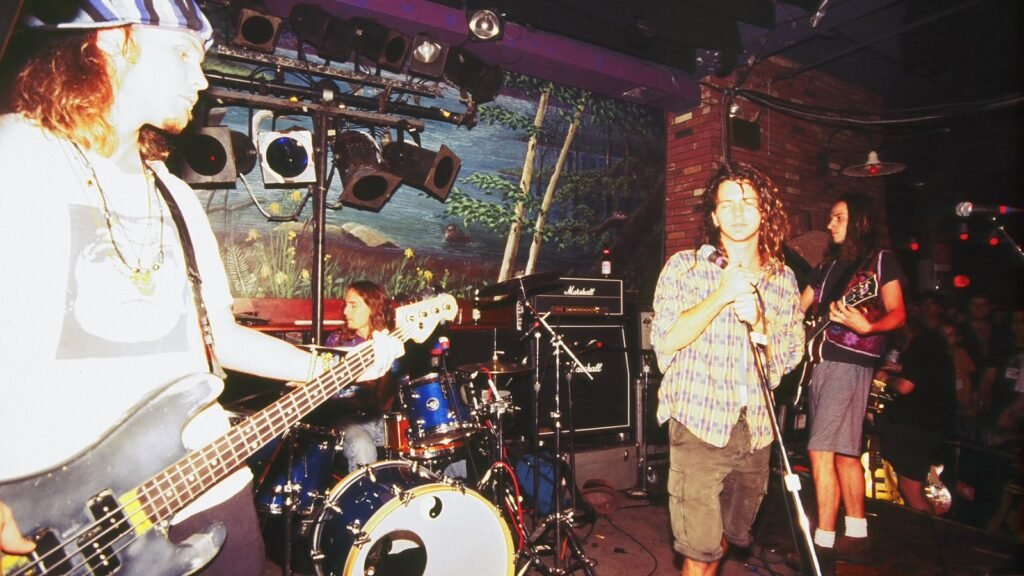
Stone Gossard was 24 years old, and not ready to give up. In March 1990, Andrew Wood, the singer of Gossard’s band, Mother Love Bone, died of an overdose, just weeks before they were supposed to release their major-label debut. That summer, Gossard and his bandmates, including bassist Jeff Ament, were left mourning and adrift. Mother Love Bone had experienced the kind of instant success that made other local bands furious, signing a record deal after playing fewer than 10 shows. What were the odds of winning that lottery twice? “I didn’t know what was going to happen,” Gossard said. “But I knew I wanted to make more demos and make more songs. I felt like I could do it again.”
He was, of course, correct. Within a few months of Wood’s death, Gossard composed an album’s worth of extraordinary songs, or at least the bones of them, minus vocal melodies and lyrics. “I’m pretty persistent,” said Gossard, who maintained a calm, prescient certainty that he would find another worthy band, another great singer. He was encouraged by the surge of Seattle rock around him, from Mudhoney, fronted by Gossard and Ament’s former Green River bandmate Mark Arm, to Soundgarden, whose next album would be Badmotorfinger. “I knew there was more out there,” said Gossard. “Andy was special, but I knew that there were other artists and other people out there that had a completely different thing.”
Gossard developed his new guitar riffs and arrangements in the attic of his parents’ house, alongside another guitarist he started hanging out with that year. Mike McCready was a metal kid turned Stevie Ray Vaughan acolyte with a gift for the kind of fluid solos that could make him “another singer in the band,” as Gossard saw it. At first, though, McCready wasn’t quite sure what they were supposed to be doing. “Stone asked me to play with him,” he recalled, “and after a week, we were in his parents’ attic, with his dog Hillie at his feet. And I said, ‘Dude, do you wanna play in a band together? What’s going on here?’ ‘Cause Stone keeps everything close to the chest, still does. And he said, ‘Yeah,’ so I was like, ‘OK,’ and I broke up the other band I was playing in, like, the next day.”
The music they were making was moody, turbulent and dramatic; it’s not hard to hear Gossard’s grief and confusion in it. But much of it also had an obvious swagger and drive, sometimes with grooves that hinted at funk, or at least a Jane’s Addiction-like approximation of it. “I like propulsion, I like rhythm,” Gossard said. “I wanted people jumping up and down. It can be kind of like ‘Achilles Last Stand,’ or anything moving toward that heavy, funky, grooving, chaotic thing.”
Ament and Gossard had slipped apart for a few months. “He told me he was writing some songs,” said Ament, who considered going back to art school. “At that point, I just needed to not play music for a while. I felt like I had kind of used up my chances at that point.” But Ament fell back in love with music after filling in on bass for another friend’s band, and ended up back with Gossard for their still-unnamed new project. In a July 1990 Rolling Stone piece on the delayed release of Mother Love Bone’s LP, Apple, Gossard and Ament said they recorded 12 instrumental demos and were “scouting additional talent for an entirely new group.”
To record those demos, Gossard reached out to Seattle’s best drummer, Soundgarden’s Matt Cameron. “I’ve met him a couple of times,” Gossard recalled thinking. “I’m presumptuous, so I’m actually going to call him and see if he’ll do it.” Guided by huge cardboard chord charts pasted up on the walls of Reciprocal Studios in Seattle, they knocked out the songs over two weekends. “I got the impression that he definitely had a pretty big picture of what this next musical endeavor was going to be,” said Cameron. “I felt like the music was very well-arranged and very well-focused for a potential singer. It felt like everything was parted out for vocals.” In some cases, the path was laid out: The song that would become “Black” (temporarily titled “E Ballad”) already had its wordless hook in the demo. The early version of “Alive” is an anomaly, since Gossard originally wrote the music in the Mother Love Bone days, and Wood had written an entirely different song to it. Titled “Dollar Short,” its lyrics and melodies are apparently lost to history. Mother Love Bone rehearsed it and played it at least once live but never recorded it in a studio.
Former Red Hot Chili Peppers drummer Jack Irons told Gossard and Ament about a guy living in San Diego named Eddie Vedder, who had recently made an impression on Irons and his friends, Flea among them, with his daring antics on a camping trip. “They were jumping off cliffs together on the river or something,” said Gossard. “He was well thought of.” Camping skills aside, Irons did also manage to mention at some point that Vedder “sings really good.”
Vedder got his hands on the tape, labeled “Stone Gossard Demos,” and the music on it stirred something in him. “I recorded my vocals in four or five hours,” Vedder said in 2009. He famously wrote most of the lyrics and melodies in his head while surfing after a couple sleepless nights. He was, at the time, working as a security supervisor at a petroleum company, while singing in bands and making four-track recordings in his home — the same spot where he recorded his vocals over the demo tape. “I just didn’t think about it,” he added. “And it changed our lives in infinite ways. It’s almost terrifying to listen to it. It gave me what’s certainly the best life I’ve ever lived — to be able to support my kids, to be able to travel. It was the best five hours I ever spent.”
The parts that Vedder laid down on “Alive” and “Once” (plus the eventual “Jeremy” B side, “Footsteps”) got eerily close to what would end up as the finished versions on Ten. There’s a rock-opera narrative there — the same character is in all three songs — that’s not necessarily obvious on the album. But the ingredients were all present, beginning with that singular singing voice, low, resonant and unabashedly passionate, the antidote to a decade of hard-rock singers trying to out-high-note each other. “I loved his low register immediately,” said Gossard. “I thought, ‘Oh, my God, this is so great. Nobody’s going down there.’” Vedder’s elliptical tales of adolescent trauma were a perfect fit with music that blended classic-rock tropes (especially McCready’s solos) with punk energy, grunge guitar tones and the groove-heavy vibe of early-Nineties alt-rock. The music on that cassette helped define the sound, style and attitudes of a generation. It made Pearl Jam so ridiculously popular that they had to spend a decade retrenching.
All that said, Vedder didn’t completely nail it on his first try. “There was one part in there that’s as hysterical as anything I’ve ever heard — I haven’t laughed so hard in years,” Vedder said. He’s referring to his early version of “Once,” which is easily the goofiest thing he’s ever recorded. The humongous chorus is intact, but the rest wavers between bizarre spoken word segments and ill-advised falsetto funk breaks. “It becomes this little audio play or something. I’m fortunate that they were able to see beyond that and give me the job.”
Before Vedder actually got the gig, the other guys had to get to know him. In October 1990, the singer was able to get seven days off from his day job. He was ready to make the 1,200-mile drive from San Diego, only to be surprised and delighted to hear that Gossard and Co. would cover the cost of flying him out. “I was like, ‘Wow, OK… I don’t have to pay for it?’” Before he came out, Vedder completed two or three more songs over Gossard’s demos, including “Black.”
Vedder wanted to overcome any potential awkwardness by getting straight to work. “He called and said, ‘I just have one request, and that’s when we get there, if I can go straight from the airport to the practice place and we can play,’” recalled Ament. “And so, that was kinda our mode for the next week. We’d play for three or four hours, and we go over and get a bean burrito at Mama’s, and we’d play until seven or eight at night, and then we’d hang out and drink some wine or whatever and whatever we did, and we did that for five or six days straight, and half the time we were working on songs we already knew, and half the time we were, like, jamming.”
It was clear to everyone involved that the band was the real deal. “I had never really been in a situation like that, where all five guys were fuckin’ firing on all cylinders,” said McCready. “And it wasn’t too thought out. I mean, we’d rehearsed prior to it, but when it happened, it was like, ‘OK.’ I felt like we could fuckin’ take on some other bands. I was like, ‘We’re fuckin’ great!’”
On drums was another newcomer, Dave Krusen, who grew up half an hour away from Seattle, bashing out on prog-rock in his basement; the Police’s Stewart Copeland was a musical role model. Shortly before Vedder’s arrival, Krusen heard that the former members of Mother Love Bone needed a drummer. He called up Ament and had a successful jam session. “It was right in the mode of the stuff that I loved to play,” says Krusen, who developed the highly syncopated style he used on Ten simply by following Ament’s parts. The bassist eventually gave him a James Brown live album for Christmas and suggested he study it. Struggling with a drinking problem, Krusen would play on all of Ten and then immediately be pushed out of the band. “He was pretty out of control,” said Gossard. But his former bandmates still love his playing, and reunited with him for their 2017 induction into the Rock and Roll Hall of Fame. “Dave Krusen was a real hero,” said Vedder. “He was really, really a great drummer. He had a great flow and a great style.”
Pearl Jam’s original lineup, who were about to christen themselves Mookie Blaylock, jammed for five or six days and came away with most of Ten ready to go, as a 10-song rough demo they knocked out at the end of that week demonstrates. “It wasn’t an audition,” said Vedder. “It was just an art project.” By January 1991, he had relocated permanently to Seattle, and the band went into the studio to record pro-level demos of several songs. One of them, “Alive,” ended up as the version on their finished album, despite attempts to re-record it. “We tried to do it and it was just like, ‘This is cool, but this one just has an urgency to it,’” said Krusen. “The fact that it isn’t as clean-sounding — and it’s not as ‘good’ sounding — just worked for that track, in the context of the lyrics and all that. We had to capture a feeling, and that was more important than the sound quality of the recording.”
When Pearl Jam entered Seattle’s London Bridge Studios in March to begin recording in earnest for the album, the band was well-rehearsed, especially after playing a bunch of live dates opening for Alice in Chains. The producer was Rick Parashar, whom they’d met on the Temple of the Dog album. But some of the musicians describe Parashar as more of an engineer than a producer. “Stone and Jeff were really doing the producing,” says Krusen. “And that’s how they got the sounds they did. Rick was more of a sounding board, and a great engineer.” Krusen’s first child was born just as they started recording, and he “was drinking every day” during the sessions. Considering all that, he plays remarkably well. “I learned to play on various substances,” he shrugs, though he regrets some of his performances.
“It was more difficult than making Temple of the Dog,” said Gossard. “That’s what I remember thinking. We overthought it. You can get really bogged down as a young band in the process of recording.” Eventually, tensions grew between the band and Parashar (who died in 2014). “It felt dysfunctional,” Gossard added. “We didn’t know where we wanted to go and that’s where it broke down, so communication got bad, and it just went south.” Nailing “Even Flow” was the hardest part, with Vedder recalling them recording it 70 times or more. Krusen partially blames himself. “That song has a giant edit in the middle of it because I just had a hard time tracking it. I don’t know why.”
Vedder was apparently unaware of his bandmates’ worries and tensions during the sessions. Unlike Gossard and Ament, he had never made a professional album before, except for his contribution to “Hunger Strike.” “I’m glad I didn’t hear that then,” Vedder said, “because they had made records, and I thought they knew what they were doing! And I thought that this was my first chance to make a real record, and to be honest, I was pretty damn focused on the job at hand. I was in a new town and I was in a new whatever, so that replaced my friends and family, that batch of songs and writing. It was a big deal to be able to make a real record.”
When it came time for vocal overdubs, Parashar needed a break and brought in engineer Don Gilmore, who would later become a producer for Linkin Park and others. Gilmore recalls Vedder actually living in the recording studio, sleeping on a couch. “He had pictures, and artwork — kind of like an insane person — put up all over the studio,” Gilmore says with a laugh. The studio’s security system required Vedder to be locked in at night, but he didn’t mind. “Eddie wanted to redo stuff and redo stuff and redo stuff,” adds Gilmore. “He really wanted to get things right. So I come in in the morning, I unlock the door, and Eddie would come out and he’d be drawing and doing things and having coffee, and he’s like, ‘Yep, let’s do it.’ So we’d get in there and would just work all day.”
Vedder was revising lyrics, and also trying to get the vocal takes up to his standards, which were already quite high. “He had complete command over what he was doing,” says Gilmore. “Eddie just was in search of perfection, not unlike a lot of big artists. . . . He was sort of internally producing himself and directing himself. He had an idea of what he wanted, and nobody was going to tell him it would be a different way.”
Engineer Tim Goldstone mixed the album in the English countryside, with the band hanging out in the pastoral setting of Ridge Farm Studio, where the Smiths had recorded Meat Is Murder. It was mostly relaxed. Between some minor overdubs, most of the band played tennis, and McCready recalls “smoking a bunch of hash” and listening to a couple of Pink Floyd albums that Ament suggested. But Vedder remembered at least one battle: He had to fight off an effort to cut 45 seconds out of “Black,” including the part where he sings, “I know someday you’ll have a beautiful life.” “That’s almost the peak of the song there,” said Vedder, still a little peeved, “and it almost got lost.”
At some point in the process, the band is convinced something went wrong. The guitars and drums float inside stadium-size digital reverb that now sounds more Eighties than Nineties, which they tried to rectify with a tougher-sounding 2009 remix by Brendan O’Brien. In general, the members of Pearl Jam are more critical of Ten than most of their fans. “From a musical point of view, it still seems kind of unrealized,” said Gossard. “But that just shows I can’t hear it.” Still, he loves playing the songs live: “The way we inhabit the songs and what they mean to all of us now is incredible, in terms of what they mean to the crowd — and how long ago they were written and how they still reveal new things.”
In the end, Ten is the sound of a band settling in for what they already knew would be a long, long ride. “We would always think, ‘What’s the third record going to be, what’s the fourth record going to be like?’” said Vedder. “We were really wanting to figure it out, knowing it was somehow going to get better. And we weren’t going to stop trying.”
[This story was originally published in print in 2017. Interviews with the band members were conducted in 2009, with additional interviews in 2017.]
You may be interested

Key moments from Lindsay Clancy trial: What to know as jury weighs case of mom who killed 3 kids
new admin - Aug 27, 2026Lindsay Clancy's murder case is now in the hands of a Massachusetts jury after 22 days of testimony in Plymouth…
The Dog Stars review: Ridley Scott’s post-apocalyptic flick adds little to the genre
new admin - Aug 27, 2026The Dog Stars review. Next James Bond favourite Jacob Elordi stars in this The Last of Us pastiche. Source link
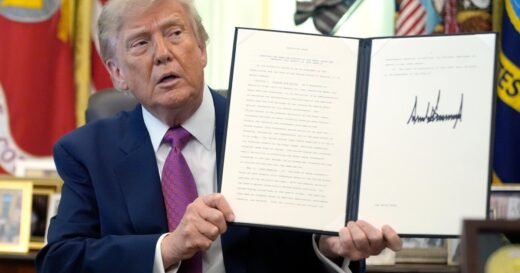
Trump signs executive order to rename Lake Ontario “Lake America”
new admin - Aug 27, 2026Washington — President Trump on Thursday signed an executive order to rename Lake Ontario "Lake America," making good on a…