

Students’ Choices Fueling Polarization in Higher Ed

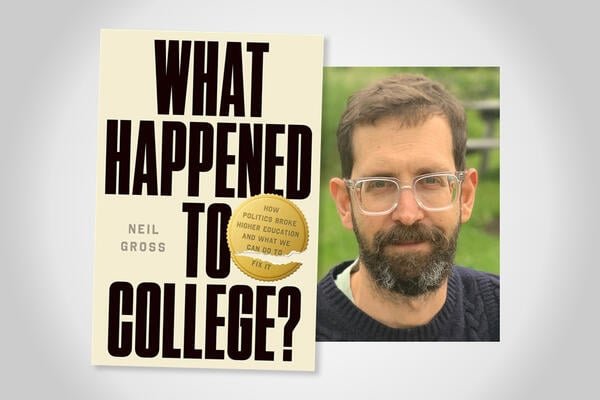
Every day, conservatives accuse universities of being too liberal—indoctrinating students rather than teaching them. Neil Gross, a Colby College sociology professor who teaches a course called College in Crisis, has written a new book that argues polarization is a major problem on campuses. But he says students are largely fueling it, and colleges aren’t doing enough to counteract their ideological self-isolation.
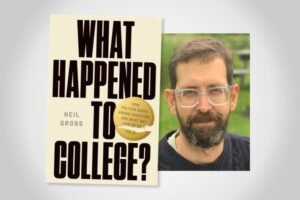
Gross conducted nationally representative surveys of four-year undergraduates and interviewed 100 undergrads and recent alumni across 18 institutions, research that went into his new book, What Happened to College? How Politics Broke Higher Education and What We Can Do to Fix It (Simon & Schuster). His book describes how students form their own political bubbles through their selection of roommates, friends, lovers, clubs, majors and even the universities they attend.
Gross spoke with Inside Higher Ed via phone. This transcript has been edited for length and clarity.
Q: The title of your book is a question: What happened to college? Can you tell me what happened?
A: The answer is polarization.
Higher education has lots of problems and lots of good things going for it. Cost is one of those problems. Attacks from the federal government are another one. But the core problem I’m concerned with in this book is the effect of political polarization.
We’re very used to talking about the effects that polarization has had on other institutions, like the Supreme Court, Congress [and] the judiciary more generally.
Polarization has also upended much of the college experience.
It’s really changed the way that the undergraduate experience is organized, from where students choose to go to college to whom they become friends with, what they major in and what classes they take, and the argument is that’s not good. In particular, a form of polarization called affective polarization—which is when people with different beliefs come to not simply hold different views, but see the other side as evil—has crept into more and more of the college experience.
Q: Can you drill down a little bit more into what ways colleges and their students have become polarized?
A: Part of the issue is that the country as a whole has become polarized, and as that’s happened, it’s just filtered down into higher education. But I’ll give you a good example, which is in college admissions and the college search.
It’s always been the case that some very politically committed students have paid attention to the politics of their university and have maybe sought out schools with like-minded students. But the evidence suggests that is much more the case now than it was 20 or 30 years ago. A nontrivial number of students are very aware of the political reputation of their schools when they’re applying.
This is especially so for students applying to more selective schools, but it’s also true across the board. They’re interested not just in whether the school has a reputation for being liberal or conservative, but also in things like whether the school has a reputation for being political or not.
Students are still prioritizing things like cost and proximity and academic quality, but [politics is] there in the background for a lot of students. And one result is that we’re seeing a growth of some colleges that are becoming considerably more progressive in the leanings of the student body, [and] other colleges that are becoming more conservative in the leanings of the student body. So we’re getting almost two different sets of academic institutions.
Q: You write, “In 1982, some 20 percent of first-year students described themselves as liberal or far left. By 2019, that number had almost doubled, to 37 percent.” You also write that students who identified as middle-of-the-road declined significantly, while conservative/far-right–identifying students remained at about 20 percent. So, isn’t the increasing polarization of students before they get to college the real source of polarization here?
A: Those pre-existing attitudes of students before they come to campus is a big part of the story.
But there is additional polarization that takes place once students get to campus, and beyond that, there are ways in which campuses should be working to counter polarization that they’re not.
The particular kind of polarization that’s of interest to me, or of greatest concern to me, is this affective polarization, where people on one or the other side of the issue not only disagree with their ideological opponents, but really feel that the other side is immoral. [They] regard them with a great sense of dislike or even hatred, and that’s what higher education should be countering.
Students are coming into college with these already affectively polarized attitudes. When they get there, they end up sorting through the college experience in ways that keep them from talking to that many people with different views, and therefore not putting them in a position to really counter those stereotypes.
Q: Wouldn’t a better book title have been “What Happened to America”? Wouldn’t efforts to address polarization in college be fruitless, considering polarized society as a whole will just keep repolarizing colleges and the students once they graduate?
A: It could well be the case that the trend toward polarization that we’re seeing in the broader society can’t be countered by the actions of institutions. But I’m more optimistic than that. Higher education institutions are powerful. They’re powerful places from which ideas emit, and they have a pretty powerful and sometimes even transformative role in the lives of people.
If colleges were paying more attention to polarization, we could be doing a lot more to try to counter it, to reduce polarized attitudes among young people, perhaps even in ways that would spread out to affect their communities.
Colleges and universities have taken up many important social and other sorts of problems over the years. We haven’t recognized the extent to which polarization is just a serious ill.
Q: Your suggested solutions include increasing political diversity among students and faculty—an idea supported by many conservative critics of higher ed, but which some have condemned as “affirmative action for conservatives.” How do you suggest colleges and universities do this?
A: Ideologically diversifying the student body might include trying to identify people who are going to bring more positions on the right into higher ed, it could involve making sure that the student body includes plenty of center-right people, it could include making sure that the student body includes lots of Democratic Socialists.
The idea is that as admissions officers begin to think about what makes for an interesting class, it might be the case that they would find a way not by directly prioritizing ideology, but [by trying] to increase the ideological spread.
That could be through leaning into things that they’re already doing, like trying to recruit more students from rural areas. It could mean trying to recruit more students through venues that might have some association with different ideological positions—for example, networks tapped into religious institutions.
It’s much easier to have classes where students get into real, meaningful debates when there are really significant debates among students. It’s easier to tamp down cancel culture when there is real political diversity among the student body. I’m not suggesting that admissions officers admit students on the basis of their ideologies, but I do think that looking for ways to make sure that the student body has a kind of full spectrum of different positions is important.
On the faculty piece, I absolutely agree that affirmative action on the basis of ideology is not a good way to hire.
In the short term, one reasonable solution is to make faculty lines available in areas that would tend to attract a greater variety of applicants—these could be applicants on the right, it could be applicants more in the center—and then to allow existing departments to hire on the basis purely of academic merit.
Rural sociology has fallen out of fashion in many sociology departments. It’s not the case that everyone who studies rural sociology is on the center or on the right, but there’s evidence suggesting that they tend to be a little bit more right-leaning, certainly, than the average sociologist. So, if an academic administrator or president were to say, “Here’s a line in rural sociology, go hire the best person you see fit,” it would still be up to an academic department to find the person who meets the best academic qualifications.
Long term, I’m quite enthusiastic about efforts to encourage more young people with a whole variety of ideological views to consider higher education as a career. There are mentoring efforts that target undergraduates who are thinking about going to graduate school. There are efforts along those lines run right now through Johns Hopkins and AEI [American Enterprise Institute].
What we need to do to restore America’s confidence in higher education—and, in particular, restore the confidence of people on the right—has to be much broader than that, but I do think that is one part of the story.
Q: You reference multiple times—perhaps as an example of the negative impacts of polarization—the heated pro-Palestinian protests that occurred in the wake of the Oct. 7 [2023] attacks. But some faculty have criticized the push for more “civil discourse” at a time like this. Someone could argue that those protests were, on the whole, representative of something going right in higher ed: Students fervently demonstrating against ongoing bloodshed.
A: The main goal of the book was to understand the student experience and try to think through and understand the ways that polarization is affecting the lives of students—everything from how they choose schools, to whom they become friends with, what clubs they join, what they major in and, yes, also their participation in activism.
I bring up the pro-Palestine protests in the book primarily to make a larger point, which is that higher education is often a site of contestation, where people on the left have tried to use it to pursue their political ends, and people on the right.
Activism and protest is absolutely natural on college campuses. It’s part of civic learning, and something that we absolutely should not clamp down on or try to sway students from. I also think civil dialogue on college campuses is an important part of civil, civic learning and something we should be encouraging, and it’s when those two things become significantly in tension that problems arise.
Q: A lot of what you discuss here as both sources of problems and potential solutions seem to deal with issues that are only present at four-year institutions, especially selective ones.
A: I do focus in the book more on selective schools than on nonselective.
Some of the research in the book does cover the entire student population, excluding community colleges. But looking at four-year schools, these issues matter for students at a whole variety of institutions.
One of the questions that I asked … was “What have been the biggest sources of influence on your political views during your college years?” So focusing just on juniors and seniors, [who have] gone through more of the full arc of college, the No. 1 influence that they cited was their parents, which I think is fascinating. I think it speaks to a change in the nature of the college experience writ large, where parents remain in much closer contact with their kids.
High school students, for example, who have more conservative leanings may be sidestepping college altogether because of their concern that it’s too liberal of an environment for them, and that would keep them out of not just super-selective institutions, but potentially schools that would have more direct career relevance.
Students across the spectrum are concerned with political issues, worried about what’s happening in higher education, and want to see their way through to a good experience. And I think it’s incumbent upon those of us in higher education to make sure that we position them well to learn how to think critically, to acquire relevant career skills as part of the college experience but also to learn how to be more virtuous citizens who can be passionate in their views and active when necessary, but also not hate one another as they proceed along in their lives. And I think colleges have an important role to play there regardless of what kind they are.
You may be interested
Moving Through Grief – CBS News
new admin - Aug 19, 2026August is National Grief Awareness Month, and Kate Doerge wants to reimagine how we deal with grief. After the experience…
Easy method to banish limescale on taps with natural item that actually works
new admin - Aug 19, 2026Limescale can quickly turn shiny taps dull and chalky - especially in hard water areas. The good news is you…
Calif. Bill Could Create Asian-Serving Designation
new admin - Aug 19, 2026[ad_1] The bill, which passed the state Assembly 58 to 16, will soon head to the Senate for a vote.…