



Interview With the U.K. Rock Band

I
t’s their only day off at home in months, and the members of Westside Cowboy are doing the thing they enjoy the least: staring at a screen. Just one member of the Manchester, U.K. band owns a smartphone. Singer-guitarist Reuben Haycocks used to have a flip phone, but he lost it some time ago, and he’s in no hurry to find it.
“We are not very phone-y people, generally, “ says Haycocks, squeezed into a Zoom frame with vocalist-guitarist Jimmy Bradbury, vocalist-bassist Aoife Anson O’Connell, and drummer Paddy Murphy. “As in, phony in the English sense, or in the made-up sense. We’re not phone-ish people. We may be phony in the American sense. I guess it depends how much you like us.”
The fast-rising quartet is likely to find out all that pretty soon. Since releasing their debut EP last year, they’ve played Glastonbury (and won the festival’s emerging talent competition), opened for Geese across Europe, and appeared on the U.K. music TV institution Later…with Jools Holland. Their first album, It Goes On, will be released Aug. 21 on Island Records. It’s full of bare-bones, propulsive rock songs that might remind you a little bit of another band or two you loved once before, but they don’t mind: Reminding you of music you love, or just the concept of loving music in general, is the whole idea. Especially when it’s a human making it.
Today, though, the members of Westside Cowboy are doing the ardous work of air-drying laundry in the apartment a few of them share together, with Bradbury doing a couple laps at the pool before our Zoom to work off, he claims, all the veggie burgers the band has been eating on the road (note to backstage catering: expand your vegetarian options). They look pretty much as they do when they roll onstage, in casual T-shirts and jeans. They like to keep it simple, and offline, as much as possible.
“We try not to be divas,” says Haycocks. “But it would be nice if we didn’t see a single phone for a whole set. That would be a dream of ours.”
It’s an attitude that might surprise some grumpy elders, who like to paint their generation as disconnected, unengaged, and thoroughly obsessed with the nonstop scroll, unable to form a sentence without asking ChapGPT to do it for them. Truth is, Westside Cowboy — all of whom are in their early to mid-twenties — are just as worried about it all as anyone else. Since coming together at university just three years ago, they’ve striven to be a four-piece rock band antidote to the digital age. They want their shows to be messy and urgent, their imperfections shown, their music uncomplicated. A guitar that sounds like a guitar, a drum that sounds like it came from a human actually hitting it. No synths, no fills, no click tracks. Absolutely no AI.
“People want to hear someone sing with a beautiful voice and amazing lyrics, and then fuck up a line,” O’Connell says. “They’re searching for something more tangible. Gardening clubs, singing together, football, independent shops. Anything where they can have a real interaction with someone, and a real bond.”
That human interaction — and a lot of youthful fun — is the key to Westside Cowboy’s story. O’Connell, Murphy, and Haycocks were friends at the Royal Northern College of Music, while Bradbury and Murphy used to play gigs together in a “three-piece surf-punk band.” They all grew up around Manchester, listening to the Strokes and Arctic Monkeys despite the ever-prevalent electronic sounds around them, eventually becoming enamored with the DIY scenes in their local community.
Well, all of them except O’Connell.

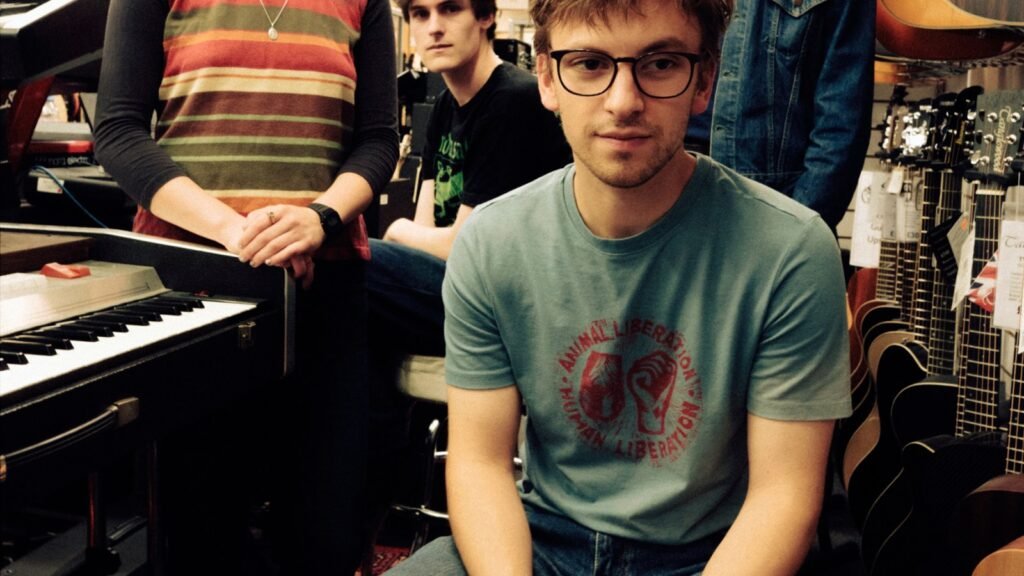
Westside Cowboy in Manchester, July 2026.
Samantha Corcoran for Rolling Stone
“As a teenager, I mainly listened to string quartets and the top 40, which was not the coolest thing in the world,” she says. She went to school to study cello, and hadn’t sung in front of anyone since she was 13 years old at church. Belle and Sebastian and Sufjan Stevens were her gateway drugs, and when she met the rest of the band, they mostly just got together to have a good time and play Lonnie Donegan covers, almost like an after-school club. Everything else around them seemed so serious, so precious.
They wanted to reconnect with what they loved about music as kids, like “when you find that weird album that someone cool has recommended to you and it’s like, ‘This is now everything to me,’” Murphy explains. “Trying to return to that feeling of genuine excitement about music.” And to blatantly ignore any and all ideas that rock & roll might be dead, or at least endangered.
They wrote their first original song by accident, and when more started to come, they set some ground rules to keep it simple, low-stress, and just as youthful as always. Nearly all their songs feature two guitars, a bass, and drums. If they want to add so much as a shaker, then someone’s going to have to figure out how to shake it while they play the instrument they already have, even if it means lacing it between their toes. (“This is what we currently believe,” adds Haycocks. “Maybe in the future when we’ve all got arthritis, we might think differently.”) Each member writes songs, and they rotate singing lead.
The idea was to keep it human, and not try to reinvent the wheel, though they did initially attempt to label their sound, built both on the British rock traditions and American pop culture they grew up around, as “Britainicana,” a term they seem to ever so slightly cringe at now.
“At the time, everyone was a post-punk band in Manchester,” Murphy says. “It was a fun way to say we weren’t that. It’s more like British bands have been loving American music, and American bands have been loving British bands, and it’s just a continuation of things.”
They played gigs locally, eventually catching the attention of Loren Humphrey, known for his work with artists like Geese. He produced Westside Cowboy’s second EP, and then signed on for the debut album.
“What attracted me to band initially was the energy,” Humphrey tells Rolling Stone. “Their ability to take a song and push it far beyond the recommended operating level while somehow still finding a way to land on their feet and crescendo a split sec before the wheels come off and the whole thing spirals down into the ravine. It felt so youthful to me, not in the way of culture or age, but more so in its velocity.”
In the studio, they held strong to their founding ethos: “It doesn’t have to be original. It doesn’t have to be anything,” says Haycocks. “We’ll write the songs as if we’re other people and write the simplest, funnest things that we possibly can.”

Samantha Corcoran for Rolling Stone
Their single “Kick Stones (The Boys)” is a good example of how well that formula worked. The Velvet Underground’s “What Goes On” was the reference point, but it the looseness keeps it fresh, with Haycock sometimes singing as if he’s racing against an hourglass and sometimes drawing each syllable into a slow ramble, meeting O’Connell on harmonies. A bit of Bradbury’s inner Julian Casablancas comes through on songs like “Dobro” and “Big Wheels,” the alternating vocalists making everything feel like a family joint, tentacles instead of a single-celled organism. Almost every track explodes into a satisfying crescendo (though they can write an equally killer ballad that never does, like “Take My Leaving As I Love You,” where you can hear the buzz of the room in the recording).
Westside Cowboy are also big on community. The community of an audience, which they observed while on tour with Geese, and the community they can create within and beyond the band itself. Haycocks has been reading about Blue Zones lately — the idea of countries where people live the longest — and he’s found that one of the biggest predictors for longevity was being around a lot of people, all of the time. “That magic of doing things with other people can literally make you live longer, statistically,” he says, cracking a joke that Mick Jagger’s secret might be that “he’s got loads of mates.”
Early on, the band co-created an organization called No Band Is An Island, which aims to push the music community to be a larger part of a collective for greater good, drawing attention to global causes and urging awareness on the road, like aiming to only play accessible venues, keeping ticket prices low, and ensuring gender-neutral restrooms at shows. Shows that they hope people will put down their phones for, and just be present for some rock & roll.
“I don’t necessarily think rock & roll has died or is dead,” Bradbury says, smiling. “It’s just moved to England.”
You may be interested

Aldi launches quirky baked bean fashion ties as accessory makes a comeback in 2026
new admin - Aug 13, 2026[ad_1] Aldi has launched a limited-edition range of novelty ties featuring some of the supermarket's most iconic products, including baked…

Year 2 Breakout Candidates: One Player From Each NFC Team Primed To Take A Leap
new admin - Aug 13, 2026[ad_1] NEWYou can now listen to Fox News articles! One need only be reminded of the fact that quarterback Sam…

Floodwaters submerge Midwest neighborhoods still bracing for more severe storms
new admin - Aug 13, 2026Flooding submerged Indiana neighborhoods in water for the second day in a row, as parts of the state saw Wednesday…