


College Wasn’t Built for Student Parents

One in five undergraduate students is a parent or caregiver, balancing coursework and college life with the responsibility of caring for someone else. Yet higher education systems and policies often weren’t designed with those students in mind.
From finding affordable childcare and stable housing to navigating time poverty, financial insecurity and questions of belonging, student parents face barriers that can shape their ability to persist and ultimately earn a degree.
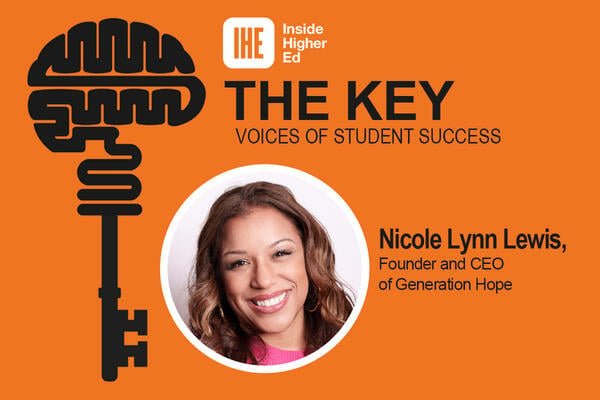
Nicole Lynn Lewis, founder and chief executive officer of Generation Hope, joined Inside Higher Ed student success reporter Joshua Bay on Voices of Student Success to discuss what colleges still misunderstand about student parents and the challenges they navigate both in and outside the classroom.
Here are five takeaways on what institutions can do to better support student parents and caregivers.
Follow us on Apple Podcasts and Spotify
- Student parents aren’t a niche population.
Lewis said 20 percent of undergraduates are student parents or caregiving students, underscoring that they are not a niche population in higher education, even if they are often overlooked in conversations about today’s college students.
“That’s part of the work that we have to do in higher education is to help anyone sitting around a kitchen table understand that the student-parent population is a significant population,” Lewis said. “The more awareness we bring to this, the more understanding that people have about the student-parent experience.”
She noted that these students are often juggling coursework with bedtime routines and staying up late to finish assignments as they navigate childcare, among other responsibilities. But understanding the size and experiences of the student-parent population also has implications beyond higher education, Lewis said.
“It helps people to think about all of the ancillary kinds of connected issues,” Lewis said. “Helping student parents get through college is a part of the solution to dismantling poverty. It’s part of the solution to advancing economic mobility.”
- Childcare is only one of the barriers student parents face.
Lewis said student parents need childcare like they need oxygen, noting that “instead of treating it as a nice-to-have, we really need to be looking at childcare as an absolute critical component to our economic engine.”
However, she said, childcare is only one piece of a much larger puzzle.
“We really need to be looking at transportation, for example,” Lewis said. “Do students have reliable public transportation options to get to campus? Are there emergency grants that can help them when their car breaks down and they need to get to campus?”
In addition, Lewis noted that housing insecurity is another major barrier for student parents, drawing on her own experience attending college with a 3-month-old daughter.
“I started at William and Mary when my daughter was a little under 3 months old, and I quickly came into a housing crisis,” Lewis said. “I was able to find a loophole in their housing that allowed me, as an undergraduate, to take advantage of their family housing that was really intended for graduate students and professors with families.”
“That was just luck,” she added. “But for most students who are going to a four-year school and have a baby or have dependents, they don’t have family housing options.”
Lewis also pointed to “time poverty”—the reality that many student parents have little discretionary time in their day—as another barrier that institutions often overlook.
“When you’re a parenting student, you’re juggling work, the needs of your children, doctor’s appointments, school meetings, coursework, all of those things,” Lewis said. “It’s incredibly important that we’re thinking about if we have, for example, a process or a policy that requires a student to make three trips to one of our administrative offices to be able to qualify for a scholarship or to be able to apply for an opportunity … how is that creating exclusions for our parenting students?”
- Student parents need to know they belong on campus.
Lewis said belonging is something that cuts across all student demographics but can be particularly complicated for student parents and caregivers, who may enter college already expecting that they won’t be in traditional campus structures.
“For student parents, you go into the higher ed experience expecting to not be included, expecting to not belong, and I think simple things can go such a long way,” Lewis said.
She noted that including student parents and caregivers in campus brochures, websites and newsletters to donors are small ways institutions can signal that these students are part of the campus community.
“It’s the big investments, the childcare center, the big kind of multimillion-dollar investments that are necessary,” Lewis said. “But also, it can be the small things like having toys in your waiting area, having those photos of caregiving students in your collateral, profiling a student parent in your newsletter to donors.”
“How are we communicating that belonging at every level and making sure it’s permeating an institution and everyone is on the same page on how we are really being intentional about saying, ‘You do belong here’?” she added.
- Supporting student parents requires more than adding services.
Lewis noted that, thankfully, more institutions are offering family resource centers, childcare programs and emergency grants specifically for student parents. But what separates an institution that truly serves student parents from one that simply adds services is whether that support is embedded across the institution.
“It’s not just one office that’s doing certain things. We want to see that change and that transformation happening across every department,” Lewis said.
That means involving people across the institution, she said—even those in departments that may not traditionally be viewed as part of student-parent support, such as facilities.
“Oftentimes people say, ‘Well, why do you have the facilities people around the table for this work?’ Well, we are helping to figure out how we can get more high chairs into the dining spaces. We’re helping to figure out how to make sure more restrooms for all genders have diaper-changing stations,” Lewis said.
“What we want to see is that an institution has ensured that there are supports, there are services, there are accommodations, there are ways that that student feels that they belong, no matter whether they’re getting a parking pass or going to get their financial aid package,” she added.
- Student parents bring strengths colleges too often overlook.
Lewis said it’s important for institutions to recognize the strengths student parents and caregivers bring to campus, noting that they often demonstrate strong academic performance and a deep determination to succeed.
“One of the things that I ask college leaders is ‘When you think about student parents, do you think of them as a liability or as an asset?’” Lewis said. “They are incredibly driven. They’re leaders at home. They can be leaders in our campus communities, so this is an opportunity to engage untapped leaders.”
She pointed to her own experience as a student parent as an example of the motivation many bring to their education.
“In college there wasn’t a plan B for me. I had to get that college degree to provide for my daughter, so every day, that was what my focus was,” Lewis said. “As I look at the scholars in our program and the many student parents I’ve met across the country, that same drive and incredible motivation is there.”
Get more content like this directly to your inbox. Subscribe here.
You may be interested

Concerns Remain Over ED’s Plan to Spend Expiring IES Dollars
new admin - Aug 13, 2026[ad_1] Higher education advocates warned for months that hundreds of millions in federal funding for education research could expire Sept. 30…

Dodgers’ Freddie Freeman takes terrifying tumble down dugout steps
new admin - Aug 13, 2026[ad_1] NEWYou can now listen to Fox News articles! Los Angeles Dodgers star Freddie Freeman suffered a serious scare in…

Democratic senators demand answers about conditions aboard USS Abraham Lincoln
new admin - Aug 13, 2026Washington — Senate Democrats demanded answers Wednesday about conditions aboard the USS Abraham Lincoln, following reports of food shortages, broken…