


AAUP Embraces Political Role With Candidate Endorsements

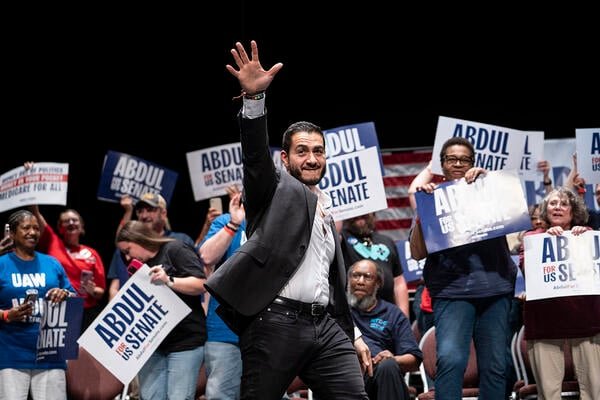
This year the American Association of University Professors is endorsing a candidate in Michigan’s Democratic U.S. Senate primary, in what the group’s president says is the first instance leaders could find of the national-level AAUP making an endorsement. It’s another sign that AAUP has become a political organization, at a time of hyperpoliticization of higher ed more broadly.
Todd Wolfson said Michigan arms of the AAUP asked the national organization to consider the endorsement. AAUP polled Michigan members, finding roughly 80 percent of those voting favored making an endorsement, and about 97 percent specifically favored Abdul El-Sayed, Wolfson said. The AAUP’s national council then signed off. Wolfson signaled there likely will be more endorsements ahead of the midterm elections.
In a news release, AAUP has trumpeted its “First-Ever National Political Endorsement” going to El-Sayed, a past AAUP member who’s on the ballot in Tuesday’s primary. The organization is also hosting a virtual rally today. The release called El-Sayed “a fierce champion for debt-free and tuition-free higher education” who “will be an invaluable ally for academic freedom and higher education as a public good in Washington.”
“He has vowed to stand up to the Trump Administration’s ideological assault on the sector and defend the rights of students and faculty to speak out on political issues, question authority, and engage in peaceful protest without fear of retribution,” the release said.
The move continues the AAUP’s evolution from its beginnings as a professional association that wrote seminal definitions of academic freedom and tenure to also becoming a left-leaning faculty union, now affiliated with the much larger American Federation of Teachers. Some faculty have said this change in the 111-year-old group has eroded its historic importance as a politically neutral defender of academic freedom. But Wolfson told Inside Higher Ed Wednesday that engaging in “politics proper” is needed nowadays to defend academic freedom and other traditional faculty rights.
“Higher ed is under threat,” Wolfson said. “And the threats are coming from the government.”
He pointed to the Trump administration’s disruption of federal research funding and the administration’s admission in recent court documents that it cut clean-energy grants based solely on the recipients being in states led by Democrats. Wolfson said there’s a “radical, right-wing agenda coming out of the federal government,” and the AAUP won’t exist in an “ivory tower” and wait for politics to be done to its members.
“That’s not the AAUP of 2026,” he said.
As for the organization’s historic mission of protecting academic freedom, tenure and shared governance, Wolfson said, “Elected leaders are going to be much more thoughtful and much more careful around those three pillars” if they see the AAUP is willing to fight for them. Beyond the endorsements, the union has taken the Trump administration to court numerous times to challenge grant cuts and other policies affecting faculty.
“We have to stand up to those who would undermine us and would undermine democracy,” Wolfson said.
‘Shedding Any Pretense of Neutrality’
Wolfson said local AAUP chapters have long endorsed candidates. And even if AAUP national hasn’t, he and his organization haven’t shied away from making what have been perceived as political statements since his election as president in 2024.
In August 2024, he called then-vice presidential nominee JD Vance a fascist in a written statement posted to the AAUP’s website. The statement focused on Vance’s past condemnations of higher ed, including his calling professors “the enemy.”
Shortly thereafter, amid Israel’s war in Gaza, the AAUP abandoned its nearly two-decade-old categorical opposition to academic boycotts, sparking accusations that it had also abandoned its commitment to academic freedom. The new AAUP policy did say such boycotts, if done, “should target only institutions of higher education that themselves violate academic freedom or the fundamental rights upon which academic freedom depends.”
In a debate last month featuring Wolfson and professor and commentator Jonathan Turley, Turley criticized the AAUP for taking political positions. Wolfson responded that “first and foremost, AAUP is a member organization. We have 60,000 members, and we’re a democratic member organization, and so we reflect the thoughts and will of our overall membership.”
“For the first 50 years of its lifetime, it was a professional association representing the profession,” Wolfson said at the debate, hosted at the University of Wyoming by Heterodox Academy and the conservative Steamboat Institute. “In that moment, I think Jonathan is right, it would be better off being neutral. [In] the last 50 years, it has pivoted to being mostly a union.”
“Unions are political organizations,” Wolfson said, “and so we have shifted the organization to reflect that.”
In an email Wednesday to Inside Higher Ed, Turley, the J.B. and Maurice C. Shapiro Professor of Public Interest Law at George Washington University, said, “Wolfson was elected on the pledge to make the AAUP an advocacy organization, shedding any pretense of neutrality.”
“With the conversion of the AAUP as an advocacy organization, there is no truly neutral agent representing the interests of all professors,” Turley wrote. “It has become the loudest part of an academic echo chamber. It only contributes to an environment of orthodoxy and intolerance. As trust in higher education continues to plunge, the AAUP is only accelerating that decline.”
Research shows union endorsements seem to matter the more local an election is, said Jake Rosenfeld, a non–AAUP member sociology professor at Washington University in St. Louis whose research has focused on labor unions and the consequences of their decline.
“If they matter at the congressional-on-up levels, they’re going to matter on the margins,” Rosenfeld said, noting the country’s “widespread polarization.” But, he said, “other things unions can do politically, I think, can matter,” including recruiting people to drive turnout.
The AAUP has started a political action committee, and Wolfson said its new political director will start soon. And if AAUP members don’t like how he’s running things, they could use their votes to vote him out.
“You can become a member of AAUP and run for president and try to transform it, and I welcome that,” Wolfson said. “It’s democracy, and we’re a democratic organization.”
You may be interested

Boxer Canelo Álvarez reflects on when he’ll retire: “I have other things to accomplish outside of boxing”
new admin - Jul 30, 2026Boxer Saúl "Canelo" Álvarez, the first undisputed super middleweight champion, is one of the biggest stars the sport has ever…

Tony Romo, Kyle Shanahan and DUIs highlight recent NFL driving incidents
new admin - Jul 30, 2026[ad_1] NEWYou can now listen to Fox News articles! Many years ago, before drunk-driving charges were euphemized as driving while…

‘Best’ setting spray for mature skin now £6 in Charlotte Tilbury deal
new admin - Jul 30, 2026[ad_1] One of Charlotte Tilbury's most sought-after products is arguably the Airbrush Flawless Setting Spray. The featherlight formula primes and…