



Building a Road Map for First-Gen Students

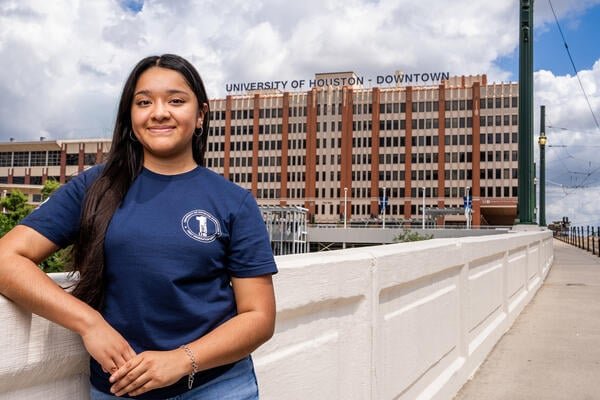
Emily Raygoza grew up without a road map to college.
Neither her mother, who was raised in an unstable household, nor her father, who was deported to Mexico before he graduated from high school, had the opportunity to pursue higher education. So when Raygoza enrolled at the University of Houston–Downtown last year as a first-generation student, she wasn’t sure what to expect—or how to navigate college on her own.
“It was really hard for me to get any sort of guidance before going to the university,” Raygoza said. “Some of the expectations that I had coming into the university were very scary. I knew I was doing it alone and would have to make progress on my own.”
Then an email about UHD’s Summer Bridge Program landed in her inbox. Raygoza enrolled immediately in the free five-week program designed to help all incoming students make the transition to college. By the time classes started that fall, she felt far more confident walking onto campus.
“It really helped me understand the atmosphere of the university and get to know the staff members,” Raygoza said. “This was a great opportunity for me to get a head start somewhere, because I didn’t have much knowledge on what was available to me.”
A support network: Summer Bridge was just the beginning. During her first semester, Raygoza became part of UHD’s broader First-Generation Gator Program, a campuswide initiative that pairs first-generation students with scholarships, peer mentoring, financial coaching and other supports designed to help them persist through graduation.
Raygoza’s experience reflects a challenge colleges nationwide are trying to address: Without parents or family members who have navigated higher education, many first-generation students arrive on campus without the same understanding of college systems, expectations and available resources as their peers.
At UHD, roughly 70 percent of the nearly 14,000 students are first generation—a significantly higher share than the national average of 54 percent and Texas’s average of 43.5 percent. The university launched the First-Generation Gator Program last year to build on supports like the Summer Bridge Program and create a coordinated network of academic, financial and social resources for students throughout their college journey.
Hope Pacheco, associate dean of students and executive director of the Gator Resource Center, said the First-Generation Gator Program is housed within the facility, which was created by merging UHD’s basic needs center with its center for advocacy and community. This structure allows the university to recognize the overlapping challenges many first-generation students face, including those who have experienced foster care or who are pregnant or parenting.
“Each of those individual groups of students have their own needs, so tailoring support to each is important,” Pacheco said. “There are supports already in existence on our campus, so this particular project really is helping us build a comprehensive support program for first-gen students.”
One of the program’s biggest lessons, she said, has been recognizing that supporting students also means engaging the people they rely on outside the classroom.
“When I think about the work and support that we’re doing now, we’ve been really intentional about acknowledging that our students are coming to the university with a family, with a support system, with supporters who may not be their biological family—they might be extended family or chosen family,” Pacheco said. “However they define family, we acknowledge that.”
This philosophy aligns with recent research from the Community College Research Center, which suggests that first-generation students often have more off-campus college-related support than is commonly assumed. More than 70 percent of first-generation students surveyed said they turned to siblings, cousins or other family members who had attended college for guidance, challenging the assumption that first-generation students lack college-connected relationships.
Pacheco said the university intentionally includes parents, caregivers and other supporters in orientation and campus-engagement efforts.
“Acknowledging that our students are coming with a support system, and including them in that next level of their academic journey, is important,” Pacheco said.
Scaling efforts: The university’s first-gen initiative recently received a major boost from the Moody Foundation, one of Texas’s largest philanthropic organizations. Following an initial $300,000 gift for the 2025–26 academic year and a $100,000 commitment to be distributed over subsequent years to support the First-Generation Gator Program, the foundation recently awarded UHD another $900,000 to expand its efforts.
Pacheco said the funding will allow the university to strengthen and expand first-generation support services, with a goal of serving an additional 2,000 students and increasing participation in those services by 50 percent.
The investment, she said, will also help the university build the capacity needed to proactively connect with students rather than wait for them to seek support.
“A lot of what we’re doing is really building infrastructure, creating awareness around our mission and creating spaces where the students are not necessarily just coming to us—we’re going to the students,” Pacheco said. “This is an important population of students, an important investment in students, and this allows our supports to not be one-dimensional.”
The university’s work has also earned national recognition. Earlier this year, the nonprofit FirstGen Forward named UHD to its FirstGen Forward Network Class of 2026, recognizing institutions committed to advancing the success of first-generation college students.
“We’re excited to be able to work with other institutions who are doing great work and learn best practices, including [putting] the infrastructure in place to be able to get good data so that we can hopefully be able to tell our story in a better way and fund the things that we need to,” Pacheco said.
Building belonging: For Pacheco, the work with first-generation students is personal. As such a student herself, she remembers when her mother drove her to campus to move into her dorm but hesitated to walk inside with her.
Her mother felt like she didn’t belong, Pacheco said, and questioned whether she had a place there with her daughter. That experience shaped Pacheco’s approach to supporting students through the First-Generation Gator Program.
“Being here and being able to use my lived experience to grow this program, it’s been a beautiful journey to watch and be a part of,” Pacheco said.
Looking back, Raygoza, now an incoming second-year student, said UHD’s supports helped her see that her family’s circumstances didn’t have to define her future.
“You’re not tied to just that,” Raygoza said. “You could be way more than what your parents were, especially if they encouraged you or they worked hard throughout their lives to give you that life that was better than what they have experienced.”
Get more content like this directly to your inbox. Subscribe here.
You may be interested

Brock Purdy Adapts To 49ers’ Kyle Shanahan-Less Start To Training Camp
new admin - Jul 28, 2026[ad_1] NEWYou can now listen to Fox News articles! Coach Kyle Shanahan's voice in Brock Purdy's helmet has been nearly…

Key takeaways as America honors Lindsay Graham’s legacy
new admin - Jul 28, 2026Key takeaways as America honors Lindsay Graham's legacy - CBS News Watch CBS News Memories of the late Sen. Lindsey…

HBO Max is putting on vertical shorts
new admin - Jul 28, 2026The clips for this feature are powered by an AI tool built in-house, which helps human editors select and verticalize…