

Agencies Can’t Cite Changed Priorities to Terminate Grants

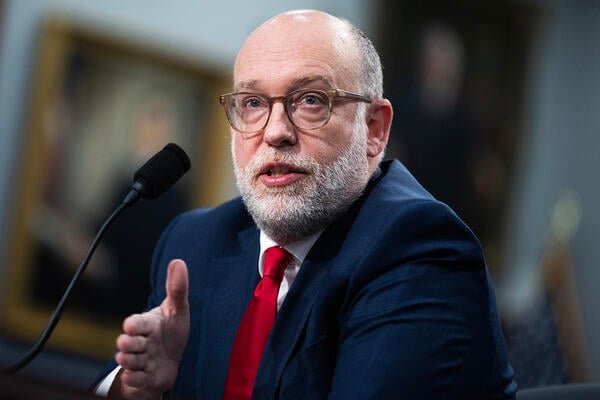
Russell Vought leads the White House Office of Management and Budget, which is working to rewrite the rules for federal grants.
Tom Williams/CQ–Roll Call Inc./Getty Images
When university researchers started to receive notice last year that the Trump administration was canceling their grants, they often didn’t get a clear explanation why beyond that their project “no longer effectuates agency priorities.”
But federal agencies can’t use that language, which stemmed from earlier federal guidance, to cancel grants based on changed priorities, a judge ruled last week, taking away one of the administration’s tools for terminating previously awarded grants. The court order only applies to the 23 states that sued.
U.S. District Court of Massachusetts Judge Indira Talwani’s Friday ruling largely concerned the meaning of a White House Office of Management and Budget clause that says a “federal award may be terminated in part or its entirety” for reasons “including, to the extent authorized by law, if an award no longer effectuates the program goals or agency priorities.” Looking at semantics of the clause, its regulatory scheme and history, and the Constitution, Talwani concluded that while the termination clause may allow for ending grants that no longer fulfill the priorities in place when they were awarded, it can’t be used to ax them based on an administration’s new goals.
“Requirements prioritize ensuring that grantees are on notice, before applying, as to what the program goals and agency priorities are for any particular award,” Talwani wrote. “It would be contrary to this extensive scheme to interpret the Termination Clause to allow the termination of grants based on new priorities, including priorities not disclosed to the grantees.”
But if the OMB finalizes the controversial proposed changes to its uniform guidance for federal grant making, the administration may again be able to terminate grants based on its own changing priorities. The proposal—which has garnered more than 490,000 public comments, including condemnation from higher ed associations and research advocacy groups—would change the termination clause to say grants could be canceled if they do not further priorities “as they exist at the time of the termination.”
Amanda Fuchs Miller, president of Seventh Street Strategies and former deputy assistant secretary for higher ed programs during the Biden administration, said Friday’s court ruling “is very powerful, and it shows all the more reason why this new proposed rule change would be so harmful.”
“Congress really needs to step in and make it clear when an agency can terminate a grant midstream and when they can’t,” Miller added.
The current ruling—if not reversed on appeal or rendered moot by the proposed OMB rule—will help protect current and future grants to higher ed institutions and researchers in the states that sued. Ted Waters, managing partner at Feldesman LLP and a George Washington University Law School adjunct professor, said it’s unclear whether it extends to nonpublic institutions in those states. All the states have either attorneys general or governors who are Democrats.
“Plaintiffs assert they possess numerous active awards, at least 1,180 active grants totaling more than $5,391,125,688 in grant funding from Defendant-Agencies, all of which have incorporated the Termination Clause into their regulations,” Talwani, an Obama appointee, wrote in her ruling.
When President Trump returned to office in January 2025, he required federal agencies to review their existing grants for adherence to his administration’s new priorities. Roughly a year ago, the states sued the OMB and multiple federal agencies—including the National Science Foundation and the National Endowment for the Humanities—and alleged that agencies terminated billions of dollars in federal grants to them, including canceling grants for universities and school lunch programs.
The states asked the court to stop the Trump administration from continuing to cancel previously awarded grants using the OMB clause in this way.
But the states didn’t ask Talwani to restore their lost money. The Supreme Court—in separate cases involving the National Institutes of Health and the Education Department, which weren’t sued in this lawsuit—has suggested that universities that lose grants can only seek relief before an obscure court called the Court of Federal Claims. That court can’t actually restore the grants but may be able to award other monetary relief.
Talwani wrote that the government correctly noted that the states “must bring any challenges to past award terminations to the Court of Federal Claims pursuant to the Tucker Act, and not to this court.” But states instead sought protection against similar terminations of current and future grants.
The judge granted that protection to them, rejecting the government’s argument that the states’ fear of future termination was only “hypothetical.” She declared that the OMB’s termination clause doesn’t allow for terminations based on changed agency priorities, citing, among other things, the Constitution’s spending clause.
“If Congress intends to impose a condition on the grant of federal moneys, it must do so unambiguously,” Talwani wrote.
Kristin West, director for research ethics and compliance at COGR, an organization that advocates for researchers and universities on the federal level and goes only by its acronym, said, “You have to give states adequate notice about the strings that are attached to the funding that you give them.”
She said the ruling cuts the legs out from under the administration’s argument that “whatever my agency priorities are today at 4:02 p.m., I can use [that] to cancel your grant.”
The OMB didn’t respond to requests for comment.
You may be interested

‘Masterpiece’ 1960s classic inspired by Elvis Presley is coming to Netflix | Films | Entertainment
new admin - Jul 21, 2026Back in 1963, George Sidney directed the big screen adaptation of the hit stage musical Bye Bye Birdie. Starring Dick…

GLP-1 drugs linked to 17% drop in worker sick leave, new economic study finds
new admin - Jul 21, 2026GLP-1 drugs could lead to cost savings for workers and their employers by reducing employee sick leave, a new economic…

Apple’s rumored ‘Upgrade’ program brings lease-to-own pricing for iPhones, Macs, and iPads
new admin - Jul 21, 2026As component and RAM shortages drive prices higher, Apple is reportedly launching an “Apple Upgrade” program for leasing new devices.…