
Newsom’s “competitive bid” diaper deal wasn’t. California’s budget includes dozens of similar no-bid exemptions.

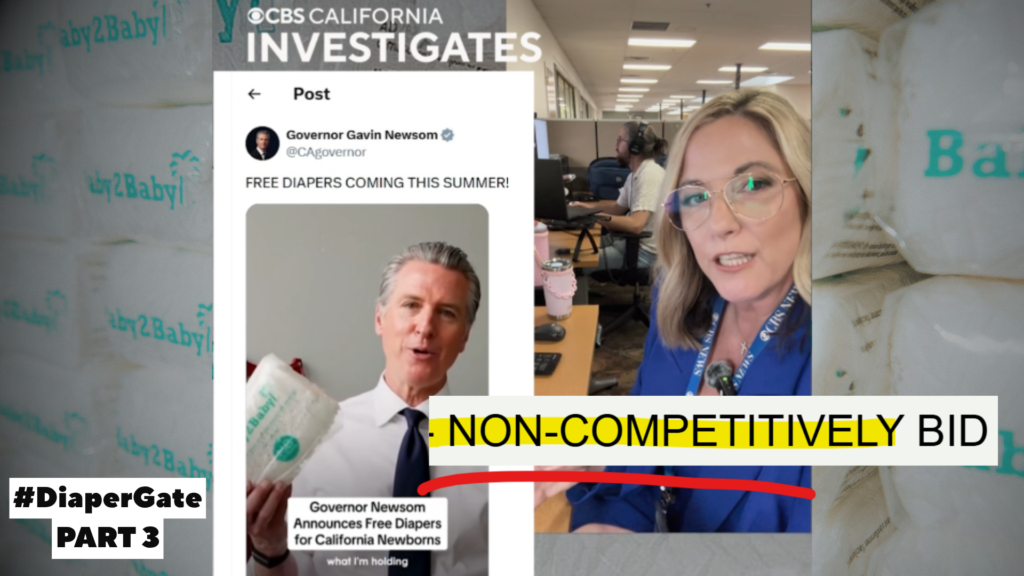
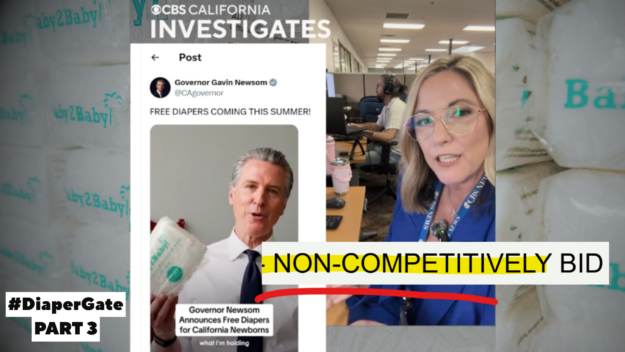
When Gov. Gavin Newsom announced Baby2Baby would manufacture and distribute millions of free California co-branded diapers to every new parent, he claimed the deal “went through a competitive bidding process.”
State records reveal it didn’t.
California’s official contract database lists the $6.2 million Baby2Baby deal as “NON-COMPETITIVELY BID.”
Baby2Baby is not alone.
CBS California Investigates found more than two dozen similar exemptions in California’s new state budget totaling more than $1 billion in appropriations for programs ranging from a $253 million opioid-response fund to suicide-crisis grants to a $12.9 million prison re-entry program. Two out of three of the exemptions never expire.
Because these deals are also exempt from state contracting oversight, they are largely hidden from public view and don’t appear in California’s public database of no-bid contracts.
Had the governor not publicly announced the Baby2Baby contract, prompting questions about the nonprofit’s ties to Newsom and his wife, the “non-competitively bid” contract may never have been discovered.
That public announcement, and the controversy that followed, prompted CBS California Investigates to fact-check some of the critics’ claims.
As part of that fact check, we requested a copy of the Baby2Baby contract and competitive bid records through a California Public Records Act Request.
For two months, the administration delayed providing those records, prompting us to dig deeper into state records that were already publicly available.
After cross-referencing the state contract database, non-competitive bid database, two years of budget hearings and four different budget bills connected to Baby2Baby non-competitive contracts dating back to 2022, it became clear that this investigation was no longer about diapers.
Key findings
- State records label the Baby2Baby contract as “NON-COMPETITIVELY BID”, despite the governor’s public description of a “competitive bidding process.”
- State law requires competitive bids, with a few legal exemptions. This contract didn’t go through the normal exemption process, which requires justification and public disclosure.
- Instead, an exemption was buried in the state budget waiving competitive bidding, oversight by the state contracting watchdog, and the public posting of no-bid contracts in the DGS database.
- CBS California Investigates found more than two dozen similar exemptions in the 2026 state budget totaling more than $1 billion in appropriations. Those contracts are also exempt from public posting and third-party oversight.
- This is at least Baby2Baby’s third no-bid state contract. The first two listed Baby2Baby by name in the budget, but neither appears in the state’s no-bid database.
- California is never identified in Baby2Baby’s public tax filings. Government grants appear only as a single $2.5 million line item, and the contributor schedule is restricted from public view, as federal law allows.
- The 2025 budget funded the free diaper program at the expense of traditional diaper bank funding. The administration told lawmakers that diaper banks would be able to competitively bid for the contract.
- Instead of a competitive bid, the state issued a Request for Information, which is a document that says, in its own fine print, it’s “Not a Solicitation.” Fifteen organizations responded.
- Several respondents, including one of the nation’s largest diaper bank networks, say they either didn’t get an interview or felt they weren’t seriously considered.
- The state continues to delay releasing the diaper contract and competitive bid scoring records to CBS California Investigates — now 66 days and counting.
“Non-competitively bid” — in the state’s own words
California’s contract database entry for the Baby2Baby deal is blunt. Acquisition method: “Exempt by Policy – Other (buyer must indicate policy) – NON-COMPETITIVELY BID.“
Pressed to explain the contradiction with the governor’s announcement, a spokesperson said the term competitive “refers to the competitive nature” of the state’s Request for Information, adding the exemption provided “flexibility to deliver on the project at the scale needed to serve Californians.”
But at a May Senate budget hearing, the department’s own chief deputy director described what the exemption really does: it “allows you to essentially engage in negotiated contracting outside of state rules,” because the formal bid process “can be cumbersome and time consuming.”
The normal way to skip a bid — and what happened instead
Skipping a competitive bid isn’t necessarily improper. State rules allow a handful of legal exemptions, including in cases of an emergency contract or for a product that only one company makes. But that path comes with strings: agencies must justify the no-bid deal to the Department of General Services, and approved exemptions are publicly posted — 474 of them since 2018.
The diaper contract took a different path entirely.
One sentence, in the 893-page budget
The Budget Act of 2025 contains a single provision exempting Diaper Access Initiative contracts from the competitive bidding law, from public advertising of the bid, and from “the review or approval of any division of the Department of General Services,” the state’s contract watchdog.
No bid required. No watchdog review. No entry in the public no-bid database. The only public trace: one coding line in a contract registry most Californians have never heard of.
And here’s how it got there. The governor proposed the free diaper program in his January 2025 budget, which never described a competitive process, saying only that the state would “identify a partner.” The exemption itself appeared in the budget bill in late June. Three days later, it was law.
More than two dozen similar exemptions
CBS California Investigates searched the full 893-page 2026 Budget Act for the same exemption language and found more than two dozen matching clauses across seven state departments, each verified against the chaptered bill text.
Each waives both competitive bidding and DGS review.
They include a $253 million opioid-response fund, grants supporting the 988 Suicide & Crisis Lifeline, and a $12.9 million prison reentry program.
The exemptions also cover funds implementing Proposition 1, the governor’s signature mental health measure. That measure squeaked past voters 50.2% to 49.8% in 2024. The margin was so thin that it took 15 days to call.
One clause gives the Office of Health Care Affordability, the state’s own health-cost watchdog, a no-bid authority through 2031. The same budget item shields that office’s report-related documents from the Public Records Act until 2031. It also grants emergency-regulation powers that skip the normal public rulemaking process.
Two-thirds of the exemptions never expire.
A separate February bill applied a similar formula to $90 million in reproductive health grants. The Governor’s office says those funds went to Planned Parenthood and other clinics. What the press release did not say is that those contracts, by law, “shall not be made public.” Lawmakers wrote findings into the bill to justify the secrecy, citing the safety of medical providers and patient privacy after federal defunding.
Baby2Baby’s third no-bid contract
This is at least the third time Baby2Baby has received state money without a competitive bid. But the earlier deals were done differently.
In 2022, lawmakers wrote Baby2Baby’s name directly into the budget for a $1 million car seat contract. In 2023, they did it again: $1.5 million, by name, for L.A. diaper distribution. Naming the vendor in the law provided a level of transparency. Lawmakers saw who was getting the money and voted on it.
But even those “transparent” no-bid deals had blind spots. Neither contract appears in the state’s no-bid database. Unless you searched the budget’s hundreds of pages, you’d never know they existed. And competitors never had the opportunity to bid on those contracts either.
This time, there’s no name in the law at all. The administration selected Baby2Baby through a process the governor called competitive. The records call it non-competitive.
Baby2Baby’s ties to the state span the governor’s tenure. He credits the nonprofit with bringing him the idea to eliminate the diaper sales tax. He suggests the free diaper program grew out of conversations with the organization. And one of its co-CEOs sits on the board of the First Partner’s California Partners Project.
Missing from the tax filings, too
You can’t trace the state’s payments through Baby2Baby’s public tax filings either.
The nonprofit’s most recent 990 reports government grants as a single line item: $2.5 million, with no indication of which governments paid. Federal law allows nonprofits to withhold the names of contributors, including government grantors, from the public copies of their filings. Baby2Baby’s contributor schedule is marked “RESTRICTED.” (The new $6.2 million diaper contract began in May and wouldn’t appear in any filing yet. The earlier state-funded deals can’t be identified in the public filings either.)
None of that is improper. It’s how the disclosure rules work. But it means the only document that can confirm what California is paying Baby2Baby, and for what, is the contract itself. The one the state won’t release.
Diaper banks lost their funding and were promised a shot
The free diaper program came at a cost to California’s existing diaper banks. The governor’s 2025 budget proposal eliminated their traditional funding and replaced it with the new statewide program. When lawmakers asked what would happen to them, state officials said at a budget hearing that the diaper banks would be able to bid.
No competitive bid process ever happened.
The legislature stepped in instead. It restored reduced funding for eleven named diaper banks and food banks in the 2025 budget: $7.4 million. This year, lawmakers more than doubled it: $16.5 million to the same eleven organizations for diaper and wipe distribution.
That means the diaper banks’ allocation this year is now larger than the $12.5 million appropriated for the next phase of the Baby2Baby program itself. The difference: the diaper banks are named in the law, in plain sight. The Baby2Baby contract still isn’t public.
“Not a Solicitation”
Instead of a bid, the state posted RFI #24-25068, a Request for Information seeking input “from diaper manufacturers.” The document itself say it is “Not a Solicitation,” clarifying it was issued “for information and planning purposes only.” Responses “cannot be accepted… to form a binding contract.” Any pricing “will not be considered a proposal/bid.”
Fifteen organizations responded. The department said it evaluated them, interviewed some, and negotiated a contract with Baby2Baby. HCAI Director Elizabeth Landsberg told senators it “was a robust, meaningful process,” the same approach used for the state’s CalRx insulin and naloxone programs.
Here’s what the state hasn’t explained: what did the “bid scoring sheets” it promised to release actually score? The RFI published no evaluation criteria.
“We weren’t seriously considered”
While diaper banks were encouraged to apply, CBS California Investigates spoke with several respondents who say they either weren’t given an interview or did not feel they were seriously considered.
One of the nation’s largest diaper bank networks told CBS California it responded to the RFI and never got an interview. When they inquired, they were told there were no updates.
Several applicants said they only learned they were out of the running when the governor announced the Baby2Baby partnership at the May press conference.
Under a traditional competitive bid, losing bidders are notified. They can request the scoring sheets. They can protest. Under this process, there was never legally a bid or scoring criteria so there was nothing to protest.
Still waiting: 66 days and counting
CBS California Investigates requested the contract and bid records on May 12, four days after the governor’s announcement. The state took 24 days to confirm that the records are public and disclosable. Then it delayed production three times. The latest delay came at 5:09 p.m. on July 3, a state holiday.
To be clear, our fact-check found Baby2Baby is a highly rated charity. Its newest filing shows the co-CEO earning under $70,000 a year and celebrity board members earn nothing.
Every exemption described in this story is legal, approved by the Legislature.
However, the question is bigger than diapers. Should the state be exempting more than a billion dollars in contracts from competitive bids and public oversight? And if the governor hadn’t called this one competitive, would anyone have ever checked?
Neither the Governor’s office nor Baby2Baby replied to our request for comment.
We’ve also asked the governor’s office what criteria the 15 respondents were scored against, and whether the others were ever notified. We’re still waiting for those answers, too.
You may be interested
Travis Scott, James Blake, Ludwig Goransson Share ‘When I’m Home’
new admin - Jul 17, 2026[ad_1] Rapper, who has a cameo role in Christopher Nolan's epic, previously contributed end credits track to the director's Tenet…
Shark’s versatile ChillPill cooling system is back to its best price
new admin - Jul 17, 2026Portable fans are one of the easiest ways to stay cool during the summer, and you don’t have to spend…
FIFA, White House monitoring wildfire situation for World Cup final
new admin - Jul 17, 2026[ad_1] NEWYou can now listen to Fox News articles! FIFA President Gianni Infantino and the White House have been in…