

An Enrollment Reprieve for Rabbinical Schools

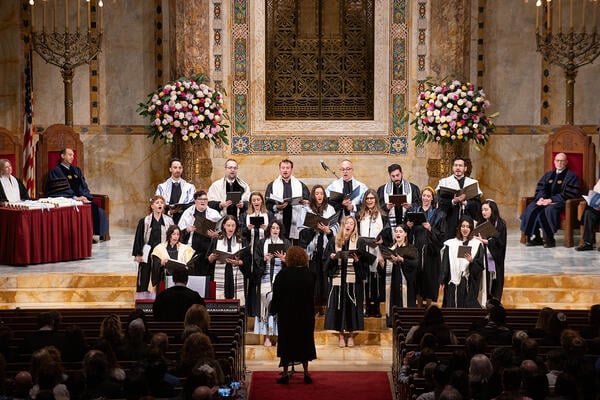
For over a decade, enrollments at some of the country’s most prominent non-Orthodox rabbinical schools have dropped, ramping up synagogue goers’ anxieties about leaderless congregations.
But some rabbinical schools are seeing a comeback, welcoming their largest classes of future rabbis in 15 years this upcoming fall, The Forward first reported. Rabbinical school leaders say new recruitment strategies are helping to boost their graduate programs. Some also believe rising antisemitism and political polarization have spurred new reflection on Jewish identity, driving interest in the rabbinate in the wake of the Oct. 7, 2023, Hamas attack on Israel and Israel’s subsequent war on Gaza.
Jewish Theological Seminary, a hub of the Conservative movement in New York City, is welcoming a new cohort of 25 future rabbis this fall, the institution’s largest class since 2011. Hebrew Union College–Jewish Institute of Religion—a bastion of the Reform movement, with campuses in New York, Los Angeles, Jerusalem and a virtual pathway—saw similar gains. Their incoming cohorts almost doubled over the last few years, from 23 new students in 2023 to 42 starting this year.
A few years of growth “does not quite yet make a trend,” said Andrew Rehfeld, president of Hebrew Union College. But “we’re very hopeful … The data will tell the story in the next few years.”
A ‘Revitalization’
Still, the increase is a welcome shift for institutions long accustomed to enrollment declines.
In 2007, five of the country’s liberal rabbinical schools enrolled a total of 100 students in their incoming classes, according to the Jewish Theological Seminary. By 2022, that number had plummeted to 52 students. Large denominational rabbinical school enrollments shrank by an average of 16 students per year from 2008 to 2020, according to a similar finding last year by Atra: Center for Rabbinic Innovation. The decline has slowed to a loss of nine students on average per year since.
The declines have prompted some rabbinical schools to make hard choices, leaders say.
Ziegler School of Rabbinical Studies in Los Angeles, which currently has 30 students training to become Conservative rabbis, paused admissions last year in preparation for an overhaul. The school’s parent institution, American Jewish University, hired an education-consulting firm to interview students, alumni, faculty and rabbinic and lay leaders as a part of a comprehensive review, which is expected to drive major changes at Ziegler—including efforts to prepare rabbis for a range of jobs beyond the pulpit.
“We’ve seen a dramatic drop in enrollment and interest,” said Jay Johnson, president and CEO of American Jewish University. “We have to understand the needs of this generation of potential students. We felt like if we just tweaked around the edges, we weren’t going to make the impact we wanted to make.”
Hebrew Union College chose to shutter its 150-year-old rabbinical program in Cincinnati in 2022 because of dwindling enrollments and financial struggles. The institution also decided to close all graduate programs on the Ohio campus, while keeping academic resources like its library and archives, and downsized its campuses in L.A. and New York.
More structural changes are ahead for Hebrew Union College as the institution tries to get on stronger financial footing, Rehfeld said. But the enrollment bump signals to him that the institution’s rightsizing and recruitment tools are working—and donors are taking notice. The college just had its best fundraising year in history, raising $50 million, though Reform congregations over all are still shrinking and donating less, Rehfeld said.
The recent enrollment growth “helps our donors have confidence in the path that we’re taking,” he said. “It’s part of the story of the revitalization.”
Recruiting New Demographics
Hebrew Union College leaders attribute the enrollment reversal to their recent efforts to create new pipelines to the rabbinical school.
HUC has been running a series of online fellowship programs for college students and recent graduates to give them a taste of the rabbinical school experience. And last year, the college opened a virtual rabbinical school program in the hopes of drawing career switchers and older learners rooted outside of New York and Los Angeles. Of the incoming class, 17 are joining the virtual program, up from 10 students in the first virtual cohort, according to data from the college. They represent a range of ages and previous careers, from academia to tech to nonprofit work, Rehfeld said.
“It not only meets people where they are and allows them to fulfill their calling,” he said, but “it also will strengthen and fertilize our Jewish communities with a new kind of experience, a new kind of perspective.”
David Fisher, who’s starting at HUC in the fall, said the virtual option played a major part in his decision to attend. He previously went to Hebrew College, a pluralistic rabbinical school in Boston, but when he and his family moved to Washington, D.C., to be closer to his wife’s family, he needed to find another option. As the father of a 3-year-old, with a baby on the way, he was drawn to HUC’s virtual program. He already knows his curriculum for the next three years, which will help him get ahead on coursework and coordinate childcare, and the program enables him to stay in D.C., where he’s grown attached to the Jewish community.
“I’ve always been somebody who’s looking for the right balance of structure, and HUC offers a really powerful blend of structure and flexibility,” Fisher said. “It’s lovely to be able to be rooted in our thriving Jewish community that we’re in and also do the learning and the training for what comes next.”
Jewish Theological Seminary updated its curriculum and made new efforts to attract and serve students who have had less formal Hebrew and Judaic studies education.
Three years ago the institution started the Religious Leadership Mekhinah Program, a virtual program to prepare potential rabbinical and cantorial students with extra online coursework in Hebrew, rabbinic literature and other topics, with support from rabbinic mentors. JTS also revamped opportunities for students to learn foundational skills and improve their Hebrew.
“We have some students who are coming in after Jewish day school, after studying college-level Judaic studies, and some who have not done serious academic study” in these areas, said Rabbi Ayelet Cohen, dean of Jewish Theological Seminary’s rabbinical school. “We needed to make sure that our curriculum was elastic enough to provide advanced learning for those who are coming in with a lot and also to reinforce the foundational texts for people who are coming in with less of that.”
Rabbi Dan Judson, provost of Hebrew College, said the institution’s enrollment has been holding steady or growing, with about 15 new students per year over the last decade. He credits the school’s commitment to text study and traditional chevruta—partnered learning—paired with its pluralistic approach. (According to the Atra study, nondenominational rabbinical schools have grown more rapidly in recent years than specific denominational Jewish institutions.) He also believes new pipelines will reap dividends, including a new yearlong program for young people, nominated by alumni who think they “would make a good rabbi,” he said, and a new certificate in prayer leadership.
But Judson sees it as good news that the denominational rabbinical schools are also experiencing growth.
“I think the world needs rabbis,” he said. It needs “people who are steeped in Jewish wisdom that are committed to service and helping others. We were sort of facing existential peril, potentially, of not having rabbis to lead a Jewish future.”
A Moment of Reflection
Cohen, of the Jewish Theological Seminary, believes the enrollment growth is born out of the post–Oct. 7 climate and prospective students’ renewed reflections on Jewish identity.
Over the last few years, multiple applicants to JTS’s rabbinical school spoke in interviews about how “this is the moment” to join the rabbinate, she said. Some described feeling shut out of social justice groups and efforts they were previously a part of, isolated by the political upheaval that arose from the Israel–Gaza war and searching for ways to continue to effect social change.
“We’re living through challenging times for the Jewish people in this country, and those moments often make one look deeply inside and think about how do I want to be a partner in repairing what’s broken in the world?” Cohen said. “And that often causes people to make different choices about … the kind of work they want to devote themselves to.”
Johnson, of American Jewish University, said the moment should prompt reflection for rabbinical schools, too. One of the questions he’s considering as a part of Ziegler’s overhaul is how to prepare rabbis to handle conflict resolution within congregations and families as Jewish communities navigate deep divides over Israel.
He also wants rabbinical schools, including his own, to examine other issues brought on by news developments and shifting trends, such as how rabbis might use artificial intelligence for Jewish textual research, how to prepare rabbis with the budgeting skills they need to keep synagogues financially healthy and how to prepare them for nonprofit roles and other jobs beyond the pulpit.
From his perspective, enrollment numbers “are relatively irrelevant” to the future vitality of the field, Johnson said—at least compared to some of these bigger questions about “what the needs of the field are, what the profession demands in the new world we live in.”
You may be interested

Simple acts of kindness can boost your wellbeing – here are the top 10
new admin - Jul 15, 2026Passersby in Battersea pledged to do good at The Goodness Exchange (Image: PinPep)More than half of Brits say cooking a…

David Bowie’s Shel Talmy Recordings Comprise a New Compilation Album
new admin - Jul 15, 2026[ad_1] A new compilation collects recordings David Bowie made in 1965, before he was famous with the already-famous producer Shel…

How much money can a smart thermostat realistically save during a heat wave?
new admin - Jul 15, 2026A smart thermostat could lower your electric bill, but the potential savings may not be what you'd expect. dowell/Getty Images…