


From Inmate to College Graduate

Tony Acevedo spent more than 13 years incarcerated at Otisville Correctional Facility in New York, an experience that left him doubtful of opportunities promising a better future.
Still, he had long been curious about going to college. That opportunity arose in 2022, when he enrolled in the City University of New York’s Prison-to-College Pathways Pipeline program, which offers incarcerated students the chance to earn an associate degree.
“It all started with a poster posted in the housing unit where I used to live in Otisville Correctional Facility that said if you want to go to college, you can come to an information session,” Acevedo said. “I was very skeptical at the time. I was incarcerated for 13 years and I’m like, ‘Well, let’s see if this is true,’ because there’s a lot of distrust in the system.”
After meeting with program staff, Acevedo said, his skepticism began to fade.
He started taking classes in English and sociology and grew motivated to take his education seriously. In 2024, Acevedo was released midway through the program and continued his education at the Borough of Manhattan Community College. Now 40, he recently earned his associate degree in liberal arts.
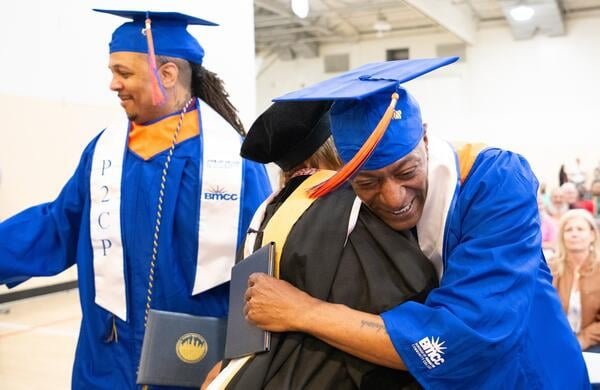
As a graduate of the program, Acevedo returned to Otisville in May for a commencement ceremony held inside the correctional facility—the first of its kind for both BMCC and the CUNY system, according to university leaders. He found the ceremony especially meaningful because it gave him the chance to watch two former classmates earn the same degree they had begun pursuing together.
“My nervousness was in fear of returning to a place where so many negative things had happened,” Acevedo said. “But I wanted to go and show them that I’m not only killing it, but that these men are going to kill it as well.”
Confidence through college: The Prison-to-College Pathways Pipeline launched in 2011 at CUNY’s John Jay College of Criminal Justice in New York City, with programming offered at Otisville. Borough of Manhattan Community College later expanded the initiative by offering an associate degree program in liberal arts beginning in fall 2024.
The first two students completed their degrees in spring 2025, followed by four more graduates in this spring. All six were recognized during the commencement ceremony held at Otisville in May.

CUNY’s Prison-to-College Pathways Pipeline launched in 2011, and BMCC expanded the initiative in 2024 by offering an associate degree program at Otisville Correctional Facility.
Louis Chan/Borough of Manhattan Community College
Michelle Ronda, professor and chair of the criminal justice department at BMCC, said that for many students, the biggest hurdle isn’t academics—it’s believing they belong in a college classroom.
“It’s such a courageous move to decide, ‘I’m going to enter a college classroom,’ because some of them have never touched a computer, some of them have very shaky confidence in terms of being able to write, some of them are terrified about mathematics and they’re going to have to challenge themselves with all of these things,” Ronda said. “It’s a real threat to your sense of self, and it’s incredibly brave, in my view, for them to come in and admit this in front of their peers and ask for help.”
Acevedo embodied that transformation, Ronda said. Now an assistant in BMCC’s criminal justice department, he returned to Otisville to speak at the commencement ceremony, reflecting on how he hadn’t taken his education seriously before his incarceration—a stark contrast to the student and leader Ronda said she has come to know.
“It was the kind of commencement speech that left everyone speechless,” Ronda said. “He’s made such an impression on me, and that speech really drove it home because it was so articulate and so reflective and so intellectual and heartwarming at the same time.”
Carla Barrett, academic director for the Prison-to-College Pathways Pipeline at John Jay, said faculty members who teach at Otisville become volunteers with the New York State Department of Corrections and Community Supervision and teach weekly classes using preapproved materials, often with few digital tools.
“There isn’t a lot of technology they have access to, so in many ways, they’re coming to college in a very old-school way,” Barrett said. “But they just take it on and they persevere through any of these kinds of obstacles.”

BMCC president Anthony Munroe (left) presents a graduate with a diploma during the commencement ceremony.
Louis Chan/Borough of Manhattan Community College
Beyond those logistical barriers, Barrett said, many students enter the program unsure of their own academic abilities after years away from the classroom.
“A number of them have really negative educational experiences. They believe that they were either stupid or feel like, ‘I can’t do this, I can’t do that,’” she said. “We work against a lot of those negative narratives in our classes with them, and you start to see them realize, ‘Oh, actually, I am good at math if I have the right teacher,’ and they start to develop a sense of self.”
A second chance: Barrett said one of the program’s biggest lessons is that its impact extends beyond the students it serves.
“This is not a one-way street,” Barrett said. “We do all these things for our students inside and they give us so much that we take back into the community, and that’s something that’s really hard to account for.”
For Acevedo, the program didn’t end when he earned his associate degree. Today, he mentors other justice-impacted students through Project Impact, BMCC’s student success program for those involved with the criminal legal system. He hopes to show them that higher education can open doors they may never have imagined.
“Education has been the common thread that just keeps me grounded,” Acevedo said. “I encourage it for those that want to pursue it.”
Get more content like this directly to your inbox. Subscribe here.
You may be interested

Character.AI wants a piece of the microdrama pie
new admin - Jul 09, 2026Character.AI’s plan to become more than just an LLM-powered chatbot platform is going beyond interactive books, comics, and audio dramas.…

Nolan Wells’ family searches for answers in death of Mississippi teen
new admin - Jul 09, 2026Nolan Wells' family searches for answers in death of Mississippi teen - CBS News Watch CBS News The family of…

‘I thought it was 2024’
new admin - Jul 09, 2026[ad_1] Veteran journalist Katie Couric revealed that she had a bout of transient global amnesia, a rare but temporary condition…