




AI Scribes in Medicine Are Short-Circuiting Thinking

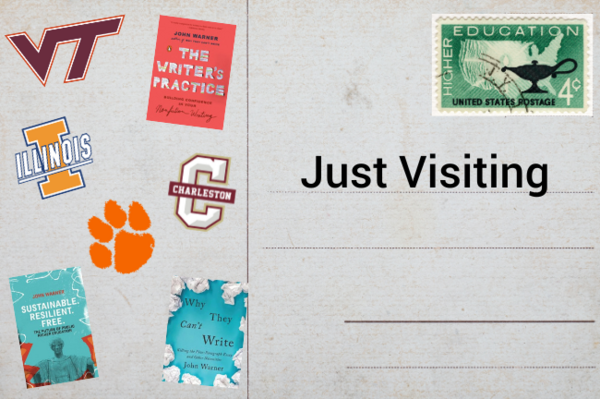
As I have now argued in three books and countless columns and articles, I believe that we should view our work as writers through the lens of a practice: the skills, knowledge, attitudes and habits of mind of a practitioner.
Gathered together, and working in interrelated ways, it is these elements of a practice that allow us to complete the labor of writing, generating written artifacts that satisfy the requirements of a rhetorical situation involving an audience attached to a need for the writing.
One of the hardest aspects about teaching writing is that one of the key elements of a writer’s practice—habits of mind—is almost impossible to assess from the outside.
Two students can turn in nearly identical artifacts, but it’s entirely possible that only one of them is developing the habits of mind that lead to continued growth. If one student is following prescribed templates and, essentially, filling in the blanks, while another is discovering the moves necessary to meet the occasion through close study and consideration of the rhetorical situation, it is only the latter who is developing a powerful and adaptable writing practice.
Habits of mind are how we do our thinking as we plan, research, draft, revise, edit and polish our writing. In order to assess progress in these areas, I asked students to reflect on their practices after each completed assignment, using two questions: 1. What do you know now that you didn’t know before? And 2. What can you do now that you couldn’t do before?
The goal is to make these habits of mind more visible to the students themselves, so they have a better meta-awareness of their own practices. One of the additional challenges regarding the building of a practice is that, over time, if one’s habits of mind are developing well, they become increasingly invisible to the practitioner even when being put to use, a.k.a. a habit.
In faculty development workshops, I often ask these experts to reflect on and unpack the different elements of the practice and then explore when and how they learned these things and to consider whether or not what they were asking students to do and how students were doing these things was helping them develop their practices.
As I also often say in these books and articles, it’s not only writers who have a practice. Essentially any activity or profession that requires a combination of these elements can be viewed through the lens of a practice. In Why They Can’t Write: Killing the Five-Paragraph Essay and Other Necessities, I analogize writers to chefs and find significant overlaps in their practices. Doctors have practices, lawyers have practices, musicians, teachers, woodworkers, personal assistants, researchers, nurses, therapists, engineers, all have practices consisting of skills, knowledge, attitudes and habits of mind.
I believe it is this arena of habits of mind that is perhaps the separator between different levels of expertise within an area of practice—and not coincidentally the most important vehicle for developing one’s habits of mind is experience. The more you do, the more you know, and the more what you know can be deployed to shape your habits of mind.
My journey as a writer is solid evidence of this, but even that journey pales in comparison to teaching, where I truly went from one of the world’s least competent composition instructors to someone who is now considered, by some, as an authority on these issues. Yes, I read and studied and thought, but mostly I did it, working the problem of teaching students how to write over many years, building my experience and, in turn, my expertise.
Introducing automation into a practice inevitably alters the practitioner’s habits of mind and changes the experience. Some believe that the potential for “cognitive offloading” that LLM automation may enable could be a benefit to humans, freeing them up to do the “important” work.
I am a skeptic on this front, or at least a skeptic that we will know what the “important” work is without a lot of trial and error and deep consideration of what we mean by this word “important.”
One area where this is becoming increasingly clear is the practice of medicine, as illustrated by a long and thoughtful piece by Helen Ouyang, a professor and doctor of emergency medicine, published at The New York Times Magazine.
Ouyang examines the practice of medicine through the evolution of the doctor’s clinical notes (or “charts”), the summaries they write reflecting the conversations with patients and their working through of additional diagnostics on their way to a treatment plan.
Ouyang traces the origin of the chart to the 19th-century rise of hospitals where the clinician’s notes became part of the medical record. In the 1960s, the structure of the note was formalized by Lawrence Reed at Case Western Reserve University, who codified the SOAP plan. S is “subjective,” what the patient reports. O is “objective,” what is observed or measured by the physician. A and P are “assessment” and “plan,” the conclusion drawn from the subjective and objective data and then the next steps forward.
AI scribes that will record and then summarize the interactions between doctor and patient are one of the earliest generative AI applications to see relatively widespread adoptions. I wrote about them in my book More Than Words (first published in 2025), meaning they would’ve been sufficiently in use to garner public notice in 2024.
The desire for this kind of offloading to automation is obvious and understandable: Charting is hugely time-consuming, seems to be a piece of bureaucratic business that could be outsourced, and any time spent dictating or typing a note is time not spent with patients. Automation could, in theory, free up time for the more meaningful work.
Ouyang was hardly concerned by the potential shift to AI scribes, seeing them “as the natural next step in this long evolution of the medical record.” The doctor’s role “seemed simple: read the [AI] draft, correct what was wrong, sign it. So fast, so easy.”
But she says this process “began to discomfit me” as she realized that she had eliminated an opportunity to think through her patient’s situation, no longer sorting through the material for meaning, but instead, checking something that “had already been made for me.”
What she discovered was music to my ears, as someone who has been beating this drum for, well, quite some time: Writing is thinking. Ouyang says, “Over time, though, I have come to see how much of my own thinking had been bound up with the writing process itself.”
She goes on to note how the presence of the AI scribe alters other aspects of the doctor’s job, including how they interact with patients. Her individual practice had been disrupted. The broader practice of medicine is being reordered, all without what seems to be the necessary consideration of what these changes may mean to doctors, patients and hospitals.
Efficiency has been privileged over everything else, but efficiency alone is not a measurement of quality, certainly not in education, nor in health care.
Ben Gooch, a general practice doctor in the U.K., experienced a similar phenomenon with AI scribes, remarking on a follow-up visit with a previously seen patient, “I sat down to review a patient I had seen six weeks previously. I read the note. It was accurate. It was comprehensive. It contained no factual errors that I could identify. And I did not recognize it.” Gooch recognized that in the name of speed he’d lost contact with that which was most meaningful to his practice—his knowledge of his patients, captured through interaction and the reflective practice of writing a clinical note.
The good news is that these are two thoughtful professionals who had the wherewithal to recognize the way that their practices had been distorted in ways that threatened to marginalize their expertise as part of the overall process.
What happens when student doctors (or lawyers, or teachers, or what have you) have never learned the habits of mind that underpin the expertise tied to these practices? Ouyang reports that third-year medical students at Johns Hopkins will no longer be writing notes during their shifts, instead relying on AI scribes.
It’s possible that AI scribes can be integrated into a practice that still values that reflective thinking that Ouyang and Gooch see as central to their work, but these investigations don’t seem to be happening.
Maybe AI is the future of work, but if that future is going to deliberately sideline the most important cognitive contributions of humans, what are we doing here?
You may be interested

CCSU President Exits Abruptly Amid Investigation
new admin - Sep 24, 2026[ad_1] Toro was accused of bullying, intimidation and asking staff members to handle personal errands. Central Connecticut State University Central…
Trump is using summit to improve his relationship with Xi, former White House Asia adviser says
new admin - Sep 24, 2026Trump is using summit to improve his relationship with Xi, former White House Asia adviser says - CBS News Watch…

Dartmouth’s provost has stopped “writing.”
new admin - Sep 24, 2026[ad_1] Dartmouth College provost Santiago Schnell no longer appears to write his opinion pieces and academic articles. This news is…