
AACC’s President on the Future of Community Colleges

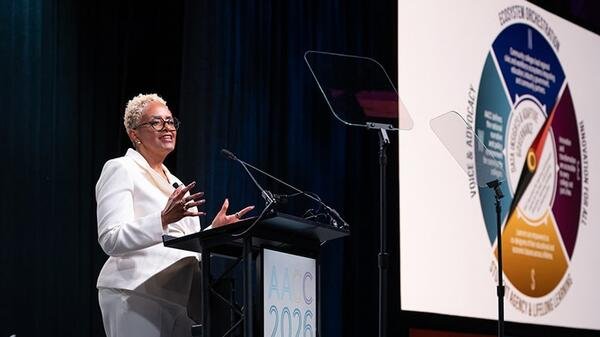
DeRionne Pollard is on a mission to raise the profile of community colleges.
The new president and CEO of the American Association of Community Colleges believes they’re key to the country’s innovation and national security, in part because they enjoy increasingly rare bipartisan support, but their outsize role too often goes overlooked.
“When you serve everyone, you’re noticed by no one,” she said. That’s why “we have to be very deliberate about how we are amplifying and telling our own story.”
Pollard served as president at three institutions—Nevada State University, Montgomery College and Las Positas College—before taking the helm at AACC, a leading advocacy organization for community colleges, last October. She spoke with Inside Higher Ed about her hopes and goals for two-year institutions in the years to come and the challenges facing the sector. The conversation has been edited for length and clarity.
Q: You’ve held multiple higher education presidencies. Now you’re heading up the AACC. What motivated you to make that transition?
A: I think there are probably three main reasons. The first is my own personal story. My earliest memory is standing in a childcare center at Kennedy King College in Chicago, and I’m probably two and a half, 3 years old, and I’m clapping cymbals and standing there thinking this is the best thing since sliced bread. And the fact that I remember that so clearly tells me about how potent that experience was. My mother was taking classes at Kennedy King College, and I was there during the day a couple times while she was taking classes, and it was phenomenal. I remember what that meant. To this day, when I’m at home in Chicago and I go past Kennedy King College, that’s my college, because I was there as a 3-year-old.
A few years later, my mother passed when I was 4, and I then went to live with my aunt, and she was taking classes to run an in-home childcare center, and she ended up doing that at Prairie State College. So, it’s not lost on me the fact that some of my earliest memories, my sister and I would sit in the hallways, and we would look through the door … We were early college navigators. We would run and tell people where the bathroom was, we’d run and get people soda—that was just a part of our lived experience. So, for me, this potent message about what America’s community colleges are starts with me first.
Secondly, I think this moment dictates that access-based institutions are tremendously needed right now. And while many folks are debating the value proposition of higher education writ large, they’re not debating the value of community colleges. For me, to be a part of this is a part of my own beliefs about service and about helping people be better.
And then finally, I grew up in AACC. It’s one of the first places I was called a leader, and I got to see what it meant to be a part of a network of institutions that were ensuring that 10 million undergraduates in this country have access to higher education and that were in communities doing powerful work. So, when the position became available, I had some friends and colleagues reach out and say, “This is your job. You need to go and do it.” I did, and the rest is history.
Q: What are some of your priorities for the organization going forward, and how do you see AACC’s role in the community college landscape?
A: Our job as a membership organization is to really amplify our role as a catalyst, a convener and then certainly as a community builder. Our job as a convener is to have intentional gatherings where we help our members connect with each other, understand the ecosystem of which they are a part [and] help share with them opportunities for a richer and more intentional work around their mission.
Then I think about catalysts. We’re also there to help drive innovation, to help fill a need. And that could be how we help respond to legislators who are wanting to understand more deeply the work that we do. It could also be about other decision-makers who are saying, “We want to help drive industry in this way. Can you be a part of that with us as we watch what’s happening with AI?” I personally think community colleges stand at the forefront of being a part of our national security for the nation. If we want to have a talented workforce, that’s going to [involve] doing the manufacturing and all of the things that we do so well. It’s going to be incumbent upon our institutions to be at the forefront of that type of work.
Community colleges are potentially the most underleveraged civic machine that we have in this country. Every community has a community college, and if we really want to be having deliberate conversations around civic engagement, community mobilization, around economic and workforce development, the nation’s community colleges are there. So, for me, if I can elevate best practices, if I can advocate for the institutions, if I can tell a compelling story about what we do and if I can help build richer and deeper networks for them as they are doing the work of the nation, then I think I will have done my job fairly well.
Q: What do you think are the biggest challenges facing community colleges right now?
A: We do really amazing work, and we do it in ways that are oftentimes misunderstood and not valued. There is a general public misunderstanding of what community colleges do and who we serve. So, I think in large parts we’ve been taken for granted as a sector. When you serve everyone, you’re noticed by no one. We have to be very deliberate about how we are amplifying and telling our own story.
I think, secondly, we’re oftentimes penalized for affordability. Lower tuition is mistaken oftentimes as lower value, and one of the things that we have to work very thoughtfully [through] is how do we not allow a discount bias, as I like to call it. Poverty is the No. 1 barrier to college completion—not potential, not promise. How do we make sure that we keep affordability at the forefront but also [ensure] that doesn’t work against us as a sector?
Third, we’ve allowed other people to define what innovation is. There are some media sources that will put out [lists of] the most innovative institutions. U.S. News & World Report just put out its most innovative colleges and universities. There’s not one community college on there. What we do at scale is unmatched and therefore is taken for granted, and as a result of that, it’s not seen as innovative because it’s just what we do. [But community colleges are] helping whole communities turn themselves around when major employers leave or major employers come in. When there’s a community problem that has to be solved, it is always community colleges at the table to do that. When new populations emerge in communities and they need access to higher education, it is the community colleges there to do that. So, how we define innovative needs to be challenged.
You add on top of that enrollment volatility, contracting resources at the local, state and federal level. You have this conversation that folks want to hold us accountable, and yet they aren’t always very clear about what are the implications around certain accountability measures and what that should look like. So, I think those are some of the challenges, but I’ll also tell you that there’s nothing that we can’t solve or work through, because that’s just who we are and how we work.
Q: What do you think are the biggest opportunities for community colleges right now?
A: Right now, we’re really uniquely positioned in this space between workforce and education. I think there’s tremendous opportunity there. When you look at what’s happening with Workforce Pell, the growing need for short-term credentials, deepening our work with employers … We know we have our fingers on the pulse. And I think some other sectors are trying to step into that space.
Technology and innovation is going to be something that we need to rethink: how we deliver our education, making it more flexible, making it more accessible. And I think we also have to reimagine some of the systems around how we define student success. Our students’ lives are very complex. We have to design systems for today’s learners. We have to look at models that understand that they learn and process differently.
I have a 19-year-old, [and] when I have conversations with him, I understand that the way he sees the world is very different than I do at 55 years old. And interestingly enough, our campuses serve the 19-year-old and the 55-year-old. We serve the returning veteran and the working mother. We serve the foster child who was recently emancipated, as well as the senior who has been dislocated or the one who’s saying, “Hey, I’m going to France for a month, and I want to learn French.” We serve all of those folks in our institutions.
Q: You’ve taken this role at a tumultuous time for higher education. But I think a lot of the conversations we have about how this political moment is affecting higher ed often center around four-year institutions. How do you see this moment affecting community colleges, and what policy issues are top of mind for you?
A: We’re seeing this kind of exponentiating impact, because our institutions certainly have to respond to a federal landscape that’s changing. But most community colleges, while they get their financial aid dollars from the feds and so forth, their main source of funding oftentimes is either local or state … We are depending upon them for both regulatory and financial support. Workforce Pell is a great example of that, because in order for the feds to approve certain programming for funding, a state has to have the infrastructure to approve that programming.
But while trust in higher education is eroding, I will say that’s not the case for the nation’s community and technical colleges. People know what we do and how we do it. We’re already in the community. So, when I go up on [Capitol] Hill and when I go across the nation, inevitably folks are saying, “Yeah, we have some concerns about what’s happening in higher ed,” but they don’t have concerns about what’s happening in the nation’s community colleges. Red or blue and everything in between, we know how to adapt our message thoughtfully to what they are saying.
Right now, there’s a lot of focus on regulatory and accountability environments. We want to make sure that doesn’t limit innovation. We’re very happy to be held accountable for what we do, but we also don’t want the bureaucracy to become so robust that it takes away from what we do.
I think for us as a sector, we remain cautiously optimistic because we think our mission supersedes this moment, and that’s one of the things that allows us to navigate these waters a little bit more deliberately than some of other sectors can. We are the nation’s workhorse. Forty percent of all undergraduates in this country attend a community college. The nation needs us to be successful, and they know that, whether it is when we’re teaching people [for their] GED, we’re going into jails and serving the incarcerated, whether it is helping people learn English language, whether it’s helping them become stronger citizens and preparing them for the workforce and transfer. Every time this nation has challenges, there’s always the nation’s community colleges that have been there to help bolster us and help heal, which is what I think will happen now.
Q: Accountability has come up a couple times. What do you think it takes to make accountability measures effective for community colleges?
A: We all have to agree on what accountability actually means. Let’s start with that. What are we trying to hold people accountable for? Is the assumption that people are not being accountable now? Why or why not? What’s the evidence for that? And then how [do] you design a system, then, that responds to those concerns?
A lot of folks right now don’t know who we serve, how we serve them, the things that we already do. So, part of what we have to do is to articulate a more compelling story about that, but secondly, acknowledge where there are areas for improvement. Right now, you see [community colleges increasingly] talking about postcompletion outcomes. That is a direct result of the fact that we moved from focusing just on access to success and now on outcomes and postcompletion. We’ve owned that as a field, and we recognize this is where we’re going.
And then, at the most basic level, is the practical tools, then, to be able to do that. [We need] the systems and the tools that are necessary to actually produce relevant data and moving beyond data. My folks have heard me say I’m beyond data. I want to get to intelligence. We are awash with data. If I get one more thing about a different dataset here, or a data warehouse here … the problem is that we don’t know how to make intelligence of it, because it’s too much. We’ve got to be able to distill that, use good tools that can help us do that and then create visuals and stories that allow us to gain meaning from it. That’s where I think the accountability question can be answered.
Q: Looking into the future, how do you want to see community colleges grow and evolve? And what do you think it would take to get them there?
A: We have to own our space around being essential [to] national security. As a nation, if we want to build a workforce that can sustain manufacturing, innovation around technology, making us builders again as a nation, it is going to be us as a sector that’s going to do that. When you think about health, about safety, about peace—all of those things are national security issues. And having a robust talent pipeline that ensures that people are not left behind and that they have lifelong learning as a part of their career plan … My 19-year-old son will constantly have to be learning in order to move into the future. And as a nation, we’re going to have to have a fundamental reset around how we think about what that educational journey is from young adult through a retirement age.
We also have to continue to challenge ourselves around our traditional orthodoxies around what it means to be a higher education institution, thinking that we’re flexible, that we’re student-centered, that we’re teaching to the students we have now—not the ones we used to have [or] the ones we wish we had, but the ones that we have right now. Our business practices have to be realigned to really look at what it means [to thrive] in a space where resources are going to be shrinking, where you have the demographic shifts that are happening.
And one of my personal ones is really around leadership, what it takes to lead organizations. I don’t know if we have done a good enough job to help prepare people to step into these spaces to do this type of work now. This is a question of character now. This is a question of understanding what your role is as a leader. And we’re seeing more and more people tap out. We’re seeing people flame out. I had a vice president say to me, “I don’t want to be a president. Who’s the fool here? Who wants to do this work right now?” If we want to have strong organizations that live up to the mission that we were called to by the Truman Commission in 1947, we need people who are prepared to do the work, and so that’s one of my personal commitments now that I’m going to spend a lot of time on.
You may be interested

Telegram chats used by men to share rape videos and drugging tips, German prosecutors say
new admin - Jul 08, 2026They called themselves the "German driving school for experts," but prosecutors say the true purpose of their Telegram chats was…

Oil surges 6%, stocks tumble after Trump says Iran ceasefire is ‘over’
new admin - Jul 08, 2026[ad_1] The price of oil surged more than 6% on Wednesday after President Donald Trump said that the ceasefire deal…
What’s on Trump’s Higher Ed Regulatory To-Do List
new admin - Jul 08, 2026[ad_1] The Education Department released its latest regulatory agenda Friday. J. David Ake/Contributor/Getty Images News/Getty Images After a year of…