

Full transcript of “Face the Nation with Margaret Brennan,” July 5, 2026

On this “Face the Nation with Margaret Brennan” broadcast, moderated by Ed O’Keefe:
- Reps. Adriano Espaillat, Democrat of New York, and Carlos Gimenez, Republican of Florida
- NASA administrator Jared Isaacman
- NCAA President Charlie Baker
- Former CDC chief medical officer Dr. Debra Houry
Click here to browse full transcripts from 2026 of “Face the Nation with Margaret Brennan.”
ED O’KEEFE: I’m Ed O’Keefe in Washington.
And this week on Face the Nation: As America celebrates its 250th birthday, we will try to put politics aside and focus on some of the things that make this nation so unique.
Despite record-breaking temperatures sweeping across much of the country, Americans came out over the weekend to honor 250 years of independence. Fireworks, parades, flyovers, and red, white, and blue were all on display as we saluted a country that, despite being one of the younger nations of the world, has one of the longest continuing governments.
(Begin VT)
DONALD TRUMP (President of the United States): There is no place we cannot go, there is no goal we cannot reach, and there is nothing that Americans cannot do. And we’re proving that right now.
(End VT)
ED O’KEEFE: We will take a look at one thing that is proving difficult to fix, immigration. Two members of Congress who immigrated here and became U.S. citizens, Florida Republican Carlos Gimenez and New York Democrat Adriano Espaillat, tell us their stories and why immigrants are so important to America’s future.
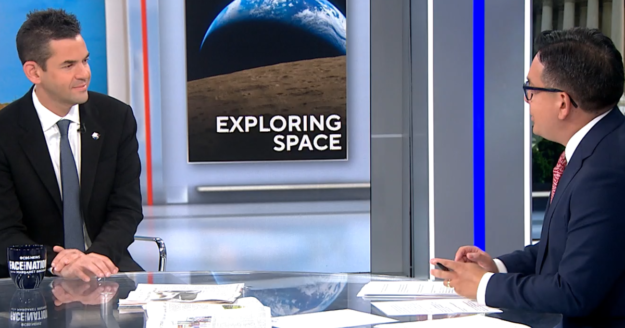
Plus: space. As America reboots its quest to lead the world in space exploration, we will reflect on our history and take a look at what’s ahead with NASA Administrator Jared Isaacman.
And sports. Americans are driven by competition and winning. And few things unite us as much as the love of the game. We will talk about changes in college sports, the proving ground for young American athletes, with the head of the NCAA, former Massachusetts Governor Charlie Baker.
All this and more just ahead on Face the Nation.
Good morning, and welcome to Face the Nation. Margaret is off. I’m Ed O’Keefe.
Neither rain nor lightning nor 100-degree-plus heat could shut down the festivities in the nation’s capital Saturday night, but all three forces combined prompted officials to evacuate thousands from the National Mall for hours until the worst of the bad weather had passed.
(Begin VT)
(SINGING)
(End VT)
ED O’KEEFE: Crowds took shelter in nearby museums and government agency buildings, but they returned to watch President Trump’s speech and what was considered the world’s largest fireworks display ever, which lasted until well after midnight.
As we reflect on what makes America such a powerful force…
(Begin VT)
WOMAN: I hereby declare on oath…
(End VT)
ED O’KEEFE: … we’re reminded that we’re a nation built by immigrants. So why is it so hard to fix our immigration system?
Well, late last week, we spoke with two members of Congress who both came to the U.S. as young children. Here’s our conversation with Florida Republican Carlos Gimenez and New York Democrat Adriano Espaillat.
(Begin VT)
ED O’KEEFE: Congressman Gimenez, you were almost 7 years old when your family fled from Cuba at the start of the Castro regime. What do you remember about those early days in Florida?
REPRESENTATIVE CARLOS GIMENEZ (R-Florida): Well, I remember that we all went to one house. My uncle, my aunt were kind enough to take us in. There were about 21 people in that house.
And I remember vividly my first day going to school. The day before I went to – they took me to a parochial school, and then the nuns saying that tomorrow was my first day of school. That was my first word in English. Until then, I only spoke Spanish.
And so, that, I vividly remember. And then the early days there, it’s like it’s like a blur, obviously, but, yes, it was completely different than my experiences had been in Cuba.
ED O’KEEFE: And, Congressman Espaillat, as I understand it, you were about 9 when you came to the United States for the Dominican Republic. I imagine New York City was a bit different back then.
REPRESENTATIVE ADRIANO ESPAILLAT (D-New York): Of course. The weather was cold, obviously. I remember the cold weather. We lived with our grandparents, who had a 4.5-room bedroom apartment in Washington Heights.
And we got there in December. And, of course, we went to school. Remember sitting in the back of the classroom and – for a year or more, not knowing really a word of English. But, surely and slowly, we acclimated, and here we are.
ED O’KEEFE: Do either of you remember your parents ever explaining why they wanted to become Americans?
REPRESENTATIVE ADRIANO ESPAILLAT: My grandmother was the first one to become a U.S. citizen, and she was so proud of it. And I remembered it that she spoke about it, about how great this nation is and how it gave us a new opportunity of moving forward.
But she was really proud of becoming an American citizen. And I think it translated then back down to all of us. So…
REPRESENTATIVE CARLOS GIMENEZ: My parents were seeking freedom, not only for themselves, but for us, his children, my sister and I, to give us the opportunity to live in a land of freedom.
I recall one day I asked him: “Hey, why is it that we came to the United States a little bit older?”
And he and he told me a story about how I had come home and I’d asked him a question, and, to him, it felt like we were being indoctrinated into communism. And he decided right then and there that we had to leave.
ED O’KEEFE: Both of you represent areas where there are many people under Temporary Protected Status, but the Supreme Court in recent days ruled that about 356,000 or so people from Haiti and Syria are going to lose their TPS.
And then that decision, of course, follows the Trump administration’s decision to cancel their temporary legal protection. This issue is perhaps most acute in South Florida, given the Haitian community, Congressman Gimenez.
I’m curious, what should the secretary do, what should the administration do now with these hundreds of thousands of people?
REPRESENTATIVE CARLOS GIMENEZ: In the case of Haiti, without a doubt, Haiti is a failed state, and I think that deporting Haitians that are under TPS right now back to Haiti would be a huge mistake.
I mean, that’s the reason why TPS was established to begin with, just like with Venezuelans. If Venezuelans lose their TPS status, which they have too, we should reinstate that because of the devastation caused by these earthquakes that happened last week.
And so TPS should be – should not be abused. TPS is what it says, Temporary Protected Status. And if you’re here for a number of years, you should change your status from TPS to something else. But, by the same token, it is meant to safeguard those that are fleeing countries which are either failed states and there would be at risk of going back to them, or countries that really can’t handle them right now, as the case of Venezuela.
ED O’KEEFE: What might be the easiest, fastest bipartisan fix Congress could make to deal with immigration?
REPRESENTATIVE ADRIANO ESPAILLAT: I believe very strongly that it should be bipartisan.
And, of course, there are three particular items that I think are easy to fix. Dreamers is one of them. These are young people that came here when they were 1, 2 years old. Many of them don’t speak the language of their homeland or have no connections whatsoever with the country where they were born.
Yet they’re Americans but for one thing, their green card. It’s a fixed number of them. I think most people agree that they should be let in. They should be allowed to stay here. So, regularizing them is one.
Farmworkers, who – many of whom are not going to the fields to work because they’re afraid they’re going to be arrested and deported, we need them. And then keeping families together is important, because a family that’s divided, that’s fractured is a weak family, and many weak families make up a weak nation.
ED O’KEEFE: Congressman Gimenez, any of those on your list?
REPRESENTATIVE CARLOS GIMENEZ: Look, I agree with a lot of what the congressman has said.
The problem in immigration got exacerbated because we – the open borders that we had during the Biden years, and you had millions and millions of people coming into the United States, and it really drove the issue of immigration home.
And I thought we were getting closer to some kind of a solution until that happened. The borders are now closed. And I have always said that, once you – once you secure the borders, then we can have an honest debate about the people that are here, the immigrants that are here, those that are undocumented.
And I think that we can reach a solution. And those that have been here for years that have been working, are part of the community, that are part of the economy, we need to find a way to normalize them.
Doesn’t necessarily mean that they’re going to be citizens at the end of the day, but to normalize them, so they can come out of the shadows, pay taxes, and then live their life without having fear of somebody coming up and taking them away after 20-something years and separating from their children that they have had during that time.
And so we have to find a solution. I think that the solution could be bipartisan, but it also seems, when the Democrats were in control, it wasn’t – it didn’t happen. When we were in control, it didn’t happen. It’s got to happen.
ED O’KEEFE: What is your message to someone, perhaps Congressman Gimenez, that is on the outside looking in, who might want to become – who might want to come to the United States and build a better life? What would be your message to them?
REPRESENTATIVE CARLOS GIMENEZ: My message is to do it the right way. And then you will be welcomed with open arms.
There’s a lot of skills that we need here still in the United States, even though we want to make sure that Americans get those jobs, but, sometimes, you do need skills from outside. And, by the way, it’s not a bad thing to get new ideas, new perspectives coming into the United States from all around the world, because that’s what makes America the greatest country in the world.
ED O’KEEFE: And Congressman Espaillat?
REPRESENTATIVE ADRIANO ESPAILLAT: This nation, as we celebrate the 250th anniversary, still has promise. And I think immigration has been a central part of our ability to move forward as a nation.
So, I ask those that want to come to our nation that this – bring your ideas. Bring your innovativeness. Bring your talent. Bring your energy, the energy that has displayed itself throughout decades and throughout our history.
There’s been no period in American history that has not been pushed by immigration forward. Even in our most difficult times, it is the influx of new ideas and new energy that makes our country different. And, of course, this is a great experiment, and everybody wants to come to America.
Do it the right way. There are channels through which you can do it. We will continue to welcome people from all over the world. This is a nation that still has a lot to offer, is still relatively a very young nation, and one that I think has a lot of promise towards the future.
I’m happy that my parents, my grandparents, who were both factory workers, brought us here to America. What a great promise. What a great nation.
(End VT)
ED O’KEEFE: Face the Nation will be back in one minute with a look at a bright part of our past and our future, space.
Stay with us.
(ANNOUNCEMENTS)
ED O’KEEFE: One of the most unifying events so far this year was April’s successful launch of Artemis II, a mission that had many of us mesmerized for days, and introduced a new generation of Americans to one of the bright spots when it comes to American ingenuity.
Here’s senior national correspondent Mark Strassmann.
(Begin VT)
VICTOR GLOVER (Artemis II Pilot, NASA): We just went sci-fi. This has – it just looks unreal.
MARK STRASSMANN (voice-over): America’s pioneering spirit, undeniable, unrelenting, it fueled Artemis II’s moonshot back in April. It has defined our country for 250 years, from sailing ship to spaceship.
What have you been most struck by?
VICTOR GLOVER: We have seen and felt things that we have never felt before.
MARK STRASSMANN: We felt it with Alan Shepard, the first American in space, John Glenn, the first American in orbit…
JOHN GLENN (Former NASA Astronaut): Oh, that view is tremendous.
MARK STRASSMANN: … and throughout NASA’s early programs, Mercury, Gemini, Apollo.
JOHN F. KENNEDY (Former President of the United States: We choose to go to the moon in this decade and do the other things not because they are easy, but because they are hard.
MARK STRASSMANN: Earth stood still and felt it in 1969 Watching in awe two Americans become history’s first moonwalkers.
MAN #1: Engine stop.
MAN #2: We copy you down, Eagle.
WALTER CRONKITE (Former CBS News Anchor): Whew. Boy.
NEIL ARMSTRONG (Former NASA Astronaut): OK. We’re going to be busy for a minute. Tranquility Base here. The Eagle has landed.
MAN #2: Roger, Tranquility. We copy you on the ground. You got a bunch of guys about to turn blue.
NEIL ARMSTRONG: That’s one small step for man, one giant leap for mankind.
MARK STRASSMANN: Retired astronaut Charlie Duke was the voice in Houston’s mission control talking to Apollo 11’s crew.
CHARLIE DUKE (Former NASA Astronaut): It really, to me, brought the U.S. together and was very significant.
MARK STRASSMANN: Especially given the turmoil of that decade.
CHARLIE DUKE: Yes, right.
MAN #3: Launch of America’s first space shuttle.
MARK STRASSMANN: Over the decades, America invited along international partners to help explore the cosmos, from the space shuttle to the International Space Station, from Hubble and other universe-probing satellites to robotic explorers on Mars, along the way, moments when the human cost was unthinkable, Challenger in 1986…
MAN #4: Obviously, a major malfunction.
MARK STRASSMANN: … Columbia in 2003, moments that paused our space exploration, but did not stop it.
WOMAN: Ignition. Liftoff.
MARK STRASSMANN: In today’s commercial era of space, companies often lead the way, rather than countries, SpaceX, Blue Origin, Boeing.
And after a nine-year gap, we’re again launching American astronauts from U.S. soil.
Former NASA Administrator Jim Bridenstine back in 2018:
Some of this is American pride.
JIM BRIDENSTINE (Former NASA Administrator): Prestige. I like – I like to use the word prestige. Great nations should be able to launch their own astronauts into space.
MAN #5: Booster ignition.
MARK STRASSMANN: Launching them to the moon and back.
MAN #6: Now bound for the moon.
MARK STRASSMANN: Yes, space is hard, but America’s space story would feel familiar to her original settlers, determination leading to discovery.
REID WISEMAN (Artemis II Crew Member): It is absolutely spectacular, surreal. There’s – I know of – there’s no adjective. I’m going to need to invent some new ones to describe what we are looking at out this window.
(End VT)
ED O’KEEFE: Our Mark Strassmann reporting, thanks to him for that.
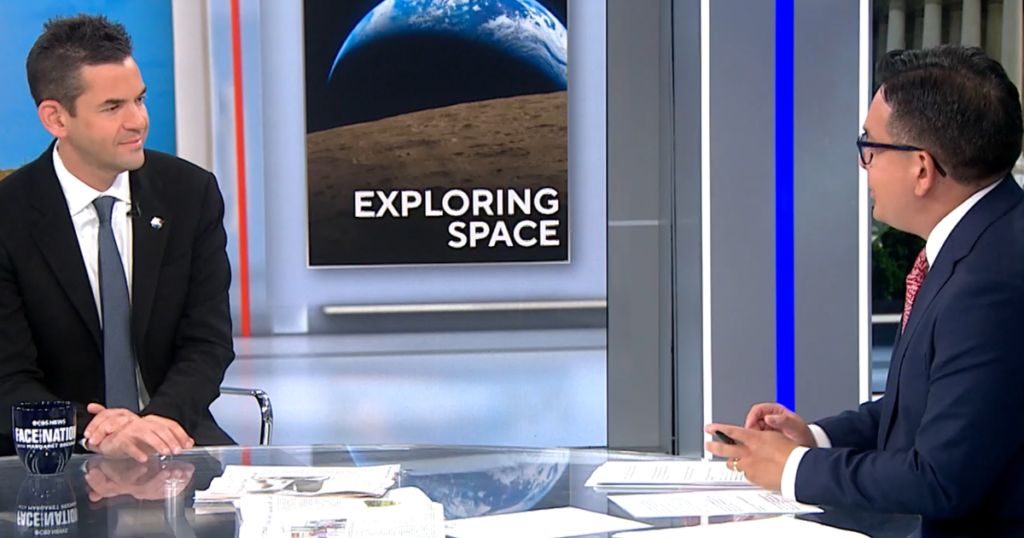
We turn now to NASA Administrator Jared Isaacman, who’s back on the ground after his Fourth of July flyover. Yes, he was one of those piloting one of those jets right there.
I think you’re going to stand in Face the Nation history as the first to ever pilot a flyover and then show up for the show. So, we appreciate it. Thanks for being here.
JARED ISAACMAN (NASA Administrator): I was grateful to participate in such a historic event, as was yesterday, and to be here today and talk about such an amazing subject.
ED O’KEEFE: Yes. And that’s part of why we wanted you here, because I think we’ve reflected on the last few months about how Artemis especially really seemed to bring the country and, to some extent, the world back together to – to focus on this common journey back into the great beyond.
Why, in your view, is it so important that America maintain a presence in space?
ADMINISTRATOR JARED ISAACMAN: Well, I have – I have been lucky to be in space twice and have that perspective and appreciation for just the scale of it all.
I mean, best way to describe it, like, we are understanding our progress on what I think is the greatest adventure in human history is literally just dipping your toe in the grandest ocean of all, I mean, just an appreciation. I mean, we are lucky. We are lucky that we’ve been gifted a moon that is just 4.5 days away as a proving ground to continue to venture out.
And we’ve just begun it all, I mean, all that we stand to learn from a scientific perspective, economic potential. I will tell you, there will be a lunar economy someday. We’ll be mining asteroids at some point. So it’s – – it’s not just scientific. There’s economic. There is a massive inspirational component to it.
I mean, we talk about the world pausing and watching those Artemis II astronauts, right? But how many children were watching, your children, grandchildren, that were watching that now want to grow up and contribute to this great endeavor as engineers and scientists and astronauts?
I mean, certainly a price worth paying, but it is only, truly, just the beginning. We barely understand our solar – you know, what’s in our solar system, let alone all the other stars in the Milky Way galaxy or all the other galaxies out there.
ED O’KEEFE: I want to ask you about a few things facing NASA right now.
First off, in the last few days, you’ve launched a bit of a repair mission with private companies to work on what’s called the Swift telescope that tracks gamma rays and has been falling lower and lower, closer to the Earth’s atmosphere for years.
How is that mission progressing now about three days into it?
ADMINISTRATOR JARED ISAACMAN: Well, we’re still getting data from it. It is an extremely fascinating mission.
It is a rescue mission for a – for a scientific instrument that’s up there. So, you know, in the past, space was extremely expensive. You’d have to spend a very long time building your instruments, you know, lots of layers of redundancy, which just adds more cost and more delays.
And now we can take advantage of the healthiest commercial launch market in the history of America’s space program, lots of different providers that can do things inexpensively, and we can experiment. So, we have a telescope or scientific instrument that’s in some degree of distress right now.
And for a very low cost, we can experiment with industry to launch a mission to rendezvous with it, dock, boost it, and give it a new lease on life. Now, it’s very early in the mission. As you said, it’s only been a couple days. We’re still establishing comms with it, and it’s also very experimental.
So I wouldn’t have expected it to come out of the gate and be perfect, but we’ll learn more in the days ahead. And, if it works, this gives us options for Hubble and other scientific instruments.
ED O’KEEFE: And it’s about a $30 million price tag, which, for NASA, is affordable, or certainly lower cost than many of the other projects, right?
ADMINISTRATOR JARED ISAACMAN: Of course.
I mean, you think about something like now James Webb, it wouldn’t be applicable to – because it’s based out of the Lagrange point. But, I mean, that was an extremely expensive, multi-multi-billion-dollar, almost a multi-decade mission.
ED O’KEEFE: Right.
ADMINISTRATOR JARED ISAACMAN: Now, instead of replacing it with another multibillion-dollar mission, if you could launch something for $30 million to go up and enhance it, you know, give it a new lease on life, that’s – that’s money worth spending.
Now, again, you wouldn’t do it with James Webb, but this is a good example of a mission where you can test out the capability. And who knows the value it’ll have in years ahead.
ED O’KEEFE: In the last century, Russia was our biggest space competitor. In this one, arguably, it’s China. And you’ve warned repeatedly that we may now be in a race with them that measures not in years, but in months.
And so it’s against that warning I ask you a few questions now about Artemis III. You’re preparing to take off the next Artemis mission next year. You have had, however, some setbacks. Are you still confident it’s going to go off as scheduled?
ADMINISTRATOR JARED ISAACMAN: Well, I would just say, first, it’s not arguably. Like, there – we are very much in a space race right now, and the Chinese are moving at incredible speeds, and they are certainly capable of doing what the Soviets were not during the – the first space race.
The Chinese will land their taikonauts on the moon. There’s no question. The question is, will the United States return before them, and will we do so in a different way this time, when we build a base, establish that enduring presence?
I think the answer is yes. President Trump gave us the national space policy my first day on the job. He gave us a $10 billion plus-up investment, a historic investment, in the Working Family Tax Cut Act. That’s what allowed us to add the Artemis III mission next year.
So we are going back. It will be an unbelievable display. Last night’s fireworks show, unbelievable display. I’m telling you, in a very short span of time, on Artemis III, you’re going to see the three most powerful rockets in the world, NASA’s SLS, SpaceX’s Starship, Blue Origin’s New Glenn.
And then you’re going to have the landers come together in Earth orbit, test out their capabilities, very a la Apollo 9,give us the confidence in our landers for Artemis IV in 2028. This is an achievable plan to put astronauts back on the surface of the moon.
And, in parallel, we’re launching missions near constantly, on a near monthly cadence in 2027 to build the moon base, so we have that enduring presence, that proving ground for Mars.
ED O’KEEFE: So, you – the goal is to get Artemis IV to the moon by 2028. The Chinese are thinking about 2030. Any delay potentially puts us too close to their 2030 goal, right?
ADMINISTRATOR JARED ISAACMAN: Well, they said before 2030, I want to clarify.
ED O’KEEFE: OK.
ADMINISTRATOR JARED ISAACMAN: That’s why I say this is months, not years, right now.
ED O’KEEFE: Yes.
ADMINISTRATOR JARED ISAACMAN: They are thinking in 2029. We’re saying end of 2028 is when we’re targeting the landing. That is months, not years. But we have an achievable plan. We have a national space policy. We have bipartisan support from Congress.
We have the best and brightest from around the nation that did this before, and we’ll do it again.
ED O’KEEFE: One of the issues in getting ready for these next missions, of course, is what happened with Blue Origin’s New Glenn rocket a few months ago. It exploded at the end of May. The CEO has acknowledged they don’t know the cause yet. They’re still trying to figure it out, but they still hope to fly and be able to relaunch later this year.
Have you gotten any updates on what happened with that explosion, and is it important to know what happened for sure before they attempt any other launches?
ADMINISTRATOR JARED ISAACMAN: Well, NASA has been playing a role in – in this from the beginning.
So, we were – I was on site with a team the next morning after that – that setback. I was there with Jeff Bezos and their CEO, Dave Limp, on the matter. We’ve helped provide subject matter experts to Blue Origin. We’re helping with anomaly investigation on the rocket. We’re helping with pad rebuild.
Most importantly, we’re helping continue to move the lander along. We can’t slow down. There are – of course, they’re going to get their arms around the anomaly. They’ve honed in already on a potential engine issue. They’re going to solve that, right?
You go back to the late 1950s, early 1960s, you can see YouTube videos of NASA rockets having issues all the time. It’s how we learn. They – no one got hurt in this, so they’re going to learn. They’re going to fix their engine. They’re going to rebuild their pad. They’re going to get back to launching rockets. NASA’s there to help.
And, like I said, it’s the healthiest launch market in the history of America’s space program. We have lots of providers that can contribute. We got to keep the lander progressing and ensure we have the right outcome, which is a successful Artemis III mission, and then we land on Artemis IV.
ED O’KEEFE: In our remaining seconds, you mentioned moon bases. By 2029, you want to have humans living on the moon for extended periods of time, right?
ADMINISTRATOR JARED ISAACMAN: Well, I would say, starting in 2027, we want to start building the base. In 2028, when the NASA astronauts get to the surface moon, there’s going to be a buggy there, a lunar terrain vehicle, there’s going to be a start of infrastructure. 2029, you’re going to have more infrastructure.
But I would say, early 2030s, the moon is going to be like the International Space Station. You’re going to have crews that are there on pretty extended periods of time, as we learn in that environment and prepare for Mars.
ED O’KEEFE: Lots of money required, lots of work to be done, but we appreciate you being here, NASA Administrator Jared Isaacman. Happy Fourth of July.
ADMINISTRATOR JARED ISAACMAN: Happy Fourth.
ED O’KEEFE: Appreciate it.
ADMINISTRATOR JARED ISAACMAN: Thank you.
ED O’KEEFE: And we’ll be right back with a lot more Face the Nation. Stay with us.
(ANNOUNCEMENTS)
ED O’KEEFE: A reminder, you can watch Face the Nation broadcasts, extended interviews, previews of upcoming interviews, much more on our Web site and YouTube page. Broadcasts and extended interviews are also available on our podcast platform.
We will be right back.
(ANNOUNCEMENTS)
ED O’KEEFE: We will be right back with much more Face the Nation, including my conversation with NCAA President Charlie Baker about the future of college sports and Margaret’s interview with a former CDC official about the challenges behind the scenes at the agency under the second Trump administration.
Stay with us.
(ANNOUNCEMENTS)
ED O’KEEFE: Welcome back to face the nation.
Tomorrow, the U.S. national soccer team takes the field against Belgium in the round of 16 in the World Cup. And along with many diehard Knicks fans, I’m still feeling the thrill of last month’s NBA championship. And then there were those amazing Olympic gold medal wins of both women and men’s U.S. hockey teams. I could go on.
But to take a look at some of the big changes in college sports, including new rules allowing athletes to earn money and schools to directly share revenue, we spoke with the president of the NCAA, former Massachusetts Governor Charlie Baker, and asked about those changes.
(BEGIN VT)
CHARLIE BAKER (NCAA President): I think it’s a good thing. Is it messy? Yes. Could it have been less messy? Maybe. But when you go through something like this, on this kind of scale, where you’re talking about a billion dollars potentially going out to student athletes every year, it’s going to be challenging. And as a result, it has been.
ED O’KEEFE: You’re supportive of the bipartisan Protect College Sports Act because it establishes national standards on the name, image, and likeness program for student athletes because it limits player transfers and makes other changes that are designed to be equitable, at least in the legislation, across college athletics.
But you know several of the largest athletic conferences take issue with this legislation. So, as Washington continues debating it, why do you think it’s necessary? Why do you think it’s worth passing?
CHARLIE BAKER: If you were to say to me, you know, is the eligibility system that we currently have working? I mean if everybody would comply with it and stay out of the courts, maybe. But they don’t. There is no agent recommendation, which is a huge problem. You talk to any student athlete about that, any school about it, they’ll tell you that. This provides some regulatory structure around agents. It also deals with all the state pr-emption issues.
What we’re really trying to achieve is some sort of national framework so that you can have national championships and national competitions in which, for all intents and purposes, everybody’s playing by the same set of rules.
Now, I understand some of the concerns that the Big Ten and the SEC in particular raised with the bill. We have some concerns with the bill too. But to simply walk away from something that deals with a number of the most significant challenges that face college sports, at that point in time, in my view, it would be a mistake.
ED O’KEEFE: By allowing the NIL and allowing schools to directly share revenue, you are seeing different Division I programs in other sports, other than football and basketball, which are the biggest, get cut. Things like volleyball, track and field, a lot of the Olympic sports. And there’s been a lot of concern about that.
What does this legislation do, what’s the NCAA doing to ensure that while all the money is going into football, basketball, lacrosse maybe to some extent, volleyball, women’s (INAUDIBLE) to some extent, but all those other sports, what are you doing to protect those and ensure that athletes who want to participate in those will still be able to do so?
CHARLIE BAKER: The idea that sports are being cut only tells half the story, because at the same time certain sports may be being cut, other sports are being introduced.
If you look at the number of kids who are playing sports right now in Division I and you look at the number that are playing in Division II and Division III, they’re basically pretty close to all-time highs. No one ever writes about or talks about or promotes the sports that get added. They only talk about – which I understand having come out of politics myself – about the sports that get cut. We track all this stuff every quarter with respect to adds and subtracts with regard to sports that are being made available and sports that are being reduced.
ED O’KEEFE: Yes.
CHARLIE BAKER: But I think the idea that somehow there’s a crisis here, I don’t buy it, first of all. And secondly, I think the – I think the legislation does deal with this in a variety of ways. I happen to think there are better ways to deal with it, and it’s an important issue, and we’re going to continue to talk to folks in the Senate about that. But I think this notion that somehow paying or providing revenue sharing to kids in high revenue sports, of which, frankly, there’s really only two, football and some basketball programs, people need to remember that football and men’s basketball, for the most part, supports all the other programs that schools make available, especially in Division I. And that is not an insignificant issue when you think about this.
ED O’KEEFE: Yes.
CHARLIE BAKER: I believe that, at the end of the day, the best way to deal with it is, treat the sports that generate significant amounts of revenue appropriately, right, and make sure there is this opportunity to share revenue.
ED O’KEEFE: In recent days, the U.S. Supreme Court decided to let states determine whether or not to allow transgender athletes to participate in sports. Last year the NCAA changed its policy to align with the president’s executive order threatening to revoke federal funding for schools that permitted transgender athletes. The NCAA changed its policy, in part, saying it provides clear, national standard.
In light of the high court’s ruling, do you foresee the NCAA having to tweak its transgender athletes policy?
CHARLIE BAKER: I don’t think so. I mean, generally speaking, we try to establish policies from most of our programs that can hopefully have a national standard to it. I had said to folks, Democrats and Republicans in Washington, after I got this job, that we needed some sort of clarity around what the national standard for this would be. And we adopted and comply with the standard that was put forth by the Trump administration.
I think what happens at the state level is a different question. Although I do think our national standard is going to be what we expect our schools to use with respect to eligibility issues for college sports.
ED O’KEEFE: There are a lot of people who, though, who look at this and think, you know, I went to this university, it can’t compete with some of these bigger ones. Are we – are we essentially in an era where the – only the biggest brands and the deepest pockets in college sports can expect to win basketball and football championships?
CHARLIE BAKER: Well, I think football is a little different than some of the other sports. I think in football, given the scale of what it takes to create a competitive program, which was true even before the NIL era, that’s probably a reasonable assumption. I think in most other sports there’s still plenty of room for competition.
I mean, if you look at baseball, for example, Troy and Alabama made it to the College World Series. If you look at – if you look at ice hockey, Denver won the national championship. There are plenty sports where there’s still a lot of competition.
What’s particularly interesting, I think, on the women’s side is – is the scale and significance of how much success the major programs and the power conference schools have had in growing and winning in women’s sports. Investments that they’ve made there have made an enormous difference in their ability to out compete just about everybody else.
ED O’KEEFE: There are leaders at the Southeastern Conference, for example, I’m thinking of the head coach and the president of the University of Georgia, who have talked openly about the SEC breaking away from the NCAA if this legislation that’s being considered isn’t considered favorable to the conference and once the TV contracts come up, why don’t they just go their own separate way? What would you say to those in SEC or other leagues that say – or conferences that say, yes, let’s just go out on our own?
CHARLIE BAKER: Well, they’ll have a hard time running national championships if they do that because everybody won’t have the same rules.
I actually like and respect a lot of the people at Georgia in particular and at Ole Miss, and at LSU, and a whole bunch of those schools who I deal with on a pretty regular basis. I think the possibility of trying to figure out some way to determine what really has to be national standard to have national championships. And what you probably could do at a conference level, because it doesn’t, you know, necessarily affect our ability to run national championships on a level playing field, could be one way to think about it.
(END VT)
ED O’KEEFE: We’ll be right back.
(ANNOUNCEMENTS)
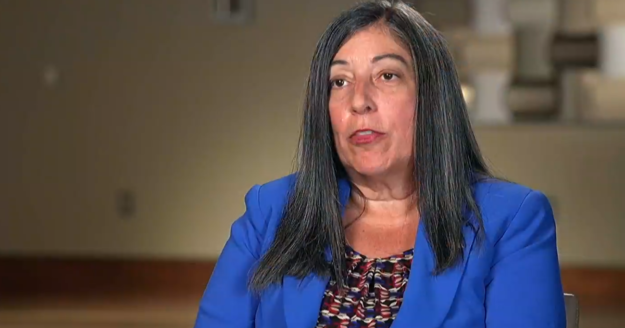
ED O’KEEFE: On Wednesday, Margaret sat down with the former CDC chief medical officer Debra Houry, who left the agency in protest after then CDC Director Susan Monarez was fired late last summer. Houry has provided a Senate committee with hundreds of e-mails documenting the challenges at the agency during this Trump administration. Here’s her story of what happened just after President Trump took office.
(BEGIN VT)
DEBRA HOURY, MD (Former CDC Chief Medical Officer): We started getting executive orders where we took down hundreds of websites. And I thought, this is highly unusual. You know, science doesn’t change based off who is in office. And so, when these things were happening, I knew this was different than before. I also didn’t brief the secretary, which was very different than prior administrations.
MARGARET BRENNAN: So, the websites you are talking about being taken down, this was because of the executive order to remove references to gender ideology.
DEBRA HOURY: Yes. And that included the term “gender.” And “gender” was in many of our data sets. Gender of animals. You know, we had transgender guidance around mpox. All of that we were told to take down.
MARGARET BRENNAN: So, it included the CDC and FDA pulling down how physicians should treat STDs. That seems important information.
DEBRA HOURY: It’s very important information but it referred to “transgender” and you couldn’t just do a word replace. And so we highlighted things like this that, you know, and again, as a doctor, it was very concerning to me that if you’ve got patients and doctors that need specific clinical guidance, to not be able to provide that information.
MARGARET BRENNAN: You also documented a scramble on the inside to get some of the sites back up.
DEBRA HOURY: Yes.
MARGARET BRENNAN: And this happened to be just a day after the secretary had finished his confirmation hearings. Why?
DEBRA HOURY: We were told that there was a concern it could hurt the secretary’s confirmation, that if vaccine-related information was missing from the website, that it could reflect poorly on him.
MARGARET BRENNAN: Specifically information about vaccines?
DEBRA HOURY: Yes.
MARGARET BRENNAN: Because, why?
DEBRA HOURY: There was a concern that the secretary had expressed anti- vaccine sentiments and that if CDC, as he was coming on board, didn’t have information on vaccines on the website, that it had to do with his hearing and his direction.
MARGARET BRENNAN: So, all of these had been taken down because you were trying to comply with what the president wanted.
DEBRA HOURY: Correct.
MARGARET BRENNAN: But then realizing it might hurt votes to confirm the secretary, you had to scramble and put some of them back up.
DEBRA HOURY: That’s our understanding. And to be very clear –
MARGARET BRENNAN: Sounds a little confusing.
DEBRA HOURY: When we took the websites down, we flagged that many of these websites contained information such as that. I don’t think they understood the volume or the impact until media and others started noticing all the websites that were gone.
MARGARET BRENNAN: You know, during the secretary’s confirmation hearing, he said, “all decisions would be free of political influence and guided by science.”
DEBRA HOURY: Yes.
MARGARET BRENNAN: But you received an e-mail from his chief of staff telling you of the, quote, “absolute need for political review of major decisions at the CDC.”
How different is that from typical management?
DEBRA HOURY: That has never happened before. Usually, you know, certainly there would be political review of high level decisions, but not every decision. And scientists’ careers would be at the table. I can tell you, through my eight months, when I was transition lead and only career (ph) in the office of the director, I was not part of most of the conversations with the political appointees at HHS.
MARGARET BRENNAN: And did most of those political appointees have medical degrees?
DEBRA HOURY: I don’t think any. And HHS, at that time, had medical degrees. We had one person at CDC who was a political appointee who had a medical degree. He didn’t come for the first few months. And then the office of the director, we had no one with a medical background or even a public health background.
MARGARET BRENNAN: So, the decisions being made were by individuals who had no medical background?
DEBRA HOURY: No medical background. And not only no medical background, no science background, and, for many of them no background in government.
And I want to be clear, it’s certainly OK to have different perspectives, you know, and different expertise. But then you want to make sure that the scientists and the experts are also being heard and part of those decisions. And we weren’t.
MARGARET BRENNAN: Back In 2024, 2025, this was a really intense flu season.
DEBRA HOURY: Yes.
MARGARET BRENNAN: The worst in more than 15 years. Nearly 300 kids died. At that time, HHS had this awareness campaign called Wild to Mild.
DEBRA HOURY: Yes.
MARGARET BRENNAN: And it encouraged everyone, it said, six months and older to get a flu shot. So, one day after Secretary Kennedy is sworn in, there are then a flurry of e-mails –
DEBRA HOURY: Yes.
MARGARET BRENNAN: Saying this is a direct request, that was the language used, from the secretary to pull down all of those ads. Why?
DEBRA HOURY: I first thought there was a misunderstanding. We’re – children are dying. It’s an active flu season. It’s not like flu is over. And we’d already paid for these – for these ads. So, it didn’t make any sense. And so, I brought it to our political leaders and brought it back to our communications staff and asked them to please relay back to the department, surely this isn’t what you want. And then we got a note back, it’s a direct request from the secretary.
MARGARET BRENNAN: A growing number of states, 29 plus D.C., have announced they’re no longer following CDC recommendations as a benchmark for childhood vaccines. This is too much. Do you think that public health and faith in public health can be restored?
DEBRA HOURY: I think the secretary has caused a lot of irreparable harm. And when you look at many of the polls out there, the trust in public health, specifically CDC, has decreased dramatically. Over 20 points in many polls. That’s really difficult to recover from.
And when states are removing links to the CDC website and following other medical organizations, I don’t know how you’d build back that trust overnight.
MARGARET BRENNAN: Autism and finding out more about it is a real focus for the secretary before. When he was running for president himself, he put this at the top of his agenda as well. A lot of families are looking to him with a lot of hope.
DEBRA HOURY: Yes.
MARGARET BRENNAN: Do you trust what is being conducted in terms of research into autism?
DEBRA HOURY: Absolutely not. And that’s unfortunate because autism is a significant issue in our country and worldwide. But there’s not a single answer to it. You know, we know that 40 to 60 percent is linked to some sort of genetic etiology. There’s environmental factors. There’s probably infectious disease factors. So, you need to really have a robust field of study around autism verses again looking at a single question.
And what we saw was back in February and March we were asked to look at autism and we proposed several different ideas, including a large study looking at autism and working with NIH. And what came back was us was, no, we want to look at the vaccine safety data link data for autism.
MARGARET BRENNAN: They were –
DEBRA HOURY: So, narrowing in on vaccines and autism verses what we had proposed. And even more concerning is, when my staff, we’d stopped NIH scientists who did autism work, they weren’t aware that the NIH acting director, and some of the other NIH political, had reached out to us about looking at vaccine and autism and CDC data.
MARGARET BRENNAN: How is that possible?
DEBRA HOURY: I guess there wasn’t communication between the NIH political and the NIH experts on autism. And after that there was no more communication between our scientists in autism and the NIH scientists on autism around that topic.
MARGARET BRENNAN: The Kennedy aides did not trust the professionals within the CDC and the NIH, is that fair?
DEBRA HOURY: I would say that’s fair.
MARGARET BRENNAN: In your e-mails there’s one from the director of the National Center on Birth Defects and Developmental Disabilities. And said they’re looking into how to respond to questions about vaccine safety and autism. And that’s when you said, not until we’re asked, and don’t go so narrow.
Whatever happened to that? Was there ever a CDC study launched?
DEBRA HOURY: No. Well, not on what I had proposed. What I had proposed back to that center director was that autism was an important thing to study and we should be looking broader and working with NIH. What came back instead was that NIH, the acting director, as well as the contractor, John Powers, who’s now NIH institute acting director, were going to look at the vaccine safety data with a lens towards autism.
MARGARET BRENNAN: Back in April, the secretary held a press conference on what he called the autism epidemic. And he claimed that the media has an etiology of epidemic denial. That we are not asking enough questions about why there is an uptick.
You wrote in one of your documents here that there was a bit of concern that you heard after the secretary spoke. What concerns were you hearing?
DEBRA HOURY: Even, you know, President Trump’s first surgeon general, Jerome Adams, put on social media about how the secretary really focused on profound autism and not really looking at the whole spectrum of autism and
MARGARET BRENNAN: Not looking at highly functional individuals.
DEBRA HOURY: Yes, and just really demeaning, you know, in my mind, anybody with autism verses recognizing the struggle that individuals and families have and how we can support them. And he, you know, really kind of misrepresented the data, like conflating information on states when a lot of it had to do with detection. And if we had been able to brief him, like I had suggested, you know, since it was a CDC paper, we could have walked through that with him. Like what the statistical analysis meant, what some of these findings meant. But we weren’t given that opportunity. And there was backlash from many in the autism community, including groups like Autism Speaks because of how the secretary spoke about autism. And again, autism is impacting so many families in our nation. We need to look at it seriously and not with a conspiracy lens like the secretary is doing.
MARGARET BRENNAN: You say a conspiracy lens. The secretary, from the podium, said –
ROBERT F. KENNEDY JR., HHS SECRETARY: Somebody made a profit by putting that environmental toxin into our air, our water, our medicines, our food and it’s to their benefit to say, oh – to normalize it, to say, oh this is all normal. It’s always been here.
MARGARET BRENNAN: You believe he had already concluded this and that’s what you were hearing, the backlash.
DEBRA HOURY: It was also that, you know, in my e-mails you’ll see that he has requested data from 30 plus years ago, from studies that have been replicated, that Congress has found that there was no wrongdoing on, because he was convinced that CDC was hiding information on autism and vaccines.
Again, if we want to do studies looking at all of autism, you know, and vaccines as a component of it, maybe that’s OK. But looking at studies from 30 years ago that have really been litigated over and over, that’s a waste of taxpayer money and really, in my mind, a disservice to families that want to know what is causing autism in their children and how can you treat it.
MARGARET BRENNAN: But he seemed to believe that there was a cover up?
DEBRA HOURY: Yes.
MARGARET BRENNAN: Within the CDC?
DEBRA HOURY: Yes. And he’d written about that in many of his books as well. When I was transition lead, I prepared for his arrival by reading many of his books and taking notes. And I had really looked at what were some of the falsehoods in those books and tried hopefully to have a discussion with him around what we had found in data, but that didn’t happen.
MARGARET BRENNAN: In all of these documents there also seems to be a theme here of the political leadership being completely out of sync with the medical professionals. And also disconnected from the Trump administration’s DOGE cuts.
DEBRA HOURY: Yes.
MARGARET BRENNAN: One of the secretary’s aids is e-mailing asking why data crunching hadn’t been done for weeks. And you explained the chief data officer, and so many people on the I.T. team had just been laid off.
DEBRA HOURY: Yes. Yes.
MARGARET BRENNAN: Did they not know about the rifts and the layoffs?
DEBRA HOURY: It seems – you know, we had to really emphasize that at multiple points. You know, once I got asked around a firefighter program and what was the, you know, operating plan to make sure that program was still in place. And I explained, we don’t have one. They’ve all been laid off. You know, you can’t replace firefighters with an infectious disease specialist when they’ve been laid off.
So, similarly, when I got asked, why is this taking so long, I said, you know, our chief data officer, our chief information officer, and the head of our forecasting group were all part of the group that was RIF, you know, reduction in force, or transferred to the (INAUDIBLE) health service or put on administrative leave. These cuts, when you lose 30 percent of your workforce, and over time we ended up losing about 80 percent of our senior leaders, had a dramatic impact on the functioning of the agency.
(END VT)
ED O’KEEFE: We’ve reached out to both HHS and the White House for comment and have not heard back.
We’ll be back in a moment.
(ANNOUNCEMENTS)
ED O’KEEFE: That’s it for us today. Thanks for watching. Margaret will be back next Sunday. Enjoy the rest of the holiday weekend. Until then, for “FACE THE NATION,” I’m Ed O’Keefe.
(ANNOUNCEMENTS)
You may be interested

Some of the nation’s rich are letting AI teach their kids
new admin - Jul 05, 2026Most Americans don’t trust AI. It’s proven that it doesn’t know what safe toppings for pizza are. People don’t even…

New York welcomes Sail4th 250 Parade of Tall Ships
new admin - Jul 05, 2026New York welcomes Sail4th 250 Parade of Tall Ships - CBS News Watch CBS News As the nation marked its…

Trump called Infantino over Balogun red card, FIFA clears striker
new admin - Jul 05, 2026[ad_1] NEWYou can now listen to Fox News articles! President Donald Trump intervened in Folarin Balogun’s red card controversy in…