

How the Supreme Court ruled on Trump’s agenda: Birthright citizenship, tariffs, presidential power

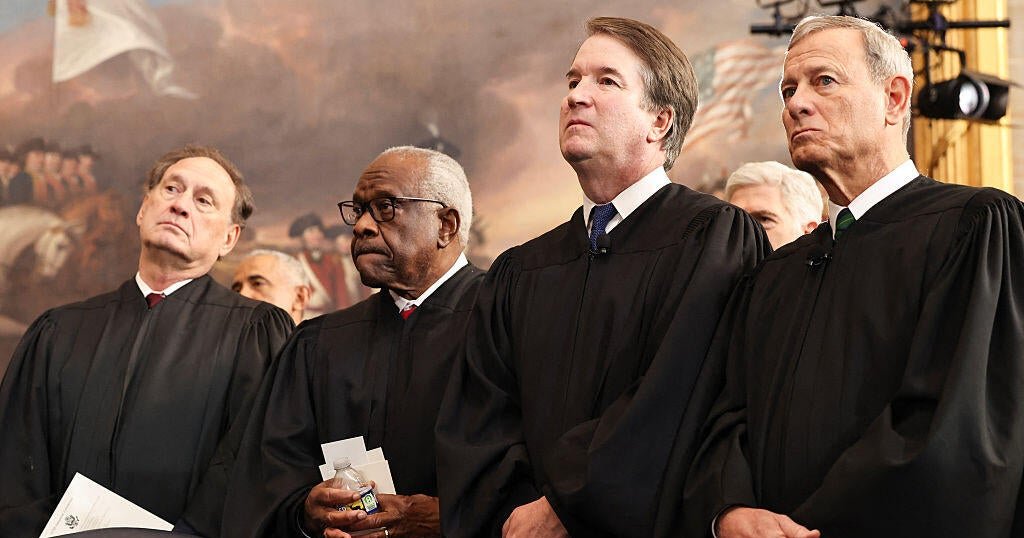
Washington — The Supreme Court issued the final rulings of its 2025-2026 term on Tuesday, capping a consequential series of decisions that addressed some of President Trump’s signature policies.
The court handed the president wins and losses on issues ranging from birthright citizenship to his ability to fire executive branch officials. Taken as a whole, the court’s moves cemented Mr. Trump’s authority over vast parts of the federal government, while delivering significant setbacks to his agenda in other areas.
The decisions against the president crossed ideological lines, with the court’s three liberal justices joining members of its conservative wing to reach majorities.
Here’s how the court’s rulings broke down:
In Trump’s favor
Firing federal independent agency officials
The Supreme Court’s conservative majority struck down removal restrictions for members of the Federal Trade Commission and overruled a 91-year-old decision that allowed Congress to shield members of many independent agencies from being fired at will.
The decision in the case Trump v. Slaughter expands the president’s power over independent boards and commissions, which Congress had insulated from political pressures by limiting the reasons for their removal.
Roberts authored the opinion for the 6 to 3 majority and was joined by the five other members of the court’s conservative wing.
“Although it is up to the Senate to decide whether to confirm those with whom the President would prefer to work, neither Congress nor the courts may saddle him with those with whom he cannot work,” he wrote. “Subordinates who exercise the President’s power are subject to removal by him. Then, and only then, can they remain accountable to the President, and the President to the people.”
Weakening the Voting Rights Act
In a landmark voting rights decision, the Supreme Court in April struck down a Louisiana congressional map that consisted of two majority-Black districts and weakened a key provision of the Voting Rights Act, Section 2.
In an opinion authored by Justice Samuel Alito in Louisiana v. Callais, the court’s conservative majority ruled that compliance with Section 2 could not justify Louisiana’s use of race in redrawing its congressional map. The Supreme Court said in order to successfully challenge House lines under Section 2, plaintiffs must put forth evidence showing a “strong inference” that the state intentionally drew districts to deprive minority voters of the opportunity to elect their preferred candidates.
The three liberal justices dissented, with Justice Elena Kagan warning that “under the Court’s new view of Section 2, a State can, without legal consequence, systematically dilute minority citizens’ voting power.”
The ramifications from the Supreme Court’s decision were swift. Several states in the South moved to recraft their House maps to reconfigure districts with majority-minority populations, which were represented by Democrats.
Allowing states’ transgender athlete bans
In a pair of cases called West Virginia v. B.P.J. and Little v. Hecox, the Supreme Court upheld laws from West Virginia and Idaho that prohibit transgender athletes from competing on girls’ and women’s sports teams.
The high court divided 6 to 3 along ideological lines in finding that both Title IX, the landmark law that promotes equal opportunity in sports, and the Constitution’s Equal Protection Clause allow states to base eligibility for women and girls’ sports on biological sex.
“The Constitution and Title IX do not require an overhaul of women’s and girls’ sports throughout America,” Justice Brett Kavanaugh wrote for the majority.
The three liberal justices dissented as to the Equal Protection Clause, and Justice Sonia Sotomayor read a summary of her dissent from the bench.
The Supreme Court’s decision protects similar laws in more than two dozen states.
Ending Temporary Protected Status
Last week, the court said the Trump administration can move forward with its efforts to strip more than 356,000 Syrian and Haitian immigrants of temporary protections that have allowed them to live and work in the United States.
In a pair of cases that tested a key aspect of Mr. Trump’s plan to crack down on immigration, a divided court ruled that the TPS law bars judicial review of claims brought under federal law. The cases were called Mullin v. Doe and Trump v. Miot.
The disputes arose out of the Department of Homeland Security’s decision to end Temporary Protected Status for more than 6,000 Syrians and 350,000 Haitians. Lower court judges had postponed the terminations of the programs. But the Supreme Court reversed those rulings, saying in a 6-3 decision that immigrants from Syria and Haiti are not entitled to judicial orders postponing the terminations of their temporary deportation protections.
“The TPS statute plainly bars consideration of respondents’ non-constitutional claims,” Alito wrote for the majority.
Striking down limits on coordinated campaign spending
On Tuesday, the court struck down federal limits on the amount of money a political committee can spend in coordination with federal candidates, further unwinding restrictions on the flow of money into congressional campaigns just months ahead of the midterm elections.
The justices divided 6-3 along ideological lines in finding that the caps on what are called coordinated party expenditures violate the First Amendment. The decision in NRSC v. FEC joins a line of recent rulings from the court’s conservative majority that have invalidated campaign finance limits on the grounds that they restrict political speech.
In an opinion authored by Kavanaugh, the conservative majority said its decision “treats all political parties equally. It will allow all political parties — including the DNC and RNC and the respective Senate and House campaign committees, as well as other parties and party committees — to participate more freely and compete more fully in the political process, and to coordinate more closely with their candidates.”
The case was brought by the National Republican Senatorial Committee and then-Senate candidate JD Vance, as well as then-Rep. Steve Chabot. The Federal Election Commission under Mr. Trump’s administration declined to defend the caps and argued that they violate the First Amendment.
Against Trump
Upholding birthright citizenship
In perhaps the highest-profile case of the term, the court on Tuesday invalidated the president’s executive order that sought to overturn birthright citizenship, the principle that nearly all babies born in the U.S. are automatically citizens.
In Trump v. Barbara, a majority of six justices said the president’s order, which would have limited citizenship for babies of those in the country illegally or temporarily, was unlawful. Five of the justices — Chief Justice John Roberts and Sotomayor, Kagan, Amy Coney Barrett and Ketanji Brown Jackson — agreed that Mr. Trump’s executive order violates the 14th Amendment of the Constitution. Kavanaugh wrote separately to say he believes the order violates federal law.
“Citizenship, then and now, was the right to have rights — to freely participate in our political community. The Framers of the Fourteenth Amendment extended that promise to ‘every free-born person in this land,'” Roberts wrote in the majority opinion. “We keep that promise today.”
Justice Clarence Thomas, Neil Gorsuch and Alito dissented.
In February, the court ruled the president does not have the authority to unilaterally impose sweeping tariffs on nearly every country under a federal emergency powers law.
The high court said that the International Emergency Economic Powers Act, or IEEPA, does not authorize the president to impose tariffs. The Supreme Court divided 6-3 in the case known as Learning Resources v. Trump, with Roberts delivering the opinion for the court. Kavanaugh, Alito and Thomas dissented.
“IEEPA contains no reference to tariffs or duties. The Government points to no statute in which Congress used the word ‘regulate’ to authorize taxation. And until now no President has read IEEPA to confer such power,” Roberts wrote in a portion of the decision joined by Barrett and Gorsuch. “We claim no special competence in matters of economics or foreign affairs. We claim only, as we must, the limited role assigned to us by Article III of the Constitution. Fulfilling that role, we hold that IEEPA does not authorize the President to impose tariffs.”
On Monday, the justices allowed Lisa Cook to continue in her post as a member of the Federal Reserve Board of Governors while legal proceedings over Mr. Trump’s attempt to fire her continue.
In a 5 to 4 decision in Trump v. Cook, the high court rejected the president’s bid to allow him to oust Cook over allegations of mortgage fraud.
Roberts wrote the opinion for the majority, joined by Sotomayor, Kagan, Kavanaugh and Jackson.
To accept the government’s arguments that Mr. Trump can fire Cook “would in effect transform the Federal Reserve’s for-cause protection into at-will employment — an interpretive leap out of step with the statute Congress enacted and our Nation’s tradition of central banking protected from political interference,” the chief justice wrote.
Counting mail ballots after Election Day
Also on Monday, the court ruled that states can count mail ballots that are cast by Election Day but arrive later, rejecting a GOP challenge to Mississippi’s law for late-arriving ballots.
The justices split 5 to 4 in finding that Mississippi’s measure does not conflict with federal statutes that set Election Day as the Tuesday after the first Monday in November in certain years. The case was known as Watson v. Republican National Committee.
Barrett authored the majority opinion that upheld Mississippi’s law, joined by Roberts and the three liberal justices. Fourteen states and the District of Columbia have these so-called grace periods in place.
“The Framers recognized the difficulty of crafting election laws ‘applicable to every probable change in the situation of the country.’ So instead of constitutionalizing election law, they decided that ‘a discretionary power over elections’ needed to be lodged ‘somewhere,'” Barrett wrote. “Suffice it to say, that power was not lodged in this Court. The election-day statutes say nothing about ballot receipt, and we cannot add to the words Congress chose.”
Rejecting Trump’s appeal in E. Jean Carroll case
The justices declined to take up Mr. Trump’s appeal of verdicts in cases brought by the writer E. Jean Carroll, who claimed Mr. Trump sexually abused her in the 1990s.
A unanimous federal jury found that a preponderance of evidence supported Carroll’s claim that Mr. Trump sexually abused her during an encounter in a New York City department store. Mr. Trump did not attend the 2023 civil trial, and his attorneys called no witnesses before the jury awarded Carroll $5 million. He has repeatedly denied Carroll’s allegations.
A separate federal jury in January 2024 found him liable for making further defamatory statements against Carroll. That jury awarded her another $83 million. Mr. Trump indicated in court filings he wanted Supreme Court review of both cases.
The justices did not address the legal merits of the case when denying Mr. Trump’s petition to review the matter.
You may be interested

Stevie Nicks’ Addiction and Recovery Examined in Excerpt From New Book
new admin - Sep 14, 2026[ad_1] Lessons & Lace, an upcoming biography about Stevie Nicks, examines life lessons the Fleetwood Mac singer endured throughout her…

Double your protein intake at breakfast by swapping to 1 simple ingredient
new admin - Sep 14, 2026People who enjoy smashed avocado on toast at breakfast may want to swap out one ingredient if they are keen…
Macklemore Removed From Ed Sheeran Tour After ‘Free Palestine’ Statement
new admin - Sep 14, 2026[ad_1] Macklemore has been removed from the rest of Ed Sheeran’s stadium tour after several venues allegedly told the trek’s…