

3 Questions for OG Education Innovator MJ Bishop

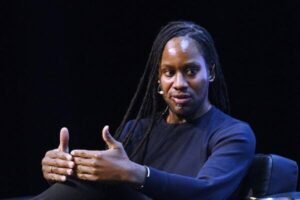
Earlier this year, my friend and longtime colleague, MJ Bishop, announced her retirement as vice president of integrative learning design at the University of Maryland Global Campus. In a field where so many of us are in inaugural roles and find ourselves making things up as we go, MJ was an early pioneer in learning design, quality, strategy, organizational change and system-level innovation. I asked if MJ would answer my questions about her career and what comes next, and she graciously agreed.

Q: First, congratulations on this new chapter in your life. In your LinkedIn post, you wrote that you “remain deeply invested in the future of this field” and are looking “forward to staying connected in new ways.” Can you share more about your future plans?
A: Retirement feels a little less like an ending and a little more like permission to keep exploring the questions that first drew me into the field more than 35 years ago.
When I left a sales position at ComputerLand in 1990 to pursue a doctorate in instructional design at Lehigh University, I really didn’t know much about the field. At the time, I was selling IBM’s new Ultimedia systems to schools—PS/2 computers connected to Laserdisc players loaded with titles like Columbus and Illuminated Books and Manuscripts. The technology was impressive, but what fascinated me were the questions it raised: The content often didn’t align well with the students it was intended to serve. The lessons didn’t fit neatly into a class period. The equipment wasn’t easy for teachers to use. I found myself becoming less interested in the technology itself and more interested in the challenge of designing learning experiences that actually worked in real-world educational settings.
Looking back, that curiosity has been a pretty reliable guide.
Some of the most important decisions in my career probably looked a little risky at the time. I stayed at Lehigh as a visiting professor, hoping there might eventually be a permanent position. Later, after earning tenure and promotion, I gave up tenure to help launch the University System of Maryland’s Kirwan Center for Academic Innovation. During COVID, I left USM to join UMGC. None of those decisions came with guarantees. What they offered was the chance to learn, work with remarkable colleagues and build something new.
Along the way, I was fortunate to work on multimedia learning, online education, open educational resources, academic innovation, digital credentials, skills architectures and, more recently, AI. The topics changed, but I found myself returning to many of the same questions: How do people learn? How do we create more opportunity for them? How do we improve learning at scale without losing sight of the human experience?
As for what’s next, I recently launched MJ Bishop Consulting and plan to continue working with institutions and organizations wrestling with many of those same questions. I’m especially interested in the future of learning, quality improvement, skills-based education, organizational transformation and the implications of AI for teaching, learning and credentialing.
Q: We’ve known each other forever, and it seems as if you know (and have worked with) everyone in the academic innovation, learning design, online learning and institutional strategy worlds. Take us through your career highlights. How did you get into (and help create) the field, and what roles, communities and networks have been most impactful in your career?
A: The easy answer would be technology, but I think it’s the wrong one.
When I entered the field, people were still debating whether computers belonged in education at all. Since then, we’ve lived through multimedia, the internet, learning management systems, online learning, MOOCs, open educational resources, learning analytics, digital credentials, competency-based education and now generative AI.
What I’ve learned is that technology rarely changes education by itself. What changes education is how people use technology to rethink teaching, learning and the systems that support them.
The more important shift has been a growing focus on learning rather than teaching. We’ve become increasingly interested in questions like: What are students actually learning? How do we know? How do we help them succeed? How do we make learning more visible and meaningful?
We’re also beginning to recognize that learning doesn’t happen only within courses and degree programs. It happens across a lifetime and in many different settings. That’s one reason we’re seeing growing interest in skills, learner records, alternative credentials, workplace learning and more flexible pathways.
What excites me is that these conversations are finally bringing together ideas that were often treated separately: learning science, instructional design, student success, workforce development, technology and quality improvement. Increasingly, we’re seeing them as parts of the same ecosystem.
I think we’re still early in that journey, but it’s one of the reasons I’m optimistic about where the field is headed.
Q: What advice do you have for any early- or midcareer academic who is interested in following (at least some) of your professional leadership journey? In an increasingly challenging and scarcity-driven higher education sector, what are the paths to leadership roles at the intersection of learning, innovation and strategy?
A: First, stay focused on problems, not tools.
Every generation of educators is convinced that the newest technology will transform learning. I’ve watched that happen with multimedia, the internet, MOOCs, learning analytics and now AI. The most important question is never “What can this technology do?” It’s “What problem are we trying to solve for learners?”
Second, spend time understanding how institutions work.
Many innovations fail not because the idea is weak but because organizations struggle to change. Learning how to navigate culture, governance, incentives and organizational systems is just as important as understanding pedagogy or technology.
And finally, don’t be afraid to take thoughtful risks.
When I look back on my career, many of the most rewarding opportunities came from decisions that felt uncertain at the time: leaving industry for graduate school, staying in academia when there was no guarantee of a permanent position, giving up tenure to lead a system-level innovation center and later moving to UMGC during a period of tremendous change in higher education.
None of those choices came with guarantees. What they offered was the chance to learn, to work with extraordinary people and to help build something new.
The field will continue to change. The technologies will change. The organizational structures will change. What matters is maintaining a sense of curiosity and a willingness to step toward opportunities that allow you to keep learning, contributing and occasionally reinventing yourself along the way.
You may be interested

'I tried Jo Malone's new Wood Sage & Sea Salt rival and it wasn't what I expected'
new admin - Aug 16, 2026[ad_1] Our beauty writer tested Jo Malone's new fragrance that's a reimagination of the iconic Wood Sage & Sea Salt…

Frank Gardner issues horror Putin nuclear weapons warning – 'mushroom clouds over London'
new admin - Aug 16, 2026EXCLUSIVE: Broadcaster and author Frank Gardner on battling on, two decades after the terror attack that nearly took his life…

£40 Tefal pan that 'cooks without oil' drops below £25 in flash sale
new admin - Aug 16, 2026Shoppers have praised the 'very, very non-stick' pan Source link