


I hate flying — I asked a pilot all the questions nervous flyers need answered

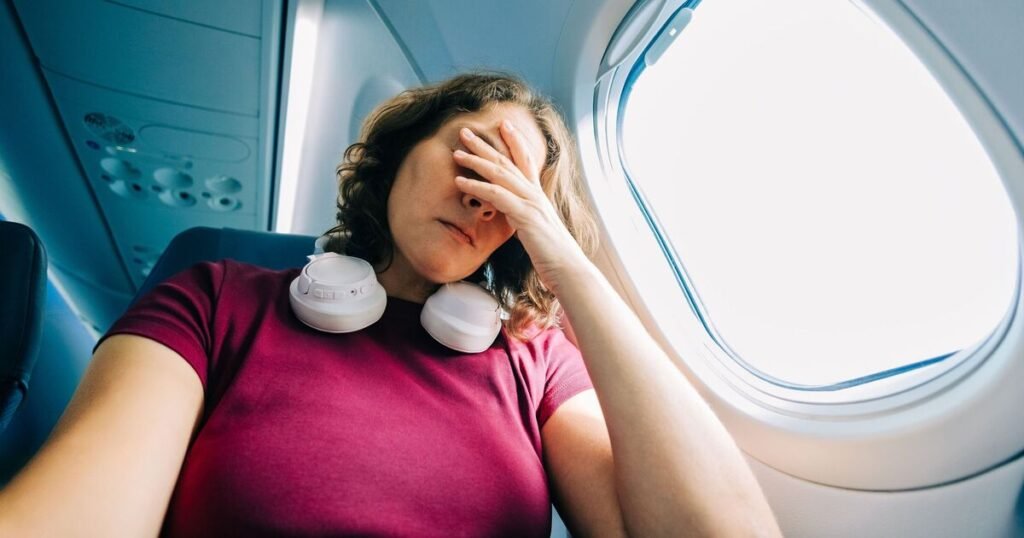

I hate flying so I asked a pilot all the questions that race through my mind when on an aeroplane (Image: Getty)
I hate flying so every holiday I go on is always a mix of excitement and dread. Fear of flying, also known as aviophobia, is very common and, for those of us who experience it, it may well stem from the same core issue of our brain trying to make sense of an environment where it feels it has absolutely no control.
It’s likely we all have similar questions:
- Can turbulence bring down a plane?
- Can someone open the cabin door mid-flight?
- What if the plane gets hit by lightning?
- What happens if an engine fails?
- What happens if we hit a bird?
- Are budget airlines less safe?
Sound familiar? Sadly, while anyone can resort to Reddit or Facebook for advice from fellow nervous flyers, few of us actually get to ask the real experts — the pilots themselves. Luckily, I got to ask Simon Tranter, a pilot with 18,000 flight hours over a 17-year career in the Royal Air Force followed by 25 years as a commercial pilot at British Airways, where he flew long-haul and short-haul routes and spent 17 years as a B737 and A320 training captain. He is now head of training at EmPower Flight.
I also spoke to Dan Bubb, a former commercial pilot who now teaches aviation courses at the University of Nevada, Las Vegas.
Are ‘budget’ airlines less safe?
“In the aviation world, the price for your ticket dictates your legroom and whether you get a free sandwich — it has zero bearing on safety,” said Simon.
“Every single airline operating in our skies must adhere to the exact same stringent regulatory laws and safety standards. Budget airlines actually tend to fly younger fleets of aircraft, which means they are equipped with the newest safety technology. They save money on business models, not on maintenance or pilot training.”
Dan added: “Budget airlines are just as safe as safe as more expensive airlines. Even though the pay scale is different, all airline pilots are trained and held to the same rigorous standard whether they fly a 15-passenger Beech 99 or a 400-passenger Boeing 747.”
Can turbulence crash a plane?
“Aircraft are engineered to withstand forces far greater than anything nature can throw at them,” said Simon. “Higher levels of turbulence can be uncomfortable for the pilots, crew and passengers, but generally the most turbulence will affect a flight is intermittent and rather like driving slowly over cobblestones. Most importantly, if you don’t have your seatbelt fastened, a sudden turbulent bump can cause you to spill your drink — that’s one of the main reasons we ask you to buckle up.”
Could a passenger open the plane door?
“It is physically impossible for a passenger to open the plane door because aircraft doors are designed as ‘plug doors’,” said Simon.
“Due to the air pressure inside the cabin being much higher than the thin air outside at 35,000 feet, the cabin pressure effectively seals the door shut with thousands of pounds of force. You could get the strongest person on Earth, give them a crowbar, and they still couldn’t open that door while we are in flight.”
Dan added: “In the past, we have seen passengers try to open the door, but they were unsuccessful.”
Are cabin crew trained to hide their concern in the event of an emergency that passengers aren’t yet aware of?
Dan said: “Cabin crew are trained to handle emergencies with calm and discretion to avoid alarming passengers. Even though the situation might be stressful, pilots and flight attendants are trained to remain calm and keep passengers calm.”
Simon said: “Cabin crew are primarily safety professionals and they undergo rigorous, regular emergency training. If you look at a crew member and they look calm, it’s because they are in control of the situation.”
What if the landing gear doesn’t come down when the plane is landing?
“This is something we practice to perfection in flight simulators,” Simon said. “Aircraft have multiple backup systems to get the wheels down. If the main hydraulic system fails, we can use an alternate system, or even let gravity ‘free-fall’ the gear into place where it locks automatically.

Simon Tranter has 18,000 flying hours in the RAF and with British Airways (Image: Simon Tranter)
“In the extremely rare event that the gear completely jams, planes are designed to land safely on their bellies. Fire crews might decide to foam the runway, and the aircraft slides to a halt. It makes for a dramatic news headline, but it is entirely survivable.”
What happens if the engine fails?
“Modern airliners are built with massive amounts of redundancy,” said Simon. “If one engine fails, the aircraft is completely capable of climbing, cruising and landing safely on the remaining engine. Even if both engines were to fail (which is virtually unheard of), a plane does not suddenly drop but instead becomes a very large glider. From a normal cruising altitude, an airliner can glide for about 80 to 100 miles, giving us plenty of time to head for a safe runway and to re-start the engines in the glide.”

Pilot Dan Bubb (Image: University of Nevada Las Vegas)
Dan said he has actually experienced an engine fail while flying — it happened on take-off when he was transporting passengers to the Grand Canyon: “We shut down the failed engine, declared an emergency and landed on the single, good engine without any problem.”
How likely is a plane to crash?
“Statistically, you are far safer in a commercial airliner than you are walking down the pavement or driving to the supermarket,” said Simon. “The International Air Transport Association (IATA) say there is ‘one fatal accident for every 5.6 million flights (2021-2025)’. You’d have to fly every single day for thousands of years to statistically encounter an accident.”
Dan said: “Given the rigorous training through which pilots have to do, the chance of a commercial passenger plane crashing is slim. As a colleague of mine likes to say, you have much higher chances of getting into a car accident on your way to the airport than in a commercial passenger plane.”
Why are passengers told to turn phones off during take-off and landing and what happens if we leave them on? Will they interfere with the plane’s systems?
“The technical reason is that older phones used to occasionally cause a harmless but annoying ‘click-click-buzz’ sound in the pilots’ headsets, similar to putting a mobile phone right next to an old audio speaker,” said Simon.
“The real-world reason is that take-off and landing are the most dynamic parts of the flight. We need you alert and not looking at a screen, in case we need to give you important instructions.”
Dan backed it up, saying: “Take-off and landing are the most critical phases of flight, which is why flight attendants are adamant about enforcing this regulation.”
Could a passenger break a plane window and what would happen if they did?
“No,” said Simon. “The windows you see are made of incredibly tough, multi-layered aerospace acrylic, not household glass. They can easily withstand immense pressure and impact. If an outer pane were to crack, the inner layers are more than strong enough to hold the cabin pressure perfectly.”
However, while Dan also said it would be “difficult for a passenger to break a window” he did refer to an incident in 2018 where a window broke, apparently as the result of an exploding engine, and a woman died after being partially sucked out.
Is it safe to fly during a storm? What happens if the plane gets hit by lightning?
“We don’t fly through severe storms,” said Simon. “Our onboard weather radar allows us to see them miles in advance and simply steer around them. If a plane does happen to get struck by lightning, it’s surprisingly uneventful. The skin of the aircraft acts like a protective shield (a Faraday cage). The electricity strikes the plane, flows harmlessly along the outside skin and through specific lightning conductors, and leaves through the tail. Passengers might hear a loud crack or bang, but the aircraft systems are built to handle it effortlessly.”
In 2019, a plane landing in Cardiff Airport from Ibiza was hit by lightning and passengers reported a “huge bang”. The flight landed safely with no reported injuries.
Are bird strikes dangerous?
“Most bird strikes happen at low altitudes, when the aircraft is at slower speeds near airports, and the vast majority of them are entirely harmless events”, said Simon.
“Aircraft engines and structures are specifically designed and tested to ingest birds without catastrophic failure. As a precaution, if we suspect a bird strike, we will always make an assessment of any possible damage and let our engineers give the plane a thorough inspection.”

Pilot Chelsey B Sullenberger landed in the Hudson River in New York after hitting a flock of geese (Image: NY Daily News Archive via Getty Images)
However, Dan said bird strikes “can be very dangerous”, referring to the incident which saw Captain Chelsey Sullenberger land his US Airways Airbus on the Hudson River in New York City after a flock of Canadian geese flew into and destroyed both of the airplane’s engines.
What happens if the pilot turns up to work really tired?
“We have a very strict, no-blame safety culture in aviation called fatigue reporting,” said Simon. “If a pilot hasn’t slept well or feels unfit to fly for any reason, they simply log into the system and declare themselves unfit due to fatigue. The airline immediately calls in a standby pilot, no questions asked. There is absolutely no pressure to fly if you aren’t at 100%.”
How much does a computer fly a plane and how much do you fly a plane?
“The computer — or autopilot in an aircraft — is like a highly sophisticated cruise control on a modern car,” said Simon. “It’s an incredible tool that does the heavy lifting of flying the aircraft while the pilots are managing the busy flight.
“However, the computer only does what we tell it to do. We manually fly the aircraft during take-off and generally during the landing. The humans are always the ones making the strategic decisions. Occasionally, the autopilot will land the aircraft but this is only in situations of extreme fog when the aircraft is programmed by the pilots for an automatic landing and the airport is specifically authorised to apply the very special protections and safeguards needed for an ‘autoland’.”
What stops pilots becoming distracted or falling asleep during long flights?
“We have highly structured protocols whilst airborne to keep us engaged,” said Simon. “We are constantly monitoring aircraft performance, the autopilot function, fuel logs, cross-checking weather reports and communicating with air traffic control. On ultra-long-haul flights, we carry an ‘augmented crew’ (three or four pilots total). This allows us to take turns sleeping in dedicated pilot bunk beds built into the aircraft, ensuring that the two pilots at the controls are always fresh and focused.”
Is it more dangerous to fly at night?
“Not at all,” said Simon. “In fact, at night the high-intensity lights of other aircraft and runways stand out perfectly against the dark background.”
Have you ever seen another plane nearby and thought it was too close?
“Not in civil flying, but yes as an RAF fighter pilot!” said Simon. “Furthermore, all commercial planes are fitted with a system called TCAS (Traffic Collision Avoidance System). It talks to other aircraft automatically and if another plane ever wandered even slightly too close, our cockpits would warn us and tell us exactly what manoeuvre to fly to stay completely safe.”
How do you become a commercial airline pilot?
“It’s a rigorous journey,” said Simon. “It starts with strict medical clearance, followed by months of ground school training where you learn everything from meteorology to aerodynamics. From there, you start in small, single-engine aircraft to master the basics, progress to twin-engine planes, and eventually step into full-flight simulators to learn the specifics of the jet you will be flying for the airline.
“After a pilot passes all their simulator checks, they step into the real cockpit with real passengers. However, they are not amateurs. They are already fully qualified commercial pilots. During this phase, they fly with a highly experienced training captain (someone like me) sitting next to them, guiding them through the real-world nuances of airline operations until they are completely polished.”
And finally, what’s the scariest thing that’s happened to you while flying?
“Honestly, after many years flying fighter jets in the Royal Air Force and later as an airline captain, the thing that would raise my heart rate in commercial aviation is a very, very occasional turbulent and gusty crosswind landing towards the maximum crosswind component allowed,” said Simon.
“But in fairness, after 44 years as a professional pilot it’s not overly difficult, it’s simply a matter of following procedure. As our training is so intensive, when something unexpected does happen — like a sudden change in weather or a technical glitch — fear doesn’t enter the equation. Your brain instantly switches into ‘training mode’ and you calmly execute the checklist. It feels like just another busy day at the office.”
Dan said his scariest flying experience was having an engine fail on take-off while transporting passengers to the Grand Canyon. But he said: “We shut down the failed engine, declared an emergency and landed on the single, good engine without any problem. Even though we appeared calm and collected, our adrenaline was pumping.”
You may be interested

Prospective homeowners delaying purchases amid high prices, high mortgage rates
new admin - Jun 17, 2026Prospective homeowners delaying purchases amid high prices, high mortgage rates - CBS News Watch CBS News The cost of a…
Wilmington Hospital shooting suspect at large, police say; at least 1 dead and 1 injured
new admin - Jun 17, 2026Police in Delaware are still searching for a suspect who shot two people at Wilmington Hospital on Tuesday, officials said…

Vet explain reason dogs lick their lips – not because they’re hungry
new admin - Jun 17, 2026Have you noticed your dog lick their lips while relaxing at home or ahead of eating their dinner? Despite what…