
How Peer Mentors Combat Summer Melt

After spending her K–12 years with an individualized education program, or IEP, Angelina Sambuco wasn’t sure how she would access similar support when she arrived at Brooklyn College three years ago.
For years, Sambuco had accommodations built into her school days, and she worried about how she’d fare when college started. But before her freshman year began, a coach from the City University of New York’s College Bridge for All program helped ease that uncertainty, checking in regularly and connecting her with the college’s disability services office.
“The adjustment from high school to college was a really big jump,” Sambuco said. “I always benefited from prompting and getting someone to support me when I had questions and to make sure I had the services that I needed. It was a really nice bridge during that transition and helped me manage the stress.”
The experience left a lasting impression. Inspired by the support she received, Sambuco became a coach herself. Now an incoming fourth-year speech pathology major, she is preparing for her second summer helping graduating high school seniors navigate the transition to college.
“Whenever I work with students over the summer, I always use my experience as a way to connect with them,” Sambuco said. “If I have a student with an IEP, I help them through that adjustment and connect them with the campus disability office and other resources that can support them.”
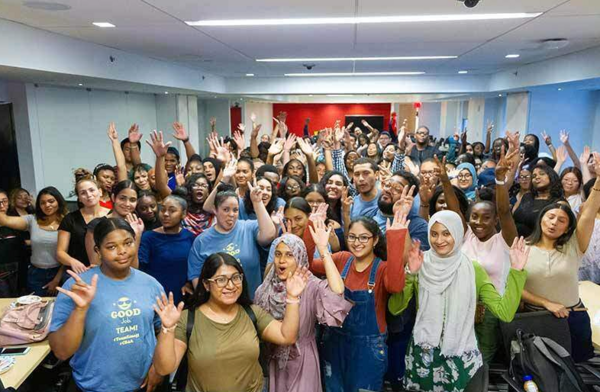
Near-peer mentoring: Launched in 2020, CUNY’s College Bridge for All program, in partnership with the New York City Public Schools, enlists college students to serve as advisers to graduating seniors. The mentors, known as Bridge Coaches, use a database that integrates contact information, application data and postsecondary plan information to provide individualized advising on financial aid, college selection and key enrollment steps.
Bridge Coaches work with all the city’s graduating seniors to help them navigate their postsecondary plans—whether it’s enrolling in college, pursuing a training program or entering the workforce. Coaches assist with everything from completing financial aid forms to understanding what to expect after high school, offering support through text messages, emails and one-on-one advising. The program operates summer and winter sessions to support students starting college in the fall and spring semesters.
In 2025, the program supported more than 50,000 NYCPS students, which college leaders say makes it the largest near-peer postsecondary advising program in the nation.
Daitwan David, director of the program, said that near-peer mentorship—in which someone slightly further along in their educational journey supports a student close in age—can be more effective than guidance from counselors, college admissions offices or even family members in certain contexts.
“The warm handoff, in our context, is thinking about what counselors have been able to do and then taking that information and being able to pass it on to Bridge Coaches to carry on the work,” David said. “They speak the language, they understand the norms, they understand what’s happening with them. They’re able to present the information in a way that’s palatable so that [the younger students] can receive it.”
Addressing summer melt: The American Educational Research Association found that 10 to 20 percent of college-bound students change their plans after graduation and never make it to campus in the fall—a phenomenon known as summer melt. Among low-income and first-generation students, the rate can reach 40 percent.
New data suggests College Bridge for All is helping combat the problem. Of the nearly 40,000 NYCPS students served by the program who planned to enroll in college last fall, 92.3 percent successfully matriculated, resulting in a summer melt rate of 7.7 percent, down from 14.4 percent in 2024.
David said the program’s ability to reach students at scale relies on the data-sharing agreement between CUNY and NYCPS.
“The fact that we are able to get contact information, understand what a student’s pathway is going to be and match a student who has language needs with a coach who can meet those needs [is] … pivotal to the work,“ David said. “It could not exist otherwise.”
Building student trust: Engagement with the program has also increased. Some 50 percent of graduating seniors engaged in one-on-one advising with their Bridge Coach in 2025—the highest uptake since the program launched.
Meanwhile, 42 percent of those students participated in high-touch advising interactions, which include proactive mentorship, mental health support and career guidance—up from 33 percent in 2024 and 24 percent in 2023.
All Bridge Coaches are NYCPS alumni—including Morgan Wong, a graduate of James Madison High School in Brooklyn who has often worked with students from her alma mater.
“That has definitely helped me build rapport and a sense of trust,” Wong said. “For some students, I’ll mention, ‘Oh, is that principal still the principal?’ and we’re able to bond over that before the conversation moves into, ‘So where are you in terms of next steps?’”
Wong, who earned a bachelor’s degree from Brooklyn College and is currently pursuing a master’s degree in industrial and organizational psychology at the CUNY School of Professional Studies, is entering her fourth summer as a Bridge Coach. She noted that during her tenure, the challenges high school students face have remained largely the same.
“I always go back to this concept of intention versus execution,” Wong said. “A lot of students know the general direction they want to go in, but it’s the execution—the actual matriculation—that’s the difficult part,” she said, adding that completing financial aid forms is often a major barrier.
“We have to remember many students are first-generation or come from families where parents don’t speak English at home, or where there isn’t anyone who can help them get their applications and documents together,” she said. “All the challenges we anticipate, we see again and again, and we’re ready for them through our training as coaches.”
Paying it forward: For Sambuco, participating in the program has come full circle: When she was a graduating high school senior, Wong was her Bridge Coach.
“Me and Morgan were a team last summer, completely unintentionally,” Sambuco said. “We were so excited that we got to see each other grow.”
She added that one of her biggest realizations as a Bridge Coach is that while the mentors operate remotely, they are not alone.
“We’re really close and we foster a sense of community. We love watching each other grow, and that definitely trickles down to the students,” she said.
For Wong, the rewards of the program extend beyond helping students navigate the transition to college. Serving as a Bridge Coach has reinforced the importance of meeting students where they are and recognizing that there is no single path through higher education.
“I always try to reiterate to my students that college is going to look different for everyone—there’s no one-size-fits-all model,” Wong said. “What my experience looked like may not apply to them, but I’m here to help figure out what works best for them.”
Get more content like this directly to your inbox. Subscribe here.
You may be interested

Hairstyles for women over 40 that take years off – 3 'flattering' cuts to try now
new admin - Sep 13, 2026A good haircut can make a world of difference to your appearance. Source link

'I've tested home scents for 4 years and this £20 room spray is my new favourite'
new admin - Sep 13, 2026[ad_1] After four-plus years of testing home fragrances, our reporter thinks she's found a new favourite. [ad_2] Source link
4 Roald Dahl books will remain relevant forever thanks to 1 key reason
new admin - Sep 13, 2026Roald Dahl's books, I believe, are timeless classics unlikely to go anywhere soon, as generations and generations of kids have…