


To Fund Pell, House Suggests Ending Subsidized Loans

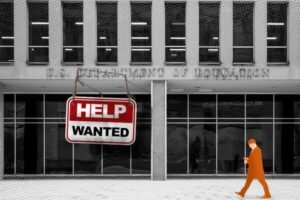
Republican House appropriators are planning to shore up funding for Pell Grants, which aid low-income college students. But they would do so through cuts that include eliminating subsidized federal student loans. Higher ed groups are calling it a poor solution to the estimated $17 billion Pell shortfall.
“We’re enormously appreciative that the House Republican legislation would address that shortfall and protect the program for students that are most in need,” said Craig Lindwarm, senior vice president of governmental affairs for the Association of Public and Land-grant Universities. “Unfortunately, though, it does so in a way that takes from students in another manner.”
At the end of December, almost three million borrowers were using subsidized loans, said Emmanual Guillory, senior director of government relations at the American Council on Education. (Only undergraduates qualify for these loans.) Current borrowers wouldn’t be affected, he said, but that’s how many could be affected in the future.
The National College Attainment Network said it conservatively estimates that ending subsidized loans—which don’t accrue interest while students are attending college at least half-time—would increase average student debt by $6,000. It said in a statement that eliminating “subsidized loans would likely increase reliance on private borrowing and compound existing affordability challenges, especially for students from low-income backgrounds.”
The Congressional Budget Office has projected that if current annual Pell appropriations remain flat, at about $22.5 billion, the program will be short nearly $17 billion by September 2027. In addition to starting to address that shortfall, the bill proposes increasing the maximum annual Pell award by $50, to $7,445.
“Unfortunately, the bill pays for the Pell investment by eliminating subsidized student loans—a change that saves approximately $16 billion over the next ten years,” NCAN said in its statement. It said, “This approach could forbode more extreme funding cuts in the future as Congress strives to find additional savings to cover the cost of the Pell shortfall.”
In part to pay for the shortfall, the Trump administration proposed eliminating funding for dozens of higher ed programs.
The bill’s $50 max Pell increase also isn’t the $200 increase advocates sought, and it’s far from the $8,109 that NCAN says Pell would pay for today if the grant’s size had kept pace with inflation.
The legislation would also cut the Federal Work-Study program by 26 percent, to $900 million, and bring funding for the Supplemental Educational Opportunity Grant down to roughly $500 million, a 40 percent decrease. Further, the Institute of Education Sciences, the federal government’s central education data collection and research funding agency, would lose nearly $500 million. Over all, it would reduce the Education Department’s discretionary budget by $8 billion, to roughly $71 billion.
On the other hand, House lawmakers rejected President Trump’s call to slash the National Institutes of Health’s budget; the bill would increase NIH’s funding to nearly $49 billion instead of the $5 billion cut Trump proposed. Congress also rejected Trump’s calls to slash NIH’s budget for this fiscal year. The agency provides significant biomedical research funding to universities.
“NIH appears to have an increase in funding over last year, no restructuring is proposed and all institutes are funded,” said Alessandra Zimmermann, research and development policy project director at the American Association for the Advancement of Science. But she said it’s not all good news for research: the Agency for Healthcare Research and Quality wouldn’t be funded.
The bill, released Thursday, is from the House Appropriations Committee’s Labor, Health and Human Services, Education, and Related Agencies Subcommittee, or Labor-H for short. The subcommittee is set to take it up Friday morning. It marks an early step in Congress’s long and often fraught process to pass a federal budget for the next fiscal year, which starts Oct. 1.
Spokespeople for the committee and subcommittee chairs didn’t respond to requests for comment.
House Appropriations Committee chair Tom Cole, an Oklahoma Republican, said in a news release that “America’s success has rested on a simple belief: that every citizen should have the opportunity to learn, work, innovate, and build a better future. This bill supports that promise. From groundbreaking medical research and restored focus on core public health to workforce training and educational opportunity, it invests in the people and institutions that strengthen our nation.”
Labor-H Subcommittee chair Robert Aderholt, an Alabama Republican, said in the release that the bill maintains “key investments in biomedical research, America’s schools, and core public health” and funds “necessary basic science.”
But committee Democrats say the bill “abandons college students and low-income workers trying to improve their lives through postsecondary education by increasing interest rates for 5 million college student borrowers, cutting funding for need-based financial aid, and eliminating job training programs.”
The bill also contains a provision saying none of its funding will go to any public college or university that denies a religious student group any rights “afforded to other student organizations” because of the group’s “religious beliefs, practices, speech, leadership standards, or standards of conduct.”
In 2010, the Supreme Court ruled that the University of California Hastings College of Law could deny recognition of a Christian student group that didn’t comply with an “all comers” nondiscrimination policy because it rejected members based on their beliefs and sexuality.
Lindwarm, of the APLU, said, “The First Amendment already provides robust protections for religious liberty at public institutions of higher education, and policymakers should proceed with extreme caution in overturning Supreme Court precedent via an appropriations policy rider.” He said the provision’s language “would possibly come into conflict with the need to protect campus communities.”
You may be interested

Space station crew moves to “safe haven” while leak is repaired
new admin - Jun 05, 2026Out of an abundance of caution, NASA on Friday directed five of the seven crew members aboard the International Space…

Bob Dylan Played a ‘Basement Tapes’ Song for First Time in 59 Years
new admin - Jun 05, 2026[ad_1] Bob Dylan kicked off his 2026 summer tour Thursday night in Troutdale, Oregon, and he stunned his most hardcore…

MAHA is coming for your clothing
new admin - Jun 05, 2026In between beef tallow fries, raw milk, and vaccine denialism, Make America Healthy Again figureheads have set their sights on…