
After RIFs, ED Turns to Contractor to Hire New OCR Attorneys

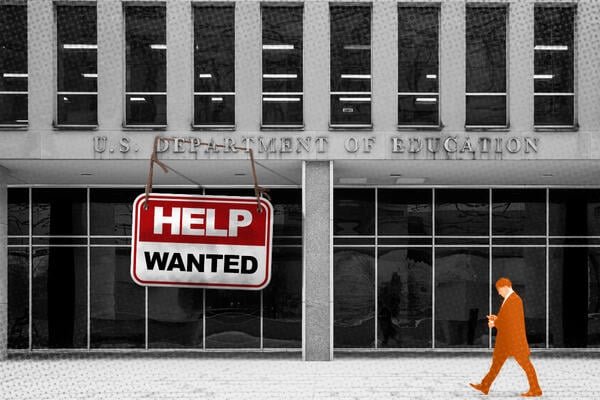
A federal contractor that was hiring several attorneys to support the Department of Education’s Office for Civil Rights took the job postings down from its website Wednesday. The removal came less than a week after social media comments sparked questions about the cost and efficiency of the positions.
The Education Department fired hundreds of OCR staffers in March 2025 but rescinded those layoffs by the end of the year. Education Secretary Linda McMahon has said recently that the agency is working to boost staffing at OCR, acknowledging a growing backlog of cases.
One of the six postings from the company, Kaiva Tech, sought an early-career attorney to work out of the department’s regional office in Denver; the position would pay $225,000 to $260,000 per year. That’s more than double what similarly experienced attorneys have been paid when hired directly by the department, public records show. The position would entail “provid[ing] direct support to the Office for Civil Rights by reviewing, analyzing, and processing civil rights complaints,” the posting explained.
Beth Gellman-Beer, a former OCR attorney who was laid off and opted not to return to the agency when the RIF was rescinded, said the posted salary is more than she earned in her 18 years at the department, including her time as a regional director. At the time of the RIF, she was making $190,000.
“This is yet another frustrating indicator that firing half of OCR staff was not a wise move,” she wrote on social media about the job postings. “But what angers me most is the additional, unnecessary expense to the taxpayers. I can only imagine how much this contractor is getting from the federal government to pay for these [attorneys], on the taxpayer dime.”
On Tuesday, Inside Higher Ed asked the Education Department about the difference in pay scale. By Wednesday morning, shortly before ED responded, the job postings had been taken down.
“We are not in a formal contract with Kaiva Tech; we are in the exploratory phase,” a department spokesperson said in an email. “As you know, salaries for contractors are not comparable to federal salaries, and we have no authority over what they pay their employees.”
The department spokesperson also stressed that “the goal here is not to backfill positions.”
“Case resolution remains a top priority and the management decisions we are making today, including hiring new staff, reflect that,” the spokesperson wrote.
Inside Higher Ed asked for further clarification about the department’s partnership with Kaiva Tech and exactly why the job postings were taken down. The department responded that they already explained the meaning of an informal contract, adding, “We cannot discuss source selection or procurement-sensitive information.”
Kaiva Tech did not respond to any questions prior to publication.
This is not the first time a contract has been signed to recruit lawyers for the Education Department since the RIF. Inside Higher Ed found at least two other contracts focused on “support[ing] the delivery of attorney services adjudication work.” There has also been a spike in hiring directly overseen by the department, not only within OCR but also the Office of Federal Student Aid.
According to Politico, leaders at FSA told existing employees that it is aiming to hire 334 full-time employees by 2027—a 45 percent increase from its staffing levels in April. A few weeks later, NPR used internal documents to report that number had reached 380 new workers.
Gellman-Beer and others argue the recent use of contractors to recruit staff and posting higher-salaried jobs suggests that what the administration marketed as an attempt to improve government efficiency did the opposite.
“The administration, and in particular [the Department of Government Efficiency], stated that their purpose in doing everything was to ‘eliminate waste, fraud and abuse,’ and yet the end result here is double the waste, fraud and abuse,” she said. “It just confirmed, yet again, that all of the chaos, torture and trauma served no one. Clearly our jobs were important, because they reinstated everyone, and now they’re even trying to hire.”
OCR Resolutions Lag
Since the March 2025 layoffs, there has been significant pushback from associations representing students of color, those with disabilities and students who’ve experienced sexual harassment—all of whom depend on OCR to protect their rights. They argue that by cutting staff in half, the department would no longer be able to sufficiently enforce federal civil rights laws, leaving vulnerable youth and college students at risk.
Some, including the Victim Rights Law Center, a group that provides legal services for sexual assault survivors, sued to reverse the layoffs. “Without judicial intervention, the system will exist in name only for children who have suffered most types of discrimination,” the complaint read.
A federal district court initially ordered the department to rehire the attorneys, but that decision was overruled by an appeals court. In December, the Education Department voluntarily decided to walk back the OCR layoffs.
At that point, 52 of the 299 OCR staffers affected by the RIF had opted to leave, NPR reports and court records show. But the other 247 who had been on administrative leave were instructed to return to work. It remains unclear how many of them actually did.
And while McMahon has largely defended the cuts to her agency, she recently suggested disapproval of DOGE’s cuts to OCR, telling the House Education and Workforce Committee that the administration “started that process before [she] came onboard.”
McMahon has also acknowledged that the Office for Civil Rights didn’t process cases as quickly as it should have in 2025, telling lawmakers in both chambers repeatedly over the past several months that she was working to hire more lawyers to address the backlog.
“We have totally revamped our OCR now,” she told members of the House.
An April report from Sen. Bernie Sanders, a Vermont Independent and ranking member of the education committee, shows only 112 of the nearly 12,000 civil rights complaints on file were resolved in 2025. Thousands of others were simply dismissed, previous reporting from Inside Higher Ed shows. And none of the cases that were resolved had to do with sexual harassment or assault.
Instead, the cases that were prioritized focused on restricting transgender students’ access to facilities and athletic teams that align with their gender identity and cracking down on diversity, equity and inclusion programs that ED deemed discriminatory against majority students. Similar patterns have been identified in reports by the Associated Press and NPR.
Meanwhile, as cases went unresolved, a February report from the Government Accountability Office shows that the department spent an estimated total of about $38 million to pay salaries and benefits for staff who were placed on administrative leave and weren’t working from March to December 2025.
And now, as ED embarks on a hiring spree to address that backlog of cases, the costs are only growing.
Some recent job postings for attorneys on USAJobs.gov have listed salaries more comparable to those government attorneys hired before the RIF.
The results of those postings are unclear. But Gellman-Beer suspects that part of why the department is increasingly partnering with third-party contractors who advertise higher salaries the way the Kaiva Tech did is that the department is struggling to get qualified applicants to apply.
“The federal service is not an attractive employer right now,” she said. “They reduced telework, so employees are in the office five days a week. The salaries are not that great when you compare it to the private sector. And the administration has gone on the record that they intend to eliminate the Education Department. So, who in their right mind would apply for a job where it’s going to be threatened to be eliminated?”
You may be interested

Hairstyles for women over 40 that take years off – 3 'flattering' cuts to try now
new admin - Sep 13, 2026A good haircut can make a world of difference to your appearance. Source link

'I've tested home scents for 4 years and this £20 room spray is my new favourite'
new admin - Sep 13, 2026[ad_1] After four-plus years of testing home fragrances, our reporter thinks she's found a new favourite. [ad_2] Source link

4 Roald Dahl books will remain relevant forever thanks to 1 key reason
new admin - Sep 13, 2026Roald Dahl's books, I believe, are timeless classics unlikely to go anywhere soon, as generations and generations of kids have…