



Can Colleges Actually Build Student Well-Being?

As institutions face growing demand for mental health support, rising rates of loneliness and new questions about where students are turning for help, many campus leaders are being forced to rethink what student success actually requires. At the center of that shift is a fundamental question: What responsibility do colleges and universities have in ensuring student well-being?
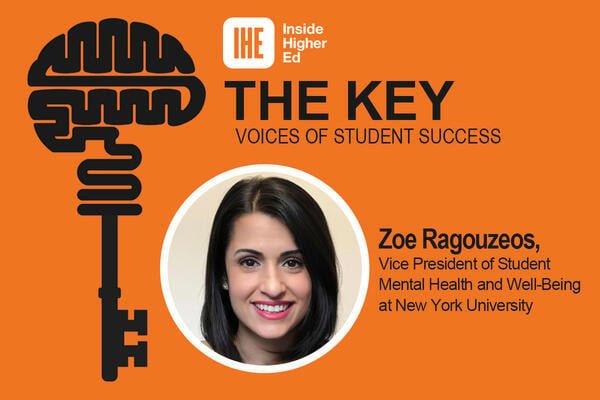
Zoe Ragouzeos, vice president for student mental health and well-being at New York University, joined Inside Higher Ed student success reporter Joshua Bay on Voices of Student Success to explore where institutional responsibility begins and ends, how campuses can move beyond reactive approaches to mental health, and what it would take to build environments where students don’t just persist but truly thrive.
Follow us on Apple Podcasts and Spotify.
Excerpts of the interview follow, edited for length and clarity.
Q: Over the course of this series, we’ve talked about rising mental health needs, student loneliness and the growing use of AI for emotional support. When you step back and look at those trends together, what do they tell you about the current student experience?
A: As it relates to mental health needs, we do need to take into account the fact that stigma has significantly decreased over the last 20 years. The fact that more students are coming forward and talking about their mental health issues is probably due to the comfort we’ve established within our higher ed institutions and, frankly, within our society, permitting people to talk about any psychological distress they’re experiencing.
Mental health needs were always in our midst; it’s just that more people are talking about them now. Our former surgeon general Vivek Murthy was one of the first people to talk about the loneliness epidemic. Certainly, AI, social media and the internet have resulted in more loneliness for our students, and I think lots of institutions are doing a great deal to combat that.
Q: For years, colleges have responded to mental health challenges by expanding counseling services. Is there a risk that we’ve come to view student well-being too narrowly—as something that is achieved inside a counseling center rather than something shaped by the entire campus experience?
A: I often say that all of our students need to feel cared for, but not all of them will need clinical care. Somewhere along the way, higher education realized that all students can benefit from centering well-being in their everyday interactions. Not all of those people are going to need a counselor and a course of treatment, but they will all benefit from universities centering well-being and charging themselves with making our students better and more resilient by the time they graduate.
I think the perspective was narrow because we always wanted to focus on our highest-need students, and that’s fair enough. But weaving well-being into the fabric of everything we do with students will make all of our students better. Of course, we still have to focus on the ones with mental health needs, but they won’t all need clinical care. They can always be better, and we should be charging ourselves with making all of them better as part of their higher ed experience—more well, more resilient and more able to flourish.
If you come to counseling, you will receive information on stress management. You could assume that people who need stress management will come to counseling, receive a wellness workshop and be able to manage their stress better. But we also know that most of our students are not going to sign up, and they don’t have the time to participate in these types of wellness programs. So it is our charge to disseminate this information where they already find themselves.
For example, we did an amazing partnership with our career services office. While students may not wake up in the morning thinking, “You know what, I need to manage my stress better, and I need more skills in order to do that,” most are certainly interested in their future careers. So we partnered with our career services center, trained the career coaches and gave them the language and skills they needed to assist students who are experiencing stress, emphasizing that if you manage your stress, your emotions and your time, those things will help get you the job. So well-being is important in service of something students want, which is to get an internship and land a job.
By the way, career coaches interact with so many more students than those who come through clinical services, and rightly so. So we trained the coaches, taught them de-escalation skills—because we know that a lot of students come in very anxious when they meet with career coaches—and gave them the language to talk about stress, time management and emotional regulation. Then we had our clinical experts create three-minute videos on these subjects that we gave to the career counselors to embed in their coaching sessions.
Q: When students feel isolated, disconnected or overwhelmed, how much of that should institutions view as an individual challenge versus a responsibility of the institution itself?
A: It has to be both. We want our students to feel connected—that is a charge of the institution—so there has to be an individual response to that. Then there should also be a systemic response. If we have students coming to us talking about feeling lonely, what specifically can we do with that particular student? But we also know good leadership requires that we think about trends and what we can do for all students in response to the individual feedback we’re seeing.
So if you want to look at loneliness, you can certainly respond by connecting a student with people like resident advisers or letting them know which clubs are available that might interest them. But if you look at it systemically, you can think about something like our In Real Life initiative, where we really try to connect students and have invested significant resources and intellectual capital into making sure students are speaking to each other face-to-face. Obviously, that has tremendous benefits for their well-being.
The isolation that comes from the online world is something students need to be educated about, and we can combat that. Our university created a device-free space, allowing people to learn how to speak to each other without their phones. So, again, we’re looking at individual feedback from students and then responding both at the individual level and the systemic level, making all of our students better, not just the ones who come and ask for help.
In terms of best practices, when we’re thinking as leaders about how to combat loneliness or create other kinds of well-being programming, partnering and co-creating with our students—as leaders and advisers, not just as recipients of these services—is really what a good response looks like.
Q: You’ve spoken about the role faculty can play in supporting student well-being. What responsibility should professors have—and where should the boundaries be?
A: Different roles within universities are going to have different responsibilities around student well-being. We do ask that every member of our community center well-being in their interactions with students, but we don’t expect our faculty to become counselors.
Students are already coming to them with well-being concerns. Faculty are noticing issues themselves, and they care about their students. So there is a distinct role faculty can play at the population level, such as including well-being statements in their syllabi, talking about stress management during stressful points in the semester and reminding students of the resources available to them. Other examples include how and when they set deadlines, how they facilitate group discussions and how they help students connect with one another. We expect that of faculty, but we don’t expect them to be counselors.
I’ve trained thousands of faculty over the years, and I’m able to make this distinction with them. By the end of the training, they have a good understanding of their role and contribution to student well-being, but also of what clinicians need to be doing. That’s on us. We need to make sure there is an easy way for faculty and staff to pass concerns along to professionals when they reach that threshold.
For example, a faculty member may talk about stress management in class, and afterward a student might approach them with more serious concerns related to anxiety. We want that faculty member to recognize the situation and easily refer the student to the proper channels. Here, we have a 24-7 counseling support and emergency response hotline available every day of the year. We receive thousands of calls from students themselves and from people who care about them, whether that’s faculty, friends or family members. All we ask is that colleagues notice concerns and report them to us. We make it that easy, and then the professionals take it from there.
Q: Many institutions say student well-being is a priority, but students often describe support systems as difficult to navigate or disconnected from their day-to-day experience. What separates institutions that are truly embedding well-being into campus culture from those that are simply adding services?
A: Expecting a single office to be in charge of student well-being is where institutions often go wrong. It can’t be that you have a health promotion office and expect it to do everything necessary to ensure students feel cared for. It really has to be the responsibility of the entire institution. That’s why I’m so grateful that our president declared flourishing a presidential priority.
When Dr. [Linda G.] Mills took office in 2023, she designated community flourishing as one of her main priorities. By doing so at the highest levels of leadership, it has allowed all of us across the university to galvanize around this work and do our part from our respective roles and vantage points.
That’s what separates a university that truly views well-being as part of everything it does—from academics and physical spaces to student services and peer interactions—from institutions that expect the health center, student well-being office or health promotion office to carry the responsibility alone.
One example I’m particularly proud of is our President’s Welcome and Reality Show. I’ve been involved with it since its inception in the early 2000s, and it’s one of our strongest statements as a university about our commitment to flourishing. We bring all incoming students—more than 6,000 at NYU—to experience a welcome from the president, followed by a theatrical production written entirely by students over the summer. The show focuses on health, well-being, safety and the realities of being a college student.
During the program, we talk about the hotline, health services, making friends, homesickness, AI, loneliness and staying safe. And by the way, these students are incredibly talented people who will go on to become future stars of theater and beyond, so the production really resonates. It’s not me up there singing and dancing.
Having the president open the event and then immediately follow it with a show centered on health and well-being sends a powerful message. It demonstrates a commitment from every part of the university that this is a priority. That’s one example of what it looks like when institutions truly embed well-being into campus culture.
Q: One theme that emerged throughout this series is that students are increasingly looking elsewhere for support—whether that’s social media, online communities or AI tools. What does it signal to you when students feel more comfortable turning to those spaces than to their institution?
A: What you’re really pointing to here is students using online resources versus not only university services, but also face-to-face external services. So the question becomes: What is it about the safety of engaging online that someone may not feel in engaging with a professional face-to-face—whether that’s inside or outside the institution?
There are a lot of reasons people might choose online care or online connection. They may feel safer; they may feel a sense of anonymity or that the distance of a screen makes it easier to open up in ways that in-person interactions feel too intimidating. And that’s on us to understand.
There is nothing wrong, frankly, with remote therapy. In fact, research shows that outcomes for remote therapy are very similar to face-to-face outcomes. So if you’re seeing a licensed professional over a screen with your camera on, you are getting good care—you are getting therapy—and that’s great.
But seeking support anonymously on social media or turning to ChatGPT for emotional support is a very different conversation. We need to educate students that AI is not able to think in the ways a human being can. At least at this moment in time, it’s not good enough, and it carries risk. If you truly need clinical care, you should not be using ChatGPT to get it. But I also understand why people do. It feels safer, and there’s something about not being a real person that allows someone who feels vulnerable to open up, because they know it’s not real in the same way.
At the same time, we have to be clear that it is not safe to rely on a bot for clinical guidance. It is not yet capable of providing safe, high-quality support. Our responsibility is to give people better alternatives—so they feel comfortable turning to a real human being, even if that interaction is remote, to have those conversations.
Q: If we revisit this conversation five years from now, what would meaningful progress look like? How would we know higher education is actually moving in the right direction on student well-being?
A: If we are able to ask any university around the country, “How are you centering well-being?” and everyone has an answer to that question, I think that would be significant progress. It would mean that everyone has accepted the idea that it is an expectation of higher education to make people better when they leave than when they started. If every leader in higher education is able to articulate how they do that, that would be real progress.
Then, if you drill down further, people should be able to explain how every aspect of the student experience is touched by this commitment to well-being. So if someone is talking about academic policies, I want to know how they’ve considered well-being in those policies. If they’re talking about peer-to-peer relationships, I want to know what they’ve done to ensure students can support one another and feel a sense of belonging.
Even physical spaces matter. We happen to be in New York, and we are tree and green space deprived. So what is the university doing to ensure students have access to outdoor spaces and that our built environment supports connection and small-group conversation—the kinds of things we know help people thrive?
That’s what real progress would look like to me: that everyone has a plan for how they are centering well-being across every aspect of the student experience.
Get more content like this directly to your inbox. Subscribe here.
You may be interested

‘NAZA’ directors talk about controversial testimonies of civilian killings in Gaza
new admin - Sep 15, 2026IE 11 is not supported. For an optimal experience visit our site on another browser.UP NEXTMacklemore says he was dropped…

FBI director insists new hiring standards on prostitution and bestiality were only meant to assist sexual assault victims
new admin - Sep 15, 2026FBI Director Kash Patel on Tuesday defended his agency's decision to lower its hiring standards, after he faced a barrage…

Taylor Swift Emmy Sketch Sparks Easter Egg Frenzy
new admin - Sep 15, 2026[ad_1] Taylor Swift sent Swifties into overdrive when she made a surprise cameo at the 78th Emmy Awards. The superstar…