

The secret to Roku’s success: not being cool

This is Lowpass by Janko Roettgers, a newsletter on the ever-evolving intersection of tech and entertainment, syndicated just for The Verge subscribers once a week.
Roughly 10 years ago, someone told me that Roku was making “cheap hardware to sell to Walmart customers in flyover states.” The remark was meant to be an insult, belittling a company that seemed to care more about hardware profit margins than design and innovation.
Still, I’ve been thinking about it a lot over the years. And as Roku became a major force in streaming hardware, surpassing 100 million households last month, I’ve come to the conclusion that Roku’s secret superpower may just be that it embraced not being cool.
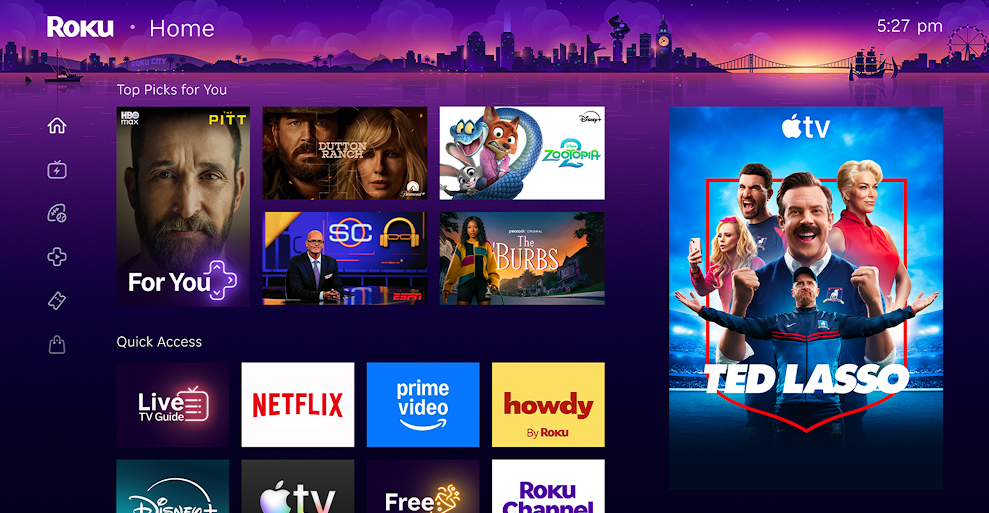
Case in point: the new homescreen the company began rolling out this week. It’s a refresh that had been overdue for some time, and, in many ways, it’s the bare minimum the company could have done — which means it’s likely going to be a huge success.
Content-forward, but not overbearing
Companies that make streaming dongles and smart TVs have long pushed the idea of content-forward user interfaces. The gist of it: People don’t want to launch an app, browse through row after row of thumbnails, and then do the same thing all over again in the next app if they can’t find something they want to watch right away.
Content-forward interfaces instead serve up personalized recommendations for individual movies and shows directly on the homescreen. Add some tiles to quickly access the next episodes of your current favorites, and you’ve got an interface that makes it much easier to actually watch TV without wasting time on discovery.
Amazon was first to embrace a content-forward interface with its Fire TV devices more than a decade ago. Google followed suit with Android TV, and then doubled down on the idea when it relaunched its living room platform as Google TV. Today, virtually every smart TV platform has some kind of content-forward interface.
The sole exception, up until now: Roku. The company added some dedicated content categories to its sidebar over the years, but largely kept the homescreen a bare list of app icons.
This week, that’s changing, but in a very Roku-like way. “I don’t think ours looks like those others,” says Preston Smalley, who led the redesign as Roku’s VP of viewer product. “Yes, it has content on it. Yes, it has a destination that you can browse, but I think it still stands apart as something unique.”
While others lead with big, wall-to-wall hero art to highlight individual shows (and the occasional ad), Roku’s new homescreen starts with a comparably small, personalized “top picks for you” section, followed by rows of tiles that look a lot like the old Roku homescreen: apps, destinations, shows, all arranged in a tight grid, accompanied by a retractable sidebar, and with enough room for a big ad on the other side (like its competition, Roku is also looking to make more money with its homescreen).
It all looks very predictable and familiar. Boring, perhaps, but also less distracting than the bigger and bolder interfaces used by Fire TV and Google TV with their massive banners and autoplay trailers. Roku’s existing customers will feel right at home.
The logical conclusion of cord-cutting
Roku has been on the forefront of one key trend: While some of its competitors were trying to make nice with cable companies, Roku embraced cord-cutting from day one. The company also realized early on that cord-cutting was primarily about saving money. It priced its hardware accordingly, struck partnerships with budget consumer electronics makers like TCL to expand into smart TVs, and has been heavily betting on free, ad-supported TV for years.
Roku executives also early on predicted the logical conclusion of this trend: If all TV is going to be streamed one day, then everyone will need to be able to access streaming — including tens of millions of people who aren’t exactly tech-savvy.
Smalley knows this late-adopter world well. Before Roku, he worked nearly a decade at Comcast. Doing user research for the cable company was an eye-opener. “I’d go to people’s homes,” he recalls. “Some people would have remote controls where they taped over the buttons and tried to simplify it down to what looks more like a Roku remote.”
Those attempts to dumb down devices continue in the streaming age. “You’ve got people that maybe only use a few apps. Maybe their son comes by and configures it so that all their apps are right there. Unfortunately, not everyone’s got a loving son. For each of those, there’s 10 more that don’t have that.”
That’s why the new Roku homescreen has a dedicated “quick access” section of frequently-used apps above the fold. The section auto-updates based on usage, and can also include the tile to change your HDMI port if you’re one of those people who frequently switches to a game console. “You have different people that are looking for different things,” Smalley says. “And yet you want to have one experience that works [for everyone].”
Roku City may be coming to mobile
One noteworthy feature of Roku’s new homescreen is a section called Your Daily Scoop that aims to serve up zeitgeist-influenced viewing recommendations. Think awards, holidays, pop culture moments, and yes, even the news — with some guardrails. “We’re not going to talk about the war,” Smalley says. “It’s definitely a curated experience.”
It’s still essentially running on autopilot, so there may be slip-ups. More importantly, it does highlight one of Roku’s weaknesses: a lack of first-party data that doesn’t originate from people using Roku’s devices. Google uses search trends to inform what it shows on Google TV, and Amazon can presumably tap into Alexa usage patterns to personalize Fire TV.
Roku doesn’t have any of that, and is trying to make up for it with third-party data. “We’re using some of the LLMs [to figure out] what people are looking for,” Smalley says.
Still, Roku also does have a few things the competition lacks. One example: Roku City, the company’s screen saver that became a cult hit during the pandemic, now has its own app icon. “We wanted to provide a way for [people] to launch it [without having to] wait 10 minutes before this thing comes on,” Smalley says.
It’s a small step, but one that’s in line with the company’s efforts to transform Roku City into both a destination and a moneymaker. In recent years, it has integrated ad campaigns, minigames, and even a live concert into the purple-tinged cityscape. Next up could be an expansion to mobile. “We have 34 million people using our mobile app every month,” Smalley says. “We’re looking at the right way to bring some of Roku City to mobile.”
If and when that happens, it will likely be deceptively simple — and incredibly successful.
You may be interested

U.S. Coast Guard can send divers to Bahamas to search for missing American woman Lynette Hooker, source says
new admin - May 28, 2026The U.S. Coast Guard has been granted permission by the Bahamian government to send divers to canvass previously unsearched areas…

Google Staffer Allegedly Used Insider Data to Win D4vd Polymarket Bets
new admin - May 28, 2026[ad_1] A Google engineer got an early look at insider data showing singer D4vd would be the surprise upset winner…

WWE’s Logan Paul undergoes tricep surgery, says he was ‘wide awake’ for it
new admin - May 28, 2026[ad_1] NEWYou can now listen to Fox News articles! Logan Paul wrote on social media on Wednesday that he was…