
Barack Obama on the Music That Made America

D
uring my first presidential campaign, I became a bit particular — maybe even a little superstitious — about my debate-day rituals. I had to get in a quick workout, and always ordered the same dinner. And then, in the half hour or so before the main event, I’d set aside whatever notes and talking points my staff had given me, put on some earbuds, and just listen to some music.
Initially, I listened to a handful of jazz classics — Miles Davis’ “Freddie Freeloader,” John Coltrane’s “My Favorite Things.” But over time, I discovered that rap was the thing that got my head in the right place. A couple of songs about defying the odds and putting it all on the line — Jay-Z’s “My 1st Song” and Eminem’s “Lose Yourself” — were always in the rotation, maybe because they felt suited to my early underdog status. Sitting alone in the back of the Secret Service SUV on my way to the venue, nodding to the beat, I would feel the pomp and circumstance and artifice of my immediate surroundings melt away. I’d find my mind returning to those things that were most essential to me — the friends and family that had shaped me; the values and ideals that drove me; and all the forgotten voices of people across the country that I hoped to someday represent.
Music has always had the ability to speak to us, and for us, in a way nothing else can. Which is why, if you want to understand the past 250 years of American life, one of the best ways to do it is to listen to the music that defined this great nation of ours.
When enslaved people were first brought to our shores hundreds of years ago, the music in their hearts gave them the strength and courage for what lay ahead. Spirituals weren’t mere entertainment. They were, as W.E.B. Du Bois would later describe, “the articulate message of the slave to the world” — a way of insisting on the humanity that others tried to deny them.
That same spirit helped animate the women’s suffrage movement. Rally songs written to the tune of “Yankee Doodle” and “America (My Country, ’Tis of Thee)” became an important part of marches and pickets, and because everyone already knew how to sing them, organizers didn’t have to print sheet music. All they had to do was hand out a new set of lyrics.
Later, riding freight trains during the Great Depression, Woody Guthrie listened to the songs of Dust Bowl migrants and immigrant laborers. He wrote “This Land Is Your Land” in response to Irving Berlin’s “God Bless America,” arguing that this country belonged to the struggling and the marginalized as much as it did to the privileged and pedigreed.
The tradition found its fullest expression during the Civil Rights Movement, which was, among other things, a singing movement. “We Shall Overcome” and other gospel songs echoed through jail cells and church basements, creating a bond that no billy club or fire hose could break. And when, at the March on Washington, Mahalia Jackson called out to Dr. King to “Tell them about the dream, Martin!” she was doing what musicians have always done at their best: arriving at the truth, then waiting for the rest of us to catch up.


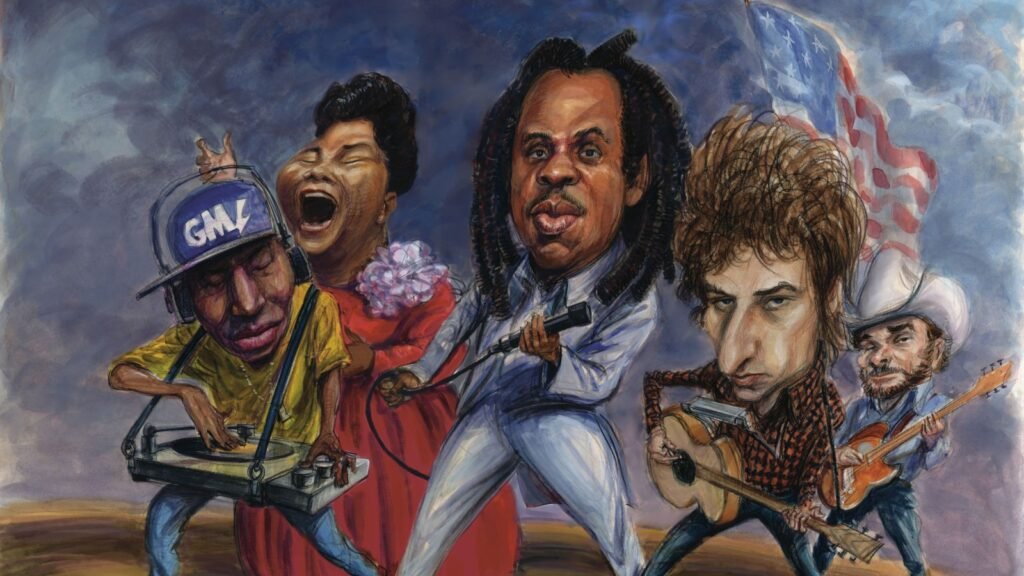
Throughout the Sixties and Seventies, popular music would continue to spur on social change, asking the questions that needed to be asked. During the Vietnam War, protest songs like “Fortunate Son,” “Blowin’ in the Wind,” and “What’s Going On” became part of the air this country breathed. Meanwhile, songs like Merle Haggard’s “Okie From Muskogee” spoke for the working-class Americans who felt the protest movement had nothing to say to, or about, them — reminding us that in a big, rambunctious nation like America, we can never presume to expect everyone to sing to the same tune.
Years later, young Black and Latino kids in the Bronx used turntables to remake popular music yet again. Like all of the best music, hip-hop wasn’t just a diversion — it was journalism set to a beat, with songs like “The Message,” by Grandmaster Flash, describing a reality most of the country had never had to confront. And over the next few decades, a genre of music created by people demanding dignity and respect would become the most popular music in the world.
Of course, none of these forms of expression existed in isolation. The reason American popular music has always been so rich and evocative, so powerfully alive, is that it reflects the mongrel, polyglot aspect of our society — blending everything from African rhythms to Irish folk music, the melodies of the concert hall to juke-joint blues. That’s why American music is constantly renewing itself, and why, at its best, it resonates beyond our borders — for it contains elements from every corner of the globe.
Partly because it draws on and experiments with so many different traditions, American music has often spoken to our most pressing issues, conflicts, and contradictions before our politics does. Not because musicians are wiser than politicians — although many are — but because music operates by different rules.
Music doesn’t have to win a majority of voters. It doesn’t need to appeal to the lowest common denominator or lay out a 10-point plan. It just has to be true enough for people to see themselves in it. It just has to remind people that they’re not alone in their fears and their struggles, their hopes and their dreams. Great music has a way of helping us feel seen; more than that, it helps us see others, enlarging our hearts and our moral imaginations. That’s how the spirituals preached emancipation before the Proclamation was signed, rock & roll encouraged integration before the Civil Rights Act was passed, and the protest songs got the wrongness of Vietnam long before the government could admit it.
Again and again, music showed us the way. And eventually, America followed.
In the White House, Michelle and I would set aside nights to honor and celebrate the music that has shaped America, from classical and country to blues, Broadway, gospel, Motown, Latin, and jazz. And when we were designing the Obama Presidential Center — which opens in June on the South Side of Chicago — we included a recording studio and a performance space so the next generation of voices can hold a mirror up to this country, with all its beauty and flaws, and lead us somewhere better.
Because America has always been worth singing about — and those songs are a form of faith. Faith that our unlikely experiment in self-government is not yet finished. Faith that America is what we make of it. The songs themselves will keep changing, but my greatest hope is that the faith in our democracy remains the same, and that together we can continue the glorious task of bringing America closer to what we know it can be.
BARACK OBAMA is the 44th president of the United States. The Obama Presidential Center opens to the public on the South Side of Chicago in June.
You may be interested
Berlin Pride attack suspect had been released from prison despite ISIS ties
new admin - Jul 27, 2026CBS News has learned that the 21-year-old man accused of plowing his vehicle through Berlin's Pride celebration on Saturday night…
Sen. Ron Johnson on released Fauci diary entries
new admin - Jul 27, 2026Ahead of Anthony Fauci's Senate testimony on Wednesday about the federal response to the COVID-19 pandemic, Kentucky GOP Sen. Rand…
Commanders fire tight ends coach Ben Steele after DWI arrest in Virginia
new admin - Jul 27, 2026[ad_1] Breaking: Son of Chiefs coordinator arrested in mother's shooting Kansas City Chiefs offensive coordinator Eric Bieniemy's son, Elijah Bieniemy,…