
The 100 Greatest Punk Albums of All Time

From New York rockers to anarchists in the U.K. from hardcore to riot grrrl to pop-punk, and more
Punk rock started in 1976 in New York, when four cretins from Queens came up with a mutant strain of blitzkrieg bubblegum. The revolution they inspired split the history of rock & roll in half. But even if punk rock began as a kind of negation — a call to stark, brutal simplicity — its musical variety and transforming emotional power was immediate and remains staggering. To celebrate the 50th anniversary of the Ramones’ toweringly influential self-titled debut, we’ve compiled a list of the 100 Greatest Punk Albums of All Time.
If Ramones was Year Zero for punk rock, it didn’t come without precedent, so we included essential forebears like the Stooges, the New York Dolls, and Patti Smith, artists who were punk in spirit before the style really had a name. When punk did happen, it was an explosion of ideas and possibilities. Along with the Sex Pistols and the Clash, Black Flag and the Descendents, Bad Brains and Minor Threat, you’ll find Gang of Four mixing funk attack and Marxist theory, the ice-storm goth of Joy Division, the Mekons’ existential country visions, riot grrrl radicals like Bikini Kill and Sleater-Kinney, ska punk from Rancid and Operation Ivy, multiplatinum pop-punks Green Day and Blink 182, and new-look hardcore bands like Turnstile and Soul Glo.
Punk and its many offshoots have spawned so much great music that we’ve included a list of 200 related albums to check out. “Punk rock should mean freedom,” said Kurt Cobain in 1991, just as Nevermind was exploding punk values across the middle American mainstream. Here’s one map to where that freedom can take you.
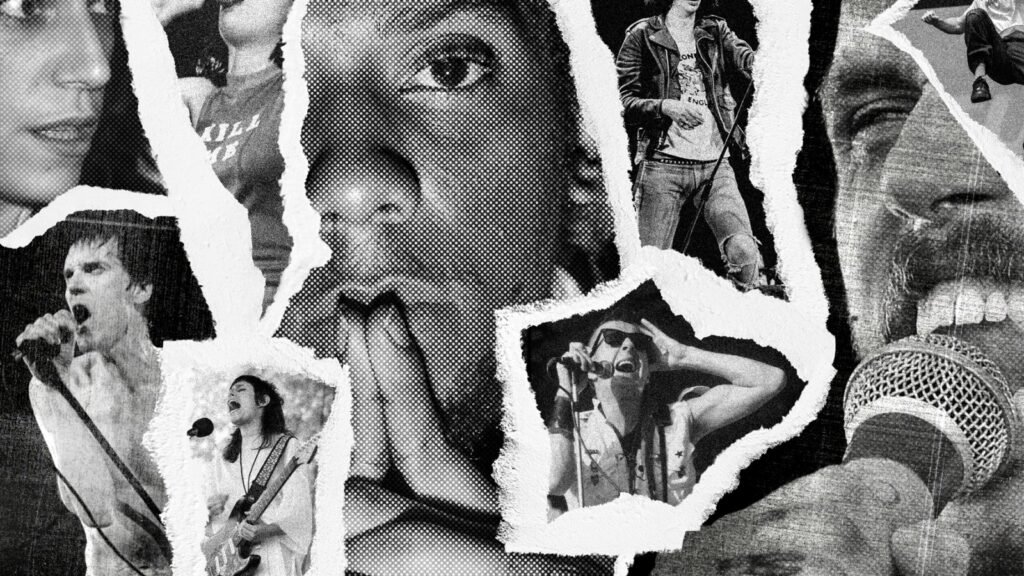
Photographs in illustration by:
Richard E. Aaron/Redferns/Getty Images; Lindsay Brice/Michael Ochs Archives/Getty Images; Peter Noble/Redferns/Getty Images; Gus Stewart/Redferns/Getty Images; Jim Dyson/Getty Images; PAUL BERGEN/ANP/AFP/Getty Images; Paul Bergen/Redferns/Getty Images; Lisa Lake/Getty Images/Anheuser-Busch; Richard McCaffrey/Michael Ochs Archive/Getty Images
-
D.R.I., ‘Dealing With It!’

Tearing through 25 songs in under 35 minutes, the pioneering Texas band turned its second full-length album into a proof of concept: Yes, Virginia, you could merge hardcore punk with the burgeoning 1980s genre known as thrash metal and come up with a pit-perfect crossover sound. Singer Kurt Brecht and his fellow Dirty Rotten Imbeciles were capable of keeping things slow and low when needed — see: the beautifully sludgy “Soup Kitchen” — but it’s songs like “Shame,” which hit the ground running, calls out everything from pollution to war to “stupid, idiot, cock-rock bands,” and still finds time for a shredding guitar solo before hitting the brakes right past the one-minute mark. Their logo of a Pedestrian-Crossing-sign figure in mid-mosh was well-earned. —David Fear
See also: Cro-Mags, The Age of Quarrel (1986); S.O.D., Speak English or Die (1985)
-
Paramore, ‘Brand New Eyes’
With Brand New Eyes, Paramore experienced their own version of Patti Smith’s epiphany on “Gloria.” “The truth never set me free/So I’ll do it myself,” Hayley Williams avowed on the album’s explosive opening track. For a pop-punk emo outfit from the Bible Belt that once sang “This heart it beats/Beats for only you” in a screamo song dedicated to God, it was a pretty punk move — and a dramatic shift that heightened inner-band turmoil. (Josh and Zac Farro even cited the lyric in their statement departing the band.) Besides challenges to their Christian upbringing, Paramore’s third LP was also filled with screeds directed at one another. In that way, Brand New Eyes is like a tame emo version of Rumours produced by the mastermind behind Green Day’s Dookie, Rob Cavallo. —Maya Georgi
See also: Fall Out Boy, Take This to Your Grave (2003); My Chemical Romance, Three Cheers to Sweet Revenge (2004)
-
The Faith and Void, ‘Faith/Void’
The two sides of this album were split between two bands that showed different strands of the Washington, D.C., hardcore scene. A band of insiders, the Faith were fronted by Alec MacKaye, younger brother of Minor Threat’s Ian MacKaye, who rages over Michael Hampton’s raw riffs and Chris Bald’s near-melodic bass thud. You can even hear a little emo in the side closer “In the Black.” Void, on the flip, hailed from the outer suburb of Columbia, Maryland, and if MacKaye sounded furious but focused, Void singer John Weiffenbach seemed completely unglued. Full of feedback and sick metallic runs played at a breakneck gallop, the amazing Void side sounds ever more chaotic as it goes along. Inspirational line: “Who are you and why am I here?” —Joe Gross
See also: Void, Live 1982 (2026); The Faith, Subject to Change (1983)
-
Naked Raygun, ‘Jettison’
Chicago’s Naked Raygun cast a long shadow over generations of other bands: Along with being Dave Grohl’s first punk show, they’ve been name-checked by Blink-182 and covered by Fall Out Boy. The band’s third album, Jettison, is a prime example why. On the ferocious, melodic opener, “Soldier’s Requiem,” singer Jeff Pezzati calls out the “lies that sought to deceive” in war while also honoring those lost in battle, peppering in perfect shout-along “whoa-oh-ohs.” From the anthemic, reflective “When the Walls Come Down” and “Walk in Cold” to the swinging “Ghetto Mechanic,” the whole thing is blue-collar Midwestern post-hardcore at its best. —Althea Legaspi
See also: The Didjits, Hey Judester (1988), Die Kreuzen, October File (1986)
-
Refused, ‘The Shape of Punk to Come’
“Can I scream?” wonders frontman Dennis Lyxzén, halfway through the Swedish hardcore legends’ skin-peeling third album. For the record, he’s not asking permission: Refused’s indisputable masterpiece is one long howl of rage, as the singer and his bandmates rip into complacency, complicity, and the dehumanizing effects of capitalism. But it’s also about the bliss of adding “new noise,” to quote one of their track’s titles, to a punk subgenre without sacrificing an ounce of the anger or speed that originally defined it. Techno beats, violin-driven laments, and the loud-quiet dynamic of early Nineties college rock — this is also hardcore, the group declares. Welcome to the future, punks. —D. Fear
See also: The (International) Noise Conspiracy, The First Conspiracy (1999); Final Exit, Teg (1997)
-
Downtown Boys, ‘Full Communism’
A lot of political rock gets dinged for being too programmatically vague. This criticism meets its match in Providence, Rhode Island’s ferocious Downtown Boys, who delineate their Marxist gospel right out front over the saxophone-laced agita of “100% Inheritance Tax” and “Wave of History,” and even get straight-up Stalinist on “Break a Few Eggs.” Singer Victoria Ruiz shouts in both English and Spanish; on the thrilling “Monstro,” she turns the repeated slogan “She’s brown! She’s smart!” into a radical statement of empowerment as the music builds to an explosive crescendo. They end it with a cover of Bruce Springsteen’s “Dancing in the Dark,” magically turning a song about midlife white-guy malaise into an anthem of radical political transformation. —Jon Dolan
See also: G.L.O.S.S., Trans Day of Revenge (2015), Perfect Pussy, Say Yes to Love (2014)
-
Redd Kross, ‘Born Innocent’
Before becoming the power-pop pioneers that laid groundwork for grunge, Redd Kross were the best hardcore band in Hawthorne, California, the sunny burg that spawned the Beach Boys. Led by guitarist Jeff McDonald and his 15-year-old brother, Steve, on bass, Redd Kross were teen dreamers fueled on pop music and pop culture — touchpoints for their 1982 debut, Born Innocent, include Linda Blair, Solid Gold, Beyond the Valley of the Dolls, and Charles Manson, who is both discussed (“Charlie”) and covered (“Cease to Exist”). Redd Kross were unafraid to drop a wild guitar solo or a beaming hook in an album of mostly sub-two-minute burners — squint just right it, and might sound like Cheap Trick or Kiss hopped up on Ovaltine. —Christopher R. Weingarten
See also: Dogmatics, Thayer St. (1984); Shonen Knife, Let’s Knife (1992)
-
IDLES, ‘Brutalism’
The debut studio album from Bristol, England’s IDLES was inspired in large part by the death of singer Joe Talbot’s mother — not exactly traditional punk-rock subject matter, especially for a band as relentlessly hard-hitting as this one. But his grief and anger become the jumping-off point for songs about class politics, cultural elitism, toxic masculinity, and feminism, delivered with pure-hearted intensity and a wry sense of humor. “The best way to scare a Tory is to read and get rich,” Talbot hollers over the pounding bass and drums of “Mother,” one of many indelible moments where he puts a new spin on old-school proletarian rage. —J.D.
See also: Shame, Drunk Tank Pink (2021); Fontaines DC, Dogrel (2019)
-
Sick of It All, ‘Blood, Sweat, and No Tears’
Blood, Sweat, and No Tears is the work of four idealists from Queens constantly disappointed by reality never meeting their expectations. They don’t like people “beating up kids weaker than you” (“Pushed Too Far”). They hate seeing criminals set free (“victims are the ones that pay,” frontman Lou Koller sings on “B.S. Justice”). And they can’t stand backstabbing buddies (they don’t need “Friends Like You”). Fortuitously, they discovered a likeminded community in New York hardcore and recorded a perfect album with 19 songs lasting 27 minutes. Each song spreads its own hardcore reality, to use their term, but “Rat Pack,” about sticking together, and the anthemic “Injustice System!” are the songs that made the band’s debut LP a classic. —Kory Grow
See also: Rest in Pieces, My Rage (1987); Judge, Chung King Can Suck It (1989)
-
L7, ‘Smell the Magic’
Seven seconds of psychedelic jamming introduce L7’s second album before Donita Sparks’ guitar rips through the purple haze with the riff to “Shove,” a middle finger to everyone in the quartet’s way. “Some guy just pinched my ass,” singer Suzi Gardner sings on the song, and the band screams, “Shove!” Smell the Magic (a T-shirt explains the title) is a short-and-sour half hour of metal-tinged punk fury by four women ready to take revenge on a sexist, corrupt world. Sparks captures the ethos of the band with the line, “[She] got so much clit, she don’t need no balls,” and later they skewer horny hair-metal bands on “Just Like Me.” L7 claimed to have no role models, but even if they did, they’d have slaughtered them anyway. —K.G.See also: Hole, Live Through This (1994); Lunachicks, Babysitters on Acid (1990)
-
The Damned, ‘Damned Damned Damned’
The first British punk band to release both a single (“New Rose”) and an album (Damned Damned Damned was rushed out in February 1977, beating the Pistols and the Clash), the Dammed weren’t revolutionaries: They were just an urgent, tough rock & roll band with a lot of attitude, a deep fondness for the Stooges (whose “1970” they cover here as “I Feel Alright”), and a monstrously agile drummer who called himself Rat Scabies. Their initial lineup (with chief songwriter and guitarist Brian James) didn’t last long, but “Neat Neat Neat” sent a thousand bored English teenagers scrambling to buy guitars. —Douglas Wolk
See also: The Damned, Machine Gun Etiquette (1979); The Adverts, Crossing the Red Sea With the Adverts (1978)
-
Angry Samoans, ‘Back From Samoa’
Were the Angry Samoans sharp satirists or just hateful little twerps? Both, most likely. Fronted by former Rolling Stone writer “Metal Mike” Saunders, the Californian band of garage-rock clowns jumped on the hardcore bus for their first album. It’s 14 very fast, very silly, deeply antisocial songs in under 18 minutes, packed with homophobic rants that usually drift into homoerotic innuendo, as with the ludicrous “They Saved Hitler’s Cock” (“Now it’s starting to get hard/I found it in my backyard”). Highlight: “Lights Out,” a 52-second headbanger about how awesome it is to poke one’s eyes out, which the Samoans’ audiences used to mime with plastic forks. —D.W.
See also: Dead Milkmen, Big Lizard in My Backyard (1985); Adolescents, Adolescents (1981)
-
Social Distortion, ‘Mommy’s Little Monster’
“We were teenagers and we were reacting against society, and society was reacting against us,” Social Distortion’s Mike Ness remembered of the Fullerton, California, band’s early days. “It was very volatile.” Social D would eventually break into the rock mainstream during the Nineties by connecting Southern California punk rock with rockabilly and country on snarling, disaffected hits like “Story of My Life” and “Ball and Chain.” But their debut is pure punk angst. Cut in a single session on Christmas Eve 1982, Mommy’s Little Monster already exudes the world-weariness that would define Ness’ later, cleaned-up work, but it’s buoyed by scrappy, youthful likability. —Michaelangelo Matos
See also: Social Distortion, Somewhere Between Heaven and Hell (1992); Youth Brigade, Sound & Fury (1983)
-
Negative Approach, ‘Tied Down’
The Midwest malaise of Detroit’s Negative Approach was one of hardcore’s better upped antes — angry, ugly, scabrous, intense, and more than willing to harsh your mellow. On the band’s lone LP, the rasp of frontman John Brannon cuts through the music like a welding torch through a carburetor, switching between furious (“Hypocrite”) and bleak (“Evacuate”). Their best known song, “Nothing,” is an absolute bummer delivered at 188 bpm, but NA still manage to end Tied Down with the defiant optimism of “I’ll Survive.” According to Brannon, their shows weren’t well-attended, and Tied Down only had a run of 3,000 copies. But these 10 tantrums (delivered in less than 17 minutes) have grown into a touchstone for punk, metal, and noise bands for years. —C.W.
See also: Necros, I.Q. 32 (1981); Zero Boys, Vicious Circle (1982)
-
Jawbreaker, ’24 Hour Revenge Therapy’
East Bay band Jawbreaker were coming off a punishing tour and the aftermath of frontman Blake Schwarzenbach’s vocal surgery when they high-tailed it to Steve Albini’s house in Chicago to work on the scathingly sincere 24 Hour Revenge Therapy. A drilled-down distillation of the best parts of their work, it was turbo-charged by Schwarzenbach unblinking candor, dark humor, and gimlet-eyed observations. Odes to bathroom hook-ups and digs at scene politics (like the immortal taunt “’You’re not punk and I’m telling everyone,’”/Save your breath, I never was one”) all shape his storytelling, which also includes experimental peaks: His images of a lonely, unfinished boat, captured from multiple angles, on “The Boat Dreams from the Hill” stick decades later.–Julyssa Lopez
See also: Jawbreaker, Dear You (1995); Sunny Day Real Estate, Diary (1994)
-
The MC5, ‘Kick Out the Jams’
The wild and woolly MC5 turned party politics into party time, spouting lefty rhetoric, aligning themselves with the Black Panthers, and disrupting the Democratic National Convention — all to the soundtrack of Wayne Kramer’s audacious, bombastic riffs. Their debut — a live album to capture their hair-whipping fury —is a proto-punk landmark, mixing revved-up classic rock (“Ramblin’ Rose” was originally done by Jerry Lee Lewis), freaked-out jazz metal (“Starship” was inspired by Sun Ra), some revolutionary banter (courtesy of poet John Sinclair) and of course the ever-enduring “Kick Out the Jams,” a rocking-out-about-rocking-out standard covered by everyone from Rage Against the Machine to Afrika Bambaataa to Jeff Buckley. —C.W.
See also: The Sonics, Here Are the Sonics!! (1965), Death, For the Whole World to See (2009)
-
Frightwig, ‘Cat Farm Faboo’
When Kurt Cobain did his legendary MTV Unplugged performance with Nirvana in 1994, he wore a Frightwig T-shirt under his cardigan — a fitting tribute for this under-the-radar band. The punk-rock women of Frightwig were raising hell in San Francisco with their 1984 debut, Cat Farm Faboo. They had choice words for the menfolk in the room, as in their self-explanatory “My Crotch Does Not Say Go.” As Courtney Love once recalled, “Me, Kat [Bjelland from Babes in Toyland], and Jennifer Finch [from L7] all watched Frightwig on the same night and all decided to start bands the next day. Frightwig are the true grandmothers of riot grrrl.” —Rob Sheffield
See also: Babes in Toyland, Fontanelle (1991); Scrawl, He’s Drunk (1989)
-
Blink-182, ‘Dude Ranch’
Dude Ranch is the masterpiece Blink-182 made right before they fully put the pop in pop punk. The SoCal trio’s second LP is more polished and precise than its predecessor, Cheshire Cat, but still scrappy and ragged. Original drummer Scott Raynor never hit with the same exactitude as Travis Barker, but that gives Dude Ranch a teetering-on-the-brink energy. Meanwhile, Mark Hoppus and Tom DeLonge’s songwriting shows how the young male psyche can use dick jokes, jerking off, and Star Wars in service of genuine vulnerability, self-reflection, and growth. Perhaps the definitive Dude Ranch anecdote is that, after shredding his voice while recording the indelible “Dammit,” Hoppus realized he had to quit smoking if he wanted to keep singing. As the saying goes: I guess this is growing up. —Jon Blistein
See also: Cosmic Psychos, Cosmic Psychos (1987); Bullet LaVolta, The Gift (1989)
-
Priests, ‘Nothing Feels Natural’
It’s easy to peg Priests’ first album to its release date: Jan. 27, 2017. Here was an upstart Washington, D.C., punk band releasing a debut album filled with astute, acerbic protest music one week after Donald Trump’s first inauguration. But as much as Nothing Feels Natural spoke to its moment, the album has a timelessness that warrants its place in the pantheon. “No Big Bang” explores creativity and consciousness, and “JJ” is a rowdy kiss-off to a person who doesn’t deserve to have such a great song written about them. When Priests do get political, they offer a reckoning with, and invective against, a system in deep decline. “Sign a letter, throw your shoe, vote for numbers one or two,” Katie Greer sings on the bracing “Pink White House.” Same as it ever was. —J.B.
See also: Flasher, Constant Image (2018); Katie Alice Greer, Fly by the Dixie Chicks (2018)
-
Discharge, ‘Hear Nothing, See Nothing, Say Nothing’
Discharge may not have invented the kick-snare, kick-kick-snare “D-beat,” but all the crustie, anarcho-punk, grindcore, and thrash-metal drummers who plagiarized it throughout the Eighties probably would have played something different if Discharge hadn’t done it so well. Yet the British quartet’s debut LP is much more than Garry Moloney’s iconic D-rattle. The record reached critical mass because of guitarist Bones’ cutting, simplistic riffs, frontman Cal Morris’ bleak tableaus of de-evolution, and the group’s sickening black-and-white cover art. Morris hectors songs like “Protest and Survive,” “Free Speech for the Dumb,” and “The Nightmare Continues” over his bandmates’ racket in a way that lodges them in listeners’ brains. Everything here is cutting and simple, and nobody ever copied the sound completely. —K.G.
See also: Napalm Death, Scum (1987); Nausea, Extinction (1990)
-
NOFX, ‘Punk in Drublic’
NOFX bassist-singer Fat Mike is one of the great American punk characters, a chronic smart aleck with a sterling sense of humor and generous heart. “That’s me in the street with a violin under my chin/Playin’ with a grin/Singin’ gibberish,” he sings on the L.A. band’s great fifth album. Everyone is equal in his eyes — from the “Punk Guy” who’s “Got a face like Charles Bronson/Straight out of Green Bay, Wisconsin” to the dude “in a tie-dyed Rancid shirt” who “wears his Birkenstocks to work.” That magnanimity makes their speedy, hooky tunes all the more relatable and admirable. Among the album’s peaks are the anti-racist “Don’t Call Me White” and the communal “The Brews.” —M.M.
See also: NOFX/Rancid, BYO Split Series/Volume III (2002); Halo of Flies, Singles Going Nowhere (1989)
-
Agnostic Front, ‘Victim in Pain’
From the Tompkins Square riots to the squats lining the park, the Lower East Side in the 1980s was a tough place — and the music that came out of it, dubbed New York hardcore (NYHC), was just as aggressive. Agnostic Front had been around for a couple of years before Victim in Pain came out, honing their sound at local spots like CBGB and A7. The album is just 15 minutes long, but it captures the feeling of the era — leaning into shouted vocals, reliance on a double bass pedal, and bone-chilling breakdowns in each of its 11 songs. The band would go on to find a poppier sound in the 1990s, but Agnostic Front’s debut established them as the toughest punks on the toughest block. —Elisabeth Garber-Paul
See also: Sheer Terror, Just Can’t Hate Enough (1989), Gorilla Biscuits, Start Today (1989)
-
Various Artists, ‘No New York’
The four bands on this legendary Brian Eno-produced 1978 compilation pushed New York punk to its atonal, often hilariously abrasive limits, creating the short-lived No Wave scene. The Contortions deconstruct jazz and funk as well as punk with impish pomp. Teenage Jesus & the Jerks, led by feral shrieker Lydia Lunch, presaged riot grrrl. Mars’ headlong “Helen Forsdale” delivered a noise freakout with the primal force of a great single. And DNA make all of the above sound like middle-of-the-road pop. Future NYC noisemakers like Sonic Youth furiously took notes. —M.M.
See also: The Contortions, Buy the Contortions (1979); DNA, DNA on DNA (2004)
-
Crass, ‘The Feeding of the 5000’
The British anarchist punk collective Crass walked the walk: Based out of a collective house that’s still in operation today, they did everything themselves, including running their own Crass Records and designing their own multimedia presentations. Their political fury was fearsome — they responded to Margaret Thatcher’s Falkland Islands war with a scalding single called “How Does It Feel to Be the Mother of a Thousand Dead?” — and they addressed their own scene’s sexism head-on. This ultra-raw debut album is driven by their four (!) vocalists’ belligerent (if pacifistic) demands: “Do they owe us a living? Of course they fucking do.” —D.W.
See also: The Ex, Two Many Cowboys (1987); Jeffrey Lewis, 12 Crass Songs (2007)
-
Dead Boys, ‘Young Loud and Snotty’
The Dead Boys made their way from Cleveland to New York City and found success thanks to Joey Ramone, who’d met them on a tour stop in Ohio and set them up at CBGB. They were an easy fit in the early New York punk scene, with guitarist Cheetah Chrome, vocalist Stiv Bators, and drummer Johnny Blitz cranking out carnal tracks about sex and violence (“What Love Is”), sex and pain (“All This and More”), and sex and rejection (“I Need Lunch”) — as well as pissed-off teenage classics like “Sonic Reducer” and “Ain’t Nothin’ to Do.” They were the sloppy brats of the CBGB scene, embodying the live-fast-die-young mantra of the era — even though they all managed to survive the Seventies. —E.G.P.
See also: Dead Boys, We Have Come For Your Children (1978); Dictators, Go Girl Crazy (1975)
-
Blondie, ‘Blondie’
If Blondie had formed a decade earlier, Phil Spector would have produced their girl group–obsessed self-titled debut. But fortuitously, Blondie were a product of 1970s Greenwich Village, where they cut their teeth at Max’s and CBGB, singing nastier lyrics than Spector would’ve allowed. On “X Offender,” Debbie Harry boldly sings about being a sex offender seducing a cop. But it’s on the dreamy “In the Flesh,” the surf rocker “In the Sun,” and the foot-stomping “Rip Her to Shreds” where Blondie’s punk interpretations of Sixties pop even bests the similarly Spector-obsessed Ramones, thanks to Harry’s coquettish delivery and Jimmy Destri’s swirling Farfisa keys. Blondie set up the band’s punk attitude when it went pop for real with its 1978 classic Parallel Lines. —K.G.
See also: Flamin’ Groovies, Shake Some Action (1976); The Clean, Boodle Boodle Boodle (1981)
-
Birthday Party, ‘Junkyard’
On “She’s Hit,” the original Junkyard LP’s loping lead track, it’s every Birthday Party member for himself: Tracy Pew plays steamrolling jazz bass, Mick Harvey and Phill Calvert pulverize their percussion at unusual (read: startling) times, Rowland S. Howard and Harvey make a sinewy racket, while frontman Nick Cave sings about “woman pie.” It’s all very unsettling, and that’s the point. Whether charging ahead with punk fury on “Dead Joe” or affecting a Jets-versus-Sharks clamor on “Big-Jesus-Trash-Can,” the Birthday Party’s secret weapon is an uncanny knack for pushing themselves to the edge of nervous breakdowns while holding themselves together. The reissue on digital platforms adds sticky little things like a second, nastier version of “Dead Joe” and the goth-punk masterpiece “Release the Bats.” Sex vampire … bite! —K.G.
See also: Swans’ Cop/Young God (1992), Bauhaus, In the Flat Field (1980)
-
Meat Puppets, ‘II’
“I’m getting tired of livin’ Nixon’s mess,” Curt Kirkwood of the Meat Puppets croaked on the Arizona’s band incredible second album. With its sublime mix of wonder and terror, the beautifully demented psychedelic country on II lands somewhere between Black Flag’s Damaged and the Grateful Dead’s American Beauty. Songs like “Magic Toy Missing” and “Split Myself in Two” throw a mosh-pit hoedown, and the band slows down and stretches out for zonked-guitar pastorales like “Aurora Borealis” and “We’re Here.” Kurt Cobain was mind-blown enough to cover two songs from this album on Nirvana’s MTV Unplugged in New York, introducing the Pups to a new cohort of fans. —J.D.
See also: Lungfish, Talking Songs for Walking (1982); Sun City Girls, Torch of the Mystics (1990)
-
Various Artists, ‘Oi! The Album’
Passionately working class and as no-frills as it got, Oi! was second-generation British punk that rejected art-school frippery and reduced glam stomp and Clash righteousness to the muddy Doc Marten basics. “That’s the sound of the streets,” goes part of the refrain of Cockney Rejects’ “Oi! Oi! Oi!” — the scene is set, and it doesn’t change much regardless of which band (Exploited, Angelic Upstarts, 4 Skins) is delivering which rousing chorus. This overview, assembled by Garry Bushell, the music’s champion in the pages of the music magazine Sounds, remains the scene’s best snapshot — not least because, in Bushell’s telling, it was soon inundated with neo-Nazis. —M.M.
See also: Sham 69, Tell Us the Truth (1978); Anti-Nowhere League, We Are the League (1982)
-
Soul Glo, ‘Diaspora Problems’
Fight or flight? It doesn’t matter. On Diaspora Problems, Soul Glo operate on pure frenetic adrenaline, never feeling comfortable. The album starts with frontman Pierce Jordan shredding his vocal cords on “Gold Chain Punk,” asking, “Can I live? Can I live?” and later worrying, “Who gon’ beat my ass?” and the band approximates his anxiety with chunky guitar and screeching noise. Then on “Coming Correct Is Cheaper,” Jordan sings about wanting respect (“I try to listen the way I wanna be listened to”), but the way he screams suggests the cause is lost. The album, the band’s fourth, presents the turmoil of Black American punks with jaw-dropping nuance, nods to hip-hop, and rage on every track. —K.G.
See also: Suicidal Tendencies, Suicidal Tendencies (1983); Fucked Up, The Chemistry of Common Life (2008)
-
The Mekons, ‘Fear and Whiskey’
Leeds, England’s Mekons made their debut in 1978 with “Never Been in a Riot,” an answer record to the Clash’s “White Riot” that showed their ironic distance from punk’s chest-thumping rhetoric. With 1985’s Fear and Whiskey, they channeled that sardonic spirit into the best roots-rock record of the 1980s, pretty much inventing “alternative country” by updating the existential dread in Hank Williams “Lost Highway” for the Reagan-Thatcher wasteland. Songs like “Hard to be Human” and “Chivalry” sound like last-call standards at an anarchist hoedown, while “Darkness and Doubt” and “Psycho Cupid — Danceband at the End of Time” chum a despair that almost feels bottomless. —J.D.
See also: The Knitters, Poor Little Critter on the Road (1985); The Waco Brothers, Cowboy in Flames (1997)
-
SS DeControl, ‘The Kids Will Have Their Say’
These Boston legends epitomized the rebel ideals of American hardcore at its purest — just kids talking to other kids. The late, great guitarist Al Barile made SSD a relentless barrage, with his “like glue, like crew” ethic and his aggressive straight-edge fervor. Like so many bands around the country, they took Minor Threat’s drug-free code to heart, to the point where the kids at SSD shows became notorious for slapping drinks out of people’s hands. But The Kids Will Have Their Say is a glorious blaze of wild-eyed fanatical fury, in “Boiling Point” (they’ve reached it, man), “Fight Them” (down with authority), “United” (down with racists), and “Police Beat” (just guess). —R.S.
See also: Various Artists, This Is Boston Not L.A. (1982); Moving Targets, Burning in Water (1986)
-
Dead Kennedys, ‘Fresh Fruit for Rotting Vegetables’
The original dirtbag leftists, Dead Kennedys pioneered a style of sardonic sneercore that pushed anti-imperialist and anti-capitalist commentary via venomous, provocative humor. Inspired by the prankish polemic of the Yippies, leader Jello Biafra turns inequality into Swiftian satire (“Kill the Poor”), envisions Jerry Brown’s political career as the start of a new age dystopia (“California Über Alles”), offers spoiled American college students a trip to a genocide (“Holiday in Cambodia”), and unleashes nerve gas on a country club (“Chemical Warfare”). More than just masterful snark, DK were also one of the most musically ambitious bands in the California hardcore diaspora, filling their debut with demented surf licks, proto-math-rock dissonance, and dramatic tempo shifts. —C.W.
See also: D.O.A., Hardcore ’81 (1981); Agent Orange, Living in Darkness (1981)
-
Dropkick Murphys, ‘Do or Die’
There weren’t many bands in the late 1990s kicking off albums with a bagpipe rendition of “Scotland the Brave” — but Dropkick Murphys weren’t any other band. Years before their music was used by Martin Scorsese in The Departed or their songs made it onto sports stadium soundtracks, the Dropkicks were combining the the tough-kid singalongs of Oi! bands with Warped Tour pop punk to create endless odes to working-class Boston. Do or Die is the only album with vocals from original singer Mike McColgan, but it established the themes — friendship, drinking, the joys of being a (nonracist) skinhead — that the band would come back to for decades. Even after the band’s mainstream succsss, “Barroom Hero” will still inspire a room full of punks to sing along. —E.G.P.
See also: The Vigilantes, No Destiny (2000); Cock Sparrer, Shock Troops (1982)
-
Suicide, ‘Suicide’
Clad in leather and wielding a motorcycle chain, minimalist synth-punk duo Suicide cut a stark figure among their CBGB peers: no guitar, no bass, no drums, just the haunting throbs of Martin Rev’s embryonic electronics rig and the harrowing, howling agony of lead bloodletter Alan Vega. Their panting, pulsing songs like “Cheree” and “Rocket U.S.A.” turn the greasy trash of ’50s pop melodies into apocalyptic nightmares, ultimately producing music that Travis Bickle would hear in his head. No moment on their classic debut is more visceral than the 10-minute “Frankie Teardrop,” a murder-suicide tale so raw and scream-saturated that Bruce Springsteen put it on his bad-mood board for 1982’s “State Trooper.” —C.W.
See also: Chrome, Half Machine Lip Moves (1979); Fad Gadget, Fireside Favourites (1980)
-
Le Tigre, ‘Le Tigre’
Le Tigre started with a radical approach: Instead of writing about the “bad stuff,” Johanna Fateman suggested to her new bandmate, Kathleen Hanna, when the two got together in 1998, “We should write about the good stuff.” Instead of singing about staring into the abyss as Hanna had in Bikini Kill, they wrote songs about being in love, dancing all night, debating art, and riding the subway. Instead of the standard rock-band lineup, they used a drum machine. Instead of a Pacific northwest grunge aesthetic, they embraced matching day-glo outfits. The result was a riot-disco revelation — political but positive, upbeat but punk. “We want to write political pop songs and be the dance party after the protest,” Hanna said in 2019. And it worked. —E.G.P.
See also: ESG, Come Away With ESG (1983); Erase Errata, Other Animals (2001)
-
Stiff Little Fingers, ‘Inflammable Material’
While some first-wave punk bands were moving on to headier, artier material, Stiff Little Fingers were doubling down. Their sound was tough, all nail-gargling vocals and revolutionary lyrics — written in part by Gordon Oglivie, who’d quit his career as a journalist to manage the band, as well as singer Jake Burns. In songs like “Alternative Ulster” and “Suspect Device,” the band tackles the complicated political climate in their native Belfast, Northern Ireland, amid the guerrilla warfare and state crackdowns of the Troubles. Their political urgency may have helped Inflammable Material become a crossover hit, but it’s the non-paramilitary moments about life amid wartime — falling for the wrong girl in ”Barbed Wire Love,” languishing through teenage boredom in “Here We Are Nowhere” — that make it so timeless. —E.G.P.
See also: The Undertones, The Undertones (1979); The Vibrators, Pure Mania (1977)
-
Screaming Females, ‘Ugly’
New Jersey has long been a state stuffed with punk scenes, and New Brunswick has always been one of its most vibrant hotbeds. Screaming Females cut their teeth in New Brunswick’s basements, developing a furious, fuzz-bombed sound that raged wonderfully alongside singer-guitarist Marissa Paternoster’s swallow-the-world howl. Ugly, the trio’s fifth and finest album, offers an expansive, adventurous vision of punk. Rippers like “Extinction” and “Something Ugly” sit alongside tracks that move with a menacing strut (“Expire”) or a jittery skitter (“Red Hand”). But the album is at its best when Screaming Females are at their heaviest. “Leave It All Up to Me” and the towering “Doom 84” can make the muscles in your neck strain, the sweat pour from your face. —J.B.
See also: The Ergs, Dorkrockcorkrod (2004); Noun, Throw Your Body on the Gears and Stop the Machine With Your Blood (2015)
-
Fear, ‘The Record’
This bruised-knuckle L.A. hardcore band led by singer-guitarist Lee Ving had already brought punk to Middle America’s living rooms, courtesy of an infamous 1981 Saturday Night Live appearance. Their debut album makes good on the dangerous promise of that appearance, immediately shoving their snotty nihilism in your face with “Let’s Have a War.” Songs like “Beef Bologna” and “We Destroy the Family” (“Steal the money/From your mother/Buy a gun”) don’t win any sensitivity points; “New York’s Alright If You Like Saxophones” is a Top Three punk diss track; and the instant hardcore anthem “I Don’t Care About You” sums up the subgenre’s early ethos in a haiku of a chorus: “I don’t care about you/Fuck you.” —D.Fear
See also: Various Artists, Repo Man (1984); Various Artists, The Decline of Western Civilization (1981)
-
Against Me!, ‘Transgender Dysphoria Blues’
It takes real guts to come out as trans, essentially, via a record — and no one could ever accuse Laura Jane Grace of being gutless. Just as importantly, she wrote a rager of a record with Transgender Dysphoria Blues, which gave a once under-recognized group an anthem with “True Trans Soul Rebel,” and forged pain, loss, and love into a fist-pumping ode to being yourself, no matter what. From the achingly sweet “Two Coffins,” written for Grace’s daughter, to the ripping take on transgender violence of “Osama Bin Laden as the Crucified Christ” to “Black Me Out,” about casting out false friends, Against Me!’s sixth album (a de facto comeback for the beloved Florida band) proves that Grace’s punk credentials never expired — they just got more legit. —Brenna EhrlichSee also: Laura Jane Grace, Stay Alive (2020); Wayne County and the Electric Chairs, Man Enough to Be a Woman (1978)
-
Flipper, ‘Generic Flipper’
When punk got faster and tighter, San Francisco’s eternally contrarian Flipper got slower and sludgier. They had two singer-bassists, Bruce Lose and the late Will Shatter, atonally moaning existential mantras (“Life is the only thing worth living for”) while guitarist Ted Falconi played nagging, off-key drones. They also had devoted fans, especially in Nirvana: Kurt Cobain wore his homemade Flipper T-shirt everywhere, and Krist Novoselic even joined the reunited Flipper for a few years. Their first and greatest album, released in 1982, is a druggy, pummeling fog that ends with seven minutes of their seven-word, one-chord showstopper “Sex Bomb.” —D.W.
See also: Killdozer, Uncompromising War on Art Under the Dictatorship of the Proletariat (1994); Melvins, Ozma (1989)
-
Iceage, ‘New Brigade’
This Danish band — whose members were all in their teens when they released their stunning debut — sold knives at their merch table and posted photos of fans who’d been bloodied at their shows. On New Brigade, they deliver a dervish blur of hardcore violence, Scandinavian austerity, and goth introspection — all pushed beyond the sonic and emotional breaking point. New Brigade exuded a sense of wonder at its own chaos and ugliness, but at the heart of the album, you can hear singer-guitarist Elias Bender Rønnenfelt hungering for meaning amidst the maelstrom. “It’s a life, paranoid/You’re blessed with holy hands,” he sings on the cathartic album-closer “You’re Blessed,” his implosive rage fueling a spiritual quest. —J.D.
See also: Protomartyr, Under Cover of Official Right (2014); Royal Headache, High (2015)
-
Liliput/Kleenex, ‘Liliput’
LiLiPUT were one of the most fiercely original punk bands — Swiss women chanting in fractured English, in a herky-jerky rush of avant-garde playground bangers and experimental art-funk. The Zurich feminist collective started out calling themselves Kleenex, until the lawyers came knocking, then became LiLiPUT halfway through their career. They were kindred spirits to the Slits and the Raincoats; Kurt Cobain listed “anything by Kleenex” on his famous list of 50 favorite albums. But despite a great string of Rough Trade singles — “Ain’t You,” “Split,” the irresistible “Ü” — they were barely known in the U.S. before breaking up in 1983. This collection has all 46 of their songs, an anarchic hop that practically demands you pogo along, jumping up and down to yell, “Ain’t you wanna get it on?” —R.S.
See also: Scritti Politti, Early (1979/2005); Television Personalities, And Don’t the Kids Just Love It (1979)
-
Gun Club, ‘Fire of Love’
Los Angeles’ Gun Club melded the gutter-dwelling ferocity of L.A. punk with the swampy grooves of American blues, with Texas-born yelper and slide guitarist Jeffrey Lee Pierce bringing together his past and present in combustible fashion on cuts like the chugging “Sex Beat” and the cracked-mirror reimagination of blues guitarist Tommy Johnson’s “Cool Drink of Water.” Their 1981 debut has bare-bones production that places Pierce’s frenzied howl at the fore, his stories of sex, drugs, and demons portraying America’s steadily growling underbelly and getting an extra charge from his band’s runaway-locomotive playing. —Maura Johnston
See also: Rocket From the Crypt, Scream, Dracula, Scream (1995); The Jon Spencer Blues Explosion, Orange (1994)
-
Public Image Ltd, ‘Second Edition’
When the Sex Pistols collapsed, Johnny Rotten started using his given name John Lydon and formed Public Image Ltd. The U.K. release of their second LP was titled Metal Box and retailed as 7-inch singles in a tin can; the traditionally packaged American version was called Second Edition. In any form, this was going to be one of the harshest, strangest records in your collection. Lydon’s surrealist yammerings on “Swan Lake,” Careering,” and “Albatross” ricochet off Jah Wobble’s molten dub-reggae-influenced bass lines and Keith Levene’s banshee guitar peels. “Hindsight does me no good,” Lydon offers on the magisterial meltdown “Poptones,” casting aside his old role as U.K. punk’s biggest rock star. By now, PIL’s revolutionary post-punk has influenced just as many bands as the Pistols. —J.D.
See also: Magazine, Real Life; Radio 4, Gotham (2002)
-
Operation Ivy, ‘Energy’
From its opening growl, Operation Ivy’s only studio album lives up to its title. The originators of the California ska-punk sound — combining the gruffness of suburban hardcore with the rhythms of Jamaican dance music — the band went on to influence generations of skateboarders and punks alike, putting Berkeley’s Gilman Street collective on the map in the process. Still, Energy is more than just infectious upbeats. Guitarist Tim Armstrong, who would later go on to start Rancid, and singer Jesse Michaels wrote songs that tackled philosophy (“Knowledge”), scene infighting (“Unity”), commercialism (“Artificial Life”), and even colonialism (“Missionary”) — showing teenagers that they could slam dance and think for themselves. —E.G.P.
See also: Screeching Weasel, My Brain Hurts (1991); The Suicide Machines, Destruction by Definition (1996)
-
The Cramps, ‘Songs the Lord Taught Us’
When Songs the Lord Taught Us landed with a thwack onto the world in 1980, it was something of a Rorschach test: Sure, you had turned-off skeptics horror-struck by lines like “I use your eyeballs for dials on my TV set,” but there were also legions of overjoyed misfits thrilled by the way the band’s mix of high-camp, smuttiness, and violent delights toyed with the punk orthodoxy in an unapologetic B-movie kind of way. Luckily, the latter view is what’s prevailed: Though the album was marked by notoriously tough recording process, helmed by temperamental rock icon Alex Chilton, it stands as a testament to the Cramps (and the everlasting love and chemistry between Poison Ivy and Lux Interior) and the instinct and imagination across their careers. —J.L.
See also: Pussy Galore, Right Now! (1987); Electric Eels, Having a Philosophical Investigation With the Electric Eels (1989)
-
Devo, ‘Q: Are We Not Men? A: We Are Devo’
Devo bounded out of Akron, Ohio, with a bunch of bizarrely fun songs that treated the hilarious imbecility of modern American late-capitalist existence like a cosmic in-joke. Formed by college buddies in the early Seventies, they sped up their sound after hearing punk rock to create their landmark debut. Are We Not Men? has something weird to say about sex (“Uncontrollable Urge”), religion (“Praying Hands”), masculinity (“Mongoloid”), technological utopianism (“Space Junk”), and much more, with a tense, clattering, oddly jovial sound that made their gospel of devolution sound a lot more fun than whatever the other kids in Middle America were driving around to. —J.D.
See also: Tin Huey, Contents Damaged During Shipping (1979); Human Switchboard, Who’s Landing in My Hangar (1981)
-
The Pogues, ‘Rum Sodomy & the Lash’
The Pogues blasted out of London in the 1980s, bashing Irish folk music in the rowdy spirit of the Sex Pistols and the Clash. “We were all into punk,” singer-poet-blackguard Shane MacGowan told Rolling Stone in 1985. “And once you’ve heard and liked that feel, you can’t really go back to being laid-back.” Growing up in London as Irish immigrant kids, despised by the English as outsiders, they infused their punk attack with the sound of the Celtic diaspora, full of accordion and tin whistle. Rum Sodomy & the Lash has their toughest down-and-out tales, with MacGowan snarling “The Sick Bed of Cuchulain” in his glorious tooth-spitting rasp. —R.S.
See also: The Pogues, Red Roses for Me (1984); The Jacobites, The Ragged School (1985)
-
Rancid, ‘…And Out Come the Wolves’
The Bay Area road warriors Rancid evolved from the cult favorite ska-punk band Operation Ivy in the early Nineties. By the time their platinum-certified second album came out in 1995, American punk rock had become neatly codified as ’77 revivalism, from its mohawks to its combat boots, and the band’s co-frontmen, Tim Armstrong and Lars Frederiksen, rarely broke from the doctrine of the first Clash album. But they brought inexhaustible gusto to their spiky-wristbands-in-the-air choruses and always kept punk’s curious links to Jamaican music in sight: The hits “Roots Radicals” and “Ruby Soho” are basically rocksteady songs in bondage pants. —D.W.
See also: Voodoo Glow Skulls, Who Is, This Is? (1994); Rancid, Let’s Go (1995)
You may be interested

Voters head to the polls for primary races in Arizona
new admin - Jul 22, 2026Voters head to the polls for primary races in Arizona - CBS News Watch CBS News Voters went to the…

FitFlop shoppers snap up sandals that are so ‘comfortable’
new admin - Jul 22, 2026[ad_1] Sandal season is here. Shoppers on the hunt for comfortable shoes they can walk in and get lots of…

Urgent recall issued for allergy tablets with ‘life threatening’ side effects
new admin - Jul 22, 2026The antihistamine has been recalled by the pharmaceutical company due to risk of contamination.New Jersey-based pharmaceutical company Rising Pharma Holdings…