



Robotaxis coming to London pose a threat to traditional cabbies who memorize 25,000 streets to earn licenses


London’s black cab drivers, already besieged by rideshare companies, may soon face another threat: AI-powered, autonomous taxis.
Yet many drivers feel they can offer something that AI can’t – deep knowledge of the city’s ancient streets and medieval alleyways. To get a cab license, drivers must pass the Knowledge, a 161-year-old test that requires memorizing 25,000 streets and thousands of landmarks and businesses. The exam process also tests an aspiring cabbie’s ability to determine the shortest route between two random points, and articulate it on the fly.
Tom Scullion, who’s been driving one of London’s black cabs for more than 30 years, says this knowledge is what makes Google Maps inferior to a black cab driver.
“It’s like comparing a hot dog vendor to Gordon Ramsay,” Scullion said, referring to the British celebrity chef.
This knowledge will soon be tested like never before. Autonomous vehicles, powered by AI, aren’t picking up passengers yet, but several tech companies are already trying out their cars in London.
What it takes to become a black cab driver in London
Trust and confidence in cabbies dates back to 1865 when the Knowledge exam was first introduced to London’s horse drawn cabmen. Today, aspiring cabbies head to the Transport for London office, which oversees transportation in the city, for a series of oral exams known as “appearances.”
Candidates are quizzed on how to get between two random points as examiners measure the distance, ensuring they’re calling the shortest route. Some cabbie hopefuls try dozens of times over years to pass the test. Anshu Moorjani successfully completed the Knowledge this past week after trying to pass for the last five years.
60 Minutes 
The memorization required to be a black cab driver has proven so challenging that it can change the structure of cabbies’ brains. A study from University College London found cab drivers’ posterior hippocampi, the part of the brain linked to memory, got bigger throughout their careers.
The effort is worth it to some drivers, who feel like they’re an iconic and essential part of London.
“It’s hundreds of years of all of history,” Moorjani said.
What AI brings to the roads
Though the cabs are still beloved, the black cab industry has declined in recent years, with the number of drivers falling from 25,000 to 16,000 over the last decade, according to Transport for London statistics. Driver income has also dropped as Uber and other ride-hailing companies cut into their business.
Now, robotaxis are coming into the picture. British startup Wayve, backed by Nvidia and Microsoft, hopes to be operational in London later this year, as does Waymo, which is owned by Google’s parent company Alphabet.
Waymo has already made significant inroads in the U.S. The company began offering rides to customers in a Phoenix suburb in 2020. Now millions of riders across 11 major U.S. cities are driven by Waymo’s robotaxis each month.
60 Minutes 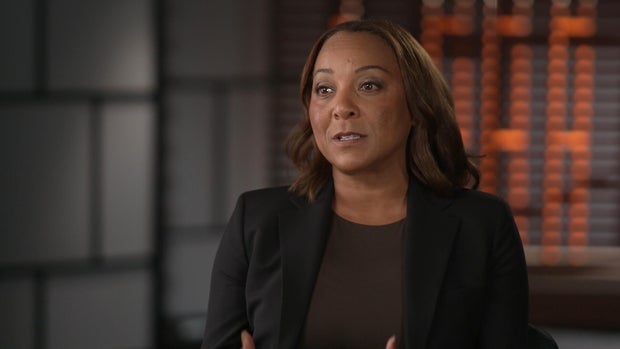
Co-CEO Tekedra Mawakana said Waymo’s driverless cars are five times safer than human drivers in the areas they operate. The Waymo “driver” is trained on every single ride the Waymo fleet has given, which makes it “the most experienced driver in the world,” according to Mawakana. Collectively, Waymo’s fleet travels more than 2 million miles a week, while the average person drives about 700,000 miles in a lifetime.
“So this is almost three lifetimes per week that our fleet is driving,” Mawakana said.
Waymo’s AI has also driven billions of miles in simulation to train for the countless rare scenarios it might face on roads, like snow on the Golden Gate Bridge or even an elephant stopping traffic.
Waymo’s robotaxis are outfitted with 29 cameras, six radars, five microphones, and five lidar sensors, which continuously pulse to measure distances, objects, and people as far as three football fields away. These sensors also enable the robotaxi to see around other cars.
“And that’s partly the design of the placement of the sensors. Makes it superhuman compared to what a human would be able to do,” ” Waymo product manager Chris Ludwick said.
But despite the hours of training and its suite of sensors, Waymo robotaxis still have problems, some of which have been caught on camera. In Los Angeles, a Waymo drove through an active police scene. There’s also been incidents of the robotaxis getting in the way of emergency responders and illegally passing stopped school buses, leading to a software recall last year and a federal investigation.
Robotaxis on the road to London
In London, Waymo’s robotaxis have been driving the streets to build a detailed 3D map to train its AI – a company standard before operating in a new area.
Unlike Waymo, Wayve’s AI doesn’t map out a city before driving in it.
“We train it on millions of hours of experience driving all around the world,” Wayve CEO Alex Kendall said. “So this means when it goes somewhere it’s never seen before or that’s never been mapped, it can understand what’s in front of it and make decisions in real time.”
60 Minutes 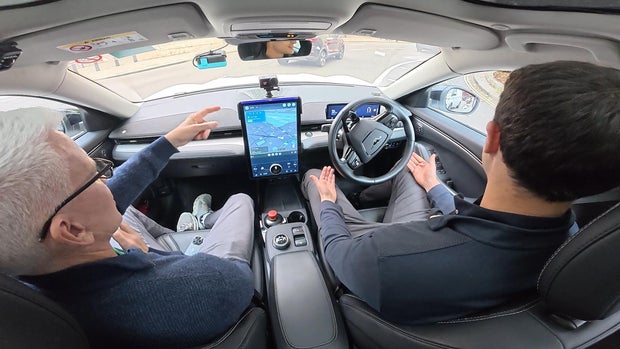
Wayve’s robotaxis are still in testing and not yet available to the public, but Kendall believes his AI will be able to more easily adapt to new environments.
Since 2019, Wayve has been testing its fleet in central London.
“There’s just such a long list of things that can happen on the road,” Kendall said. “I think that’s the main advantage of an AI driver here, is that it can have the intelligence to deal with things that you may never expect on the roads.”
It’s too early to tell if robotaxis will overtake the black cab industry. Moorjani says he’s worried, after spending years trying to pass the Knowledge.
“Every profession is being affected by AI. I don’t know what it’s going to do in the near future, but it’s always there on your mind that yes, you’re getting into a career not knowing what the future is,” he said.
However, Steven Fairbrass, who’s been studying for the Knowledge for eight years, didn’t seem too concerned about the threat of self-driving cars.
“To me, the human brain will always be the strongest tool,” Fairbrass said. “Can you imagine you’re trying to hail down a vehicle with no driver in it? You’re standing there in the rain, trying to get home? And that vehicle just drives straight past you because it hasn’t got a sensor or a human brain or an eye to turn. So to me, human beings, drivers, always gonna be needed. Always.”
You may be interested

Ford picks Apple Maps for its next EV platform and updated BlueCruise
new admin - Jul 23, 2026Ford plans to embed Apple Maps directly into its Universal Electric Vehicle Platform, which will start with a $30,000 midsize…

Malcolm-Jamal Warner's widow says her body "went through shock" when her husband died
new admin - Jul 23, 2026Tenisha Warner, the widow of "The Cosby Show" actor Malcolm-Jamal Warner, spoke exclusively to "CBS Mornings" co-host Gayle King about…

Not citric acid or spray – 1 cleaning tip makes shower head look ‘new’
new admin - Jul 23, 2026Cleaning your shower head doesn't have to be difficult (Image: Getty)Nobody likes to spend their evenings or weekends cleaning, but…