



Controversial surveillance program faces uncertain future ahead of House vote

Washington — A key surveillance authority, the spy tool known as Section 702 of the Foreign Intelligence Surveillance Act, faces major obstacles in the House ahead of its expiration next Monday.
Proponents of its renewal stress that it’s imperative that the surveillance tool not be allowed to lapse as the war with Iran continues. National security officials have long argued Section 702 is essential for preventing terrorist attacks. But opponents from both parties worry that it allows federal authorities to look at Americans’ communications without a search warrant.
House GOP leaders pushed off a floor vote until days before the April 20 deadline as several factions in the lower chamber oppose its renewal without additional reforms, making its passage uncertain.
Section 702 was last renewed for two years in 2024 after a series of abuses by the FBI led it to the brink of expiration. The provision was first authorized in 2008 and allows the government to collect the communications of noncitizens located outside the U.S. without a warrant, though it can also sweep up the data of Americans who are in contact with targeted foreigners.
The Trump administration is pushing an 18-month reauthorization of the law without any changes. President Trump on Tuesday urged Republican unity to help propel the clean extension through a party-line procedural vote that was initially expected Wednesday.
The president met with some skeptical GOP lawmakers Tuesday night. A White House official told CBS News it was a “productive discussion and we look forward to additional conversations.” CIA Director John Ratcliffe attended a House Republican Conference meeting Wednesday morning as the administration continues to advocate for a clean renewal.
GOP Rep. Andy Harris of Maryland, the chairman of the conservative House Freedom Caucus, said he expects the procedural vote to fail.
“If it’s clean … it doesn’t have the votes,” Harris said Tuesday.
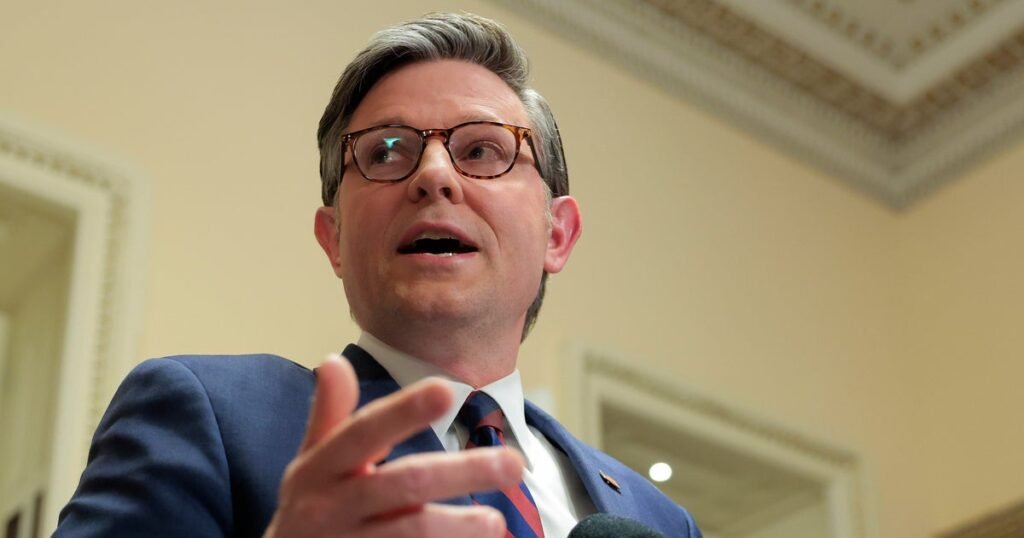
House Speaker Mike Johnson, a Louisiana Republican, said Tuesday that amendment votes would not be allowed because “it jeopardizes its passage.”
“It’s far too important right now,” Johnson said.
But Johnson appeared open to an extension shorter than 18 months, telling reporters “the timing is not as important to me.”
House Majority Leader Steve Scalise, a Louisiana Republican, said Wednesday that the GOP is having “serious discussions” about potential changes that would address holdouts’ concerns “without undermining the ability for the program to work successfully.”
Mr. Trump’s request for unity came hours before a House Rules Committee meeting, where GOP Rep. Jim Jordan of Ohio, the chairman of the House Judiciary Committee who was once a leading voice for FISA reforms, defended a clean extension. Jordan said the dozens of reforms that were enacted in 2024 have cut down drastically on abuses.
“It’s a different program today,” Jordan said, pointing to the reforms that included more oversight of FBI queries and approval requirements before running a query on a U.S. citizen.
Conservatives on the Rules Committee ultimately allowed the measure to advance out of the committee late Tuesday, teeing it up for floor consideration.
The renewal still faces opposition from members on both sides of the aisle who have cited a number of reasons that they cannot support it, with warrantless surveillance of Americans at the top of the list. GOP Rep. Lauren Boebert’s stance on the renewal is “warrants or bust” — she and other lawmakers are calling for judicial warrants if intelligence officials want to search Americans’ messages.
Ratcliffe told the House Intelligence Committee during a March hearing that “some reforms” of the law “should be considered,” but “a warrant isn’t one of them.”
“A warrant won’t work,” Ratcliffe said. “You have to make decisions very quickly, and sometimes in a matter of hours.”
Some Democrats are also hesitant to renew the statute without additional guardrails on the Trump administration. Rep. Jamie Raskin of Maryland, the top Democrat on the House Judiciary Committee, said Tuesday that it would be “moronic” to trust the Trump administration to uphold the law as intended and he would not vote to renew it without reforms.
Republican Rep. Anna Paulina Luna of Florida has called for an elections-related bill known as the SAVE America Act to be attached to the reauthorization to gain her support.
Lawmakers across the political spectrum also want to prohibit intelligence agencies from purchasing Americans’ data from third-party brokers without a warrant. Rep. Jim Himes of Connecticut, the top Democrat of the House Intelligence Committee, said Tuesday that the issue is “really important” for Congress to debate, but said it “has absolutely nothing to do with FISA 702.”
“FISA 702 does not authorize any purchase of any commercially available data,” he said.
Himes added that it was critical for Congress to reauthorize the program, which he said was the “most important intelligence authority.”
“There is simply no alternative to Section 702 and allowing it to expire would be devastating,” he said.
You may be interested

Former Astros minor leaguer Jon Kemmer, 35, dies in rollover crash
new admin - Apr 15, 2026[ad_1] NEWYou can now listen to Fox News articles! A former baseball prospect turned coach and instructor was killed near…

Billionaires, dark money fuel questions ahead of 2026 midterms
new admin - Apr 15, 2026Hedge fund manager Stephen Mandel and his wife Susan are a billionaire power couple that has a history of springing…

Microsoft counters the MacBook Neo with freebies for students
new admin - Apr 15, 2026Apple’s $599 MacBook Neo ($499 for students) has sent shockwaves through the PC ecosystem, and now Microsoft is responding with…