


On Reuniting, New Album ‘Arirang’ and Their Future Plans

W
hen RM is going through an existential crisis, which is pretty often, he might think of the words of Rainer Maria Rilke, or maybe the lyrics of Tyler, the Creator. BTS’ leader loves that other poetically inclined RM, and keeps coming back to an oft-quoted section of his 1905 poem “Go to the Limits of Your Longing”: “Let everything happen to you/Beauty and terror/Just keep going/No feeling is final.” In other words, just swim.
Lying in his cold army bunk, scalp buzzed close, struggling with 18 unrelenting months of insomnia during mandatory military service, RM would listen to Don Toliver, to Playboi Carti, to Dijon’s debut, to Joji’s ballad “Past Won’t Leave My Bed.” When the lyrics got his brain humming with too many ideas for his own, he’d switch to streaming classical and ambient music. But he really latched onto Tyler’s “Darling, I,” and the chorus phrase “Forever is too long.” Tyler and Teezo Touchdown were singing about dodging monogamy at all costs, but RM teased out his own, deeper meaning. “Maybe at that time, the military felt too long for me,” RM says. “I just kept singing the phrase all the time. And I was being healed just by singing along to it.”


His time in the military strained his mental health, leaving him in what he describes as an internal “cave.” But no feeling was final, and it wasn’t forever. On a sunless mid-February Saturday in Seoul, South Korea, he’s back with his six bandmates. They’re hanging out in a warehouse-like studio space in the towering midcity headquarters of Hybe, the ever-more-global music conglomerate originally built, for the most part, on BTS’ own singular success. It’s a sort of friendly pop-music Death Star, gleaming and metallic, where lobby guards intercept visitors with an intensity certain U.S. pop stars could only dream about, and employees upstairs proffer NDAs on clipboards. Even the bathrooms are futuristically secure, guarded by sliding electronic doors that require ID cards for both entrance and, for some reason, egress.
With BTS in the building, though, who could blame them? The slightest change in the band’s perceived fortunes can move Hybe’s stock price, but that’s the least of it. It’s nearly impossible to overstate the group’s importance to its city and its nation, which changed military-conscription rules in 2020 with BTS in mind, though all seven members went on to enlist anyway. If you’re lucky enough to fly into Seoul, you’ll only go a few minutes before spotting V in a tank top on a highway billboard promoting a local coffee brand. For their city-stopping free concert here, BTS will walk to the stage via the King’s Road, following the path of five centuries of monarchs.
Watch the video interview below
Five weeks before the release of Arirang, BTS’ first album of all-new material in nearly six years, RM is living out his favorite poem again. (His bandmate Jimin scrawled different Rilke verses on his chest for a music video in 2023. BTS are just that kind of band.) “I have extreme stress and extreme joy at the same time,” RM says. “And it’s all always back and forth, back and forth every time, every night.” He’s wearing a shiny black leather jacket over a black T-shirt, chunky boots, and oversize parachute pants you’d have to be a member of BTS to pull off. His hair is frosted at the tips, carefully tousled; his eyes are alert, amused, ever-probing. RM was originally headed for a more academic life, and it’s easy to imagine him as a very popular young professor in various other timelines, presumably in the chunky glasses he already wears off-duty.
RM is always asking himself questions, and in recent years, he’s had a long list of them about his group. What should they sound like? What do they stand for? Should they continue onward? It would be easy for him to say that Arirang settles all of those queries, but he’s too compulsively truthful for that. “I’m still really confused,” he says, “and that’s what we figured out after the military.” He thought maybe there’d be “some precise, sharp consensus that we could all relate to, which was not very true.” So the picture is “still blurry,” he adds, but “these 14 tracks could be an answer to the people wondering, ‘What is BTS in 2026?’”
Either way, his anxiety persists: “I really wanna pretend like, ‘I’m OK and I’m ready, all decided, everything’s great, I just can’t wait.’ I really wanna say that, but even more than that, I really wanna be honest.”
With a trio of English-language singles in 2020 and 2021 — “Dynamite,” “Butter,” and “Permission to Dance” — BTS completed the long process of conquering the world, to a degree no group from South Korea, or anywhere in Asia, had ever managed. But part of RM seemed to wonder if the world had also conquered BTS in the process. They had previously been deeply involved in writing their own material, had always kept most of their lyrics in their native tongue, and started out making aggro hip-hop tracks, not smooth disco pop. “I didn’t know what kind of group we were anymore,” he admitted in 2022, just before the group began a yearslong break they’d fill with military service and solo hits. “I don’t know what kind of story I should tell now.”

Later that year, in a conversation with Pharrell Williams for RS, RM went further. “I was just a small rapper and lyricist when I was young,” he told Williams. “It was 10 years, really intense as a team. I got to stop this for a bit. I got to shut it down and fall away from it and then just see what’s going on…. Sometimes I really feel afraid. Like, what if I don’t like music anymore?” Williams told him it was temporary, and offered parting advice that unintentionally echoed Rilke’s: “Just keep going.” Much later, in a livestream that had him subsequently apologizing for excessive candor, RM admitted what he had been hinting at: “I’ve thought tens of thousands of times whether disbanding or pausing the team would be better.”
J-Hope, the group’s emotional backbone, a fierce rapper rivaled only by the formally trained Jimin as the dancing-est member, was circling the same doubt. “Is getting all this love and attention actually a good thing?” J-Hope says now, recalling his feelings. “Maybe while everyone is clapping and cheering for me, I should just turn it all off. And I wondered whether I wanted this. All I had was a tiny flame inside of me, and it had just spread like wildfire. I felt a lot of pressure around that.” In 2022, he became the first BTS member to release a full-fledged solo album, Jack in the Box, which posed the question directly: “Do I put out the fire or burn brighter?”
J-Hope chose the latter option, though he wasn’t sure he really had a choice. “I realized it’s probably not something I can stop just because I want to stop it,” he tells me. “Personally, I’m very affected by the people around me, so I have to think about whether I can handle the emotional effect my decisions will have on so many others. In the end, I felt that keeping the flame burning is what I truly want, and the choice that’s most authentically me.”
The third member of the group’s rap line, the cerebral, mysteriously charismatic Suga, isn’t sure there was ever a question. “There’s no way for me to know everyone’s individual thoughts and desires,” he says, “but we all went solo because we couldn’t work in a group at the time. So before going into the military, I knew we were always gonna get back together. But I can see how it could be surprising from a foreign perspective. But for us, staying together just felt obvious. So, nobody really had opinions about that. I just thought, ‘Yeah, of course we’re doing this.’”
“If we don’t challenge anymore, there’s no reason we should keep doing this.”
RM did at least decide on a mandate for Arirang, which turned out to be an artistic and commercial triumph, selling 641,000 copies in the U.S. alone in its first week and topping Apple Music’s charts in 115 countries. “I’ve been saying to the members, ‘If we don’t challenge anymore, then I think there’s no reason that we should keep doing this as a team,’” he says. “We have to show the world that we are still ongoing and still exploring. It’s so complicated sometimes. But still, I think we have to push it to the edge even more, even more, and it’s still not enough.” He smiles at his own intensity.
IN OCTOBER 2022, all seven members of BTS, in matching purple hoodies, grasped hands and took a deep, synchronized bow as fireworks flooded the sky above the seaside city of Busan. As they walked offstage, V held aloft a laminated sign with the same message in both English and Korean, from the lyrics of the song they had just performed: “Best moment is yet to come.” They waved to their fans, trying to look upbeat. Jimin lingered at the front of the stage, eyes shimmering. It was the last time BTS would perform together in public for four years.
Jin is the eldest at 33, sardonically charming, with a rich, pure tenor and a commanding stage presence. It sometimes seems like he has entirely unwarranted impostor syndrome about his place in the group – he jokes that his one advantage is that he’s “more good-looking than the other members.” He was the first to enlist in the military, shortly after releasing the soaring Coldplay collaboration “The Astronaut.” As an assistant drill sergeant, he bought extra food for his troops, and they grew to love him, weeping when his time was over. He cried, too, at his discharge ceremony. Once he was out, he carried the Olympic torch at the Paris Games, starred in a hit Netflix variety show, and released two excellent EPs that continued to lean into the rock sounds he had come to love, mostly through his longstanding Coldplay fandom.
But the whole time, he wanted to find his way back to the band. “I just missed the other members so much,” he says. “I’ve always thought there’s no reason to continue if it’s not with the group. I guess a solo career is just not that important to me. If I did anything, it would be trying something different within the group when the fans are bored. I’m not interested in acting or anything like that.”

In 2023, Suga released his first official album under his alter ego, Agust D (the name is Suga backward, plus the initials of his hometown crew, D-Town), after two mixtapes that pushed boundaries with edgy personal confessions. This time, on “Amygdala,” he raps about dealing with his parents’ illnesses and other traumas, but declares himself liberated from the past: “What didn’t kill me only made me stronger/And I begin to bloom like a lotus flower once again.” Apparently, due to a circa-2012 motorcycle accident that once left him unable to lift his arms onstage, his military service took place in the civilian world, where he spent 21 months as a social worker. “After that final album, I don’t have any negative feelings left in my body,” he says. He also got over a fear of running out of lyrics he had confessed to in 2022. “I’ve been focusing on stressing less about it. I’m always going to find things to say, and then run out of them again. There’s an eternal cycle.”
Before enlisting, J-Hope headlined Lollapalooza in July 2022, becoming the first South Korean artist to do so at a major American festival. “I felt like I was stuck in some kind of mold that kept me from expressing myself as freely as I wanted to,” he says. “I yearned to break that mold and step into the world with my true self and all of the music that I wanted to share. But now that I’ve made more of my own music, challenged myself, I wouldn’t say that I’m in a box anymore. Now, I’m wondering, what can I create now that I’m outside of the box?” At the same time, he’s reminded himself of the power of his group: “Now that we’re back together, the other members are filling in any gaps that I feel in my expression, in my performance. In a lot of ways, I realized that this is why there were seven of us.”
Jung Kook wasted no time in stepping out as the pop star he was born to be, though BTS’ youngest member, 28, still carries himself with remarkable humility. “Honestly, I can’t really think of myself as a pop star just yet,” he says. “But I’m very grateful that I get asked about it that way, and that fans think of me that way. So I want to keep doing better, so that I can feel like a star for myself. Someday!” His single “Seven,” with Latto, which offered a rather stunning level of explicitness (“I’ll be fuckin’ you right/Seven days a week”) was Spotify’s fourth-most-streamed song in 2023.
“I wasn’t embarrassed,” Jung Kook says of the lyrics. “I just felt, ‘So what?’” But RM says he had to intervene to allow those lines to come out after execs got nervous: “I told the label, ‘Please don’t change! Why not? He’s all grown up. He can sing an f-word.’” Then, in the army, Jung Kook worked in the kitchen, stirring giant pots, even on weekends — feeding the troops right, seven days a week. “What I really felt was that I really want to perform,” says Jung Kook. “I want to sing. ‘Augh, I can’t wait to leave! I want to get out and dance!’ That’s all I thought about.”
Jimin, whose velvety voice and nearly feline lover-boy magnetism stands out even in a group filled with virtuosic singers and strong presences, shocked himself with his own solo success. His single “Like Crazy” hit Number One months before “Seven,” which made him the first Korean solo artist to top the Hot 100. “I didn’t expect it at all,” Jimin says. “But through that process, I learned that I still have a long way to go.” He enlisted at the same time as Jung Kook, and in their early army days, they participated in a footrace together. (Unlike their sprint up their charts, Jung Kook won that one.) He told me in 2021 he couldn’t imagine himself outside of the group. “My thoughts haven’t changed,” he says. “If there’s any way they have changed, it’s that while BTS, and doing well as part of BTS, remains my top priority, I want to be a better singer as an individual as well. My teammates are all so amazing, so I feel the need to improve my worth as a fellow member and not be overshadowed.”

V, the band’s smoldering baritone, designated old soul, and occasional actor, side-stepped the solo-pop arms race, opting for sultry, jazz-inflected R&B on his EP Layover. “If Layover hadn’t come out,” he says, “I think V as an artist would have been stuck as a hardcore dancer and singer, unable to share all of the different, vibrant colors within.” He will likely make a pop album, too, someday, he adds. “Even that is a style of music I love, one that I’ve worked to pursue. I don’t know when that would be, but someday, it’s a genre that I’d have to and would love to try.”
In the military, he tried to forget his music career entirely, and use the time to reboot himself. “I worked out a lot,” V says. “Read a lot, listened to a lot of music. That gave me the opportunity to rebuild my body and mind.” He can bench-press a formidable 230 pounds or so, which his army unit full of athletes considered “baby” weight, but he’s pretty sure makes him the strongest member of BTS. He read Han Kang, the Nobel Prize-winning Korean writer, and Japanese mystery novelist Keigo Higashino. He’d disappear into the stories, picturing himself as one of the characters. “I was so deep in my imagination at the time. Was it helpful? I’m not sure!”
IN THE BEGINNING, they were all dressed in black, gold chains around their necks, and even Jung Kook was rapping. BTS’ first single, “No More Dream,” debuted in 2013, with a bass line not unlike Dr. Dre and Snoop Dogg’s “Deep Cover.” The still-charming song and video showcased a high-energy, almost comically aggressive, hip-hop-dominated version of BTS. But as early as tracks from later that year like “Coffee” and “Outro: Luv in Skool,” the band’s approach began to broaden, and the singers gradually came to the forefront. By the time of their trio of English-language smashes, the most casual BTS listeners might have had no idea of the group’s rap-heavy beginning.
This time around, BTS wanted to reclaim some of that old sound, albeit in a more mature form. “We all gathered and started in 2013,” says RM. The current album, he adds, is “a new start, but I think we unconsciously come back to when we started, all those really turnt-up energy, I-want-to-show-something-to-the-world type of energy.”

Even Jin, who saw no issue whatsoever with the “Dynamite” to “Permission to Dance” run, on the grounds that a hit was a hit, came around. “I actually didn’t totally agree with the others on that issue,” Jin says. “Because with music, you see certain results, right? So I believed that our most beloved songs are our identity. But not everyone felt that way, so after a lot of discussion, I was convinced by the opinion that our identity is in the music we used to make.”
Veteran BigHit Music/Hybe staff producer Pdogg began working with BTS well before “No More Dream,” which he co-wrote and produced. “I’ve shared their journey of immense artistic growth from their trainee days to where they are now,” he says. He was deeply involved with Arirang, too, and says everyone was “very intentional about carrying a hip-hop sensibility into the album. While the album spans a range of genres, I don’t think we let go of that hip-hop root.”
In July 2025, the members — minus Jin, still on his solo tour — moved into a house together in L.A. They spent two months in the studio, rotating between four separate writing rooms, each filled with a complement of producers and songwriters, working seven or eight hours a day. According to Pdogg, the team leaned on Diplo, who worked on numerous tracks, to help suggest other Western producers and co-writers. For Gia Lim, leader of the A&R team for Hybe subsidiary BigHit, the sessions were “fundamentally about breaking away from our traditional workflow while focusing on blending a global, fresh edge with BTS’ core identity.”
One of those collaborators, hip-hop producer Mike WiLL Made-It, had to get used to creating during normal business hours. “That’s just super different than America,” says Mike, who bonded with the band members over their watches. “We might be in there all night. But I get it! It’s more efficient.” He appreciated that they went straight to him, and not an imitator. “ Salute BTS for coming to the proper source, you know what I’m saying? We don’t even fluently speak the same language, but when we were making those songs, it was like we were speaking the same language…. I liked how different they were trying to be. The beats that they picked don’t sound like no other production that I’ve done. It’s super out of pocket, and it’s just original.”

It was the first time Pdogg had been involved in every stage of a BTS album, from songwriting through mastering. He could feel the difference. “Each member’s individual color became more pronounced,” he says. “I could really see an even stronger level of ambition this time around.” Rather than trying to make the seven voices blend into one, they leaned into what the solo years had given each vocalist: “We focused more on bringing out the distinct character of each voice.”
At least one member of BTS wondered if the solo ventures might change the group dynamic. “Since all seven of us have had solo careers and strengthened our egos,” says V, “I thought that meant everyone would have much stronger opinions when we came back to work together. But to my surprise, all of the members came in so open-minded, and had grown the depths of their character. I learned so much from them working on this album.”
“It’s so amazing that we got back together.”
“Swim,” the lead single, came together in its rawest form during presessions, weeks before the members arrived in L.A. “It felt special from the first listen,” says Pdogg. “I always felt like the coolest thing they could do is something just a little bit understated,” says rising British songwriter James Essien, a key force behind “Swim.” “It’s so predictable to try and make another song like ‘Dynamite.’” He recalls improvising the song’s backing track with songwriter and multi-instrumentalist Tyler Spry after the chairman of Hybe, Bang Si-Hyuk, was unimpressed by another piece of music. “Bang walked in, face like a fucking brick wall,” Essien says. “So then we start another idea, just cycling through … and the melody kind of just comes. It fell out of the air.” The band would eventually have some trepidation about choosing a more subtle track, but Essien remembers RM telling him, “This is sexier. This is what we need now. We are sexier. We’re army-decorated.”
The adventurous Spanish producer El Guincho, whose credits range from Rosalía to Charli XCX, played two beats in his first 10 minutes with the band. They picked both, and combined them for the standout track “Hooligan,” which layers diced strings from a 1962 French film with percussive clashing knives. “They gravitated towards the most extreme ideas instead of safest bets,” he says. “ ‘Play the craziest shit you have.’” Returning to his rap roots, Jung Kook came up with the concept for “Hooligan.” “When I heard the track, I came up with the flow immediately,” he says. “And I didn’t know if the song would make it. But it got picked, and that rocked.”
As El Guincho shaped “Hooligan,” the members were already trying out dance moves, and he found himself adjusting drum patterns based on what he saw. “I look at the way certain kicks feel in their bodies, certain bass lines, certain snares,” he says. “That’s what makes it different from any other artist I’ve ever worked with.” At one point, Essien stumbled upon a side room at the studio where a crew with whiteboards was already blocking out choreography for not-quite-finished songs. “I was like, ‘Wow, this is really a well-oiled machine,’” he says.

Suga was an enigma to the producers. He’d enter a room, listen, say nothing, leave, return days later. Sometimes he’d pick up a guitar and strum along to tracks. “You could see he was really feeling the song and trying to understand it,” El Guincho says. J-Hope would shock the room when he’d shift from his cheery everyday persona to his ferocious rapping, which one collaborator compares to DMX. Jimin would sit in silence for 30 minutes, taking in producers’ thoughts, then jump in with a perfect take that incorporated all of the feedback. Jung Kook, meanwhile, blew everyone away with his uncanny facility for singing in what sounds like perfect English. “I think my ear is good for that kind of thing,” says Jung Kook. “But at the end of the day … it’s a foreign language for me. I don’t want native speakers to hear me speak their language and find it uncomfortable, or dislike it, in any way. So I’ve worked very hard on it.”
V meanwhile, stepped forward as a songwriter, particularly on the album’s closing track, the ethereal “Into the Sun,” which came from a live-band jam session. “Things were not flowing as smoothly,” Pdogg says. “We decided to ease up and just have some fun. V ended up picking up the mic, I was on Moog bass, [producer/writer] Tyler Johnson was in the booth on drums, and [producer/writer] Nitti was on guitar.” Suga wrote the song’s rap section on the terrace of the house they shared. “Before this album, I never imagined working on a song outside,” Suga says. “You only really need a notebook and pen.”
Once Jin’s solo tour wrapped, he made his way to the studio, where he discovered more than a hundred songs already written. “I was worried fans would be bored while everyone was in the military,” he says, “so there I was soothing the hearts of our fans. Meanwhile, all the songs got made.” Is he frustrated? “I’m a little bummed. But there’s more to life than just the present. There’s the future. Plus, if I had been greedy and pushed the whole session so I could add my own songs, this interview would be happening months from now. Wouldn’t the fans be too bored during that time?”
It was Bang and Hybe’s idea to name the album Arirang, after the ancient, profoundly melancholy, nearly sacred Korean folk song. The band accepted the concept almost instantly, but as seen in their Netflix documentary, the idea of including a sample of the actual song in “Body to Body” sparked weeks of discussions. That moment aside, “we did not set out to foreground ‘Korean-ness’ in an obvious way,” Pdogg says. But the band did push to reprioritize Korean lyrics. “Please” was recorded in English, but BTS insisted on rewriting it almost entirely in Korean. Lim says that the A&R team was confident “the music itself would resonate with listeners beyond linguistic boundaries.”
The album could’ve easily been an entirely different set of songs. “There were a lot of conflicts,” says RM. “Which to go, and which not to go.” J-Hope is still fond of an outtake called “Like This,” while Essien recalls a song called “Five Minutes” that everyone seemed to love. “What will happen, I wonder?” says Jimin. “What will happen to those songs we wrote?”

Suga has the answer: They’re destined for future solo projects. “Wouldn’t we use them individually or something? We would use them between ourselves, rather than give them away.”
BTS MADE HISTORY TOGETHER, split apart, made more history on their own, managed to reunite. They’ll tour the world until next March, after Jin pushed to extend the itinerary by roughly eight months longer than they planned. “When we first got our tour plans, it didn’t have very many stops,” he says. “And it was only going to last about three to four months. I said: ‘Now that we’re back, we promised so many people that we would come and meet them, and I feel like this is breaking our promise.’” But after that, what’s left for the band to accomplish?
Suga simply wants to set a different tone. “We should enjoy ourselves,” he says. “Before, we were way too competitive. I feel like, in the rush to achieve our goals, we didn’t care so much about our physical and emotional health. But now, we can relax a little, especially since we’re all older. So I think we can have more fun with it now.”
“It’s so amazing that we got back together at all,” J-Hope says, “and that we’re still making music as a group. When I think about that, goals don’t matter as much anymore.”

During rehearsals in February, Jimin suggested to the rest of the group that they should get back in the studio right after their tour ends and record another album. But that, in turn, gave Suga a different idea. “Time is moving so fast, and trends change so quickly,” he says. “And I wonder if we should try releasing singles for a while. See, it was last September when we finished the album at the prerecording stage. But it took all this time for it to be released. So when we made it, we had no idea about the trends in March and April, or what kind of genres would be popular. It was tricky to try and make good music. For a lot of those reasons … maybe we’ll make a single, maybe a mini album, something along those lines.”
The band members took note of Bad Bunny’s Super Bowl triumph, entirely in Spanish, and they’re intrigued by the idea of following his lead. “We can’t do it unless we’re invited,” Jimin says, while Jin acknowledges already imagining what their show would be like.
RM is more cautious. “Maybe if time goes by, and the thoughts in the people change,” he says. “All of the people in the world are watching Parasite, all these great things in Korean culture, so if there’s a chance, we definitely want to, some day.”

The group’s leader is keenly aware that BTS have attracted some fervent haters, and he addresses them directly on the Mike WiLL-produced “2.0.” “There are really people who just pray in their home,” RM explains. “ ‘Please, BTS, just go fall down. Just break apart and collapse.’ So we’re thinking about ‘OK, guys, for two, three years, we have been apart … and three years passed, and there are ARMYs waiting for us, the world waiting for us, so you guys had your little fun.’”
So they still read the comments? “Never!” Suga says.
“Sometimes,” RM admits, and the rest of the group laughs.
The braggadocio of “2.0” also seems aimed at competitors, but who, precisely, would that be at this point? I suggest to the band that the answer might be other global pop icons: Taylor Swift, Bruno Mars, Harry Styles. RM winces at the comparison. “They are greater artists than us,” he replies, softly. “We’re just so small. We’re just a boy band from Korea.” It’s the only thing he says all day that doesn’t quite ring true.
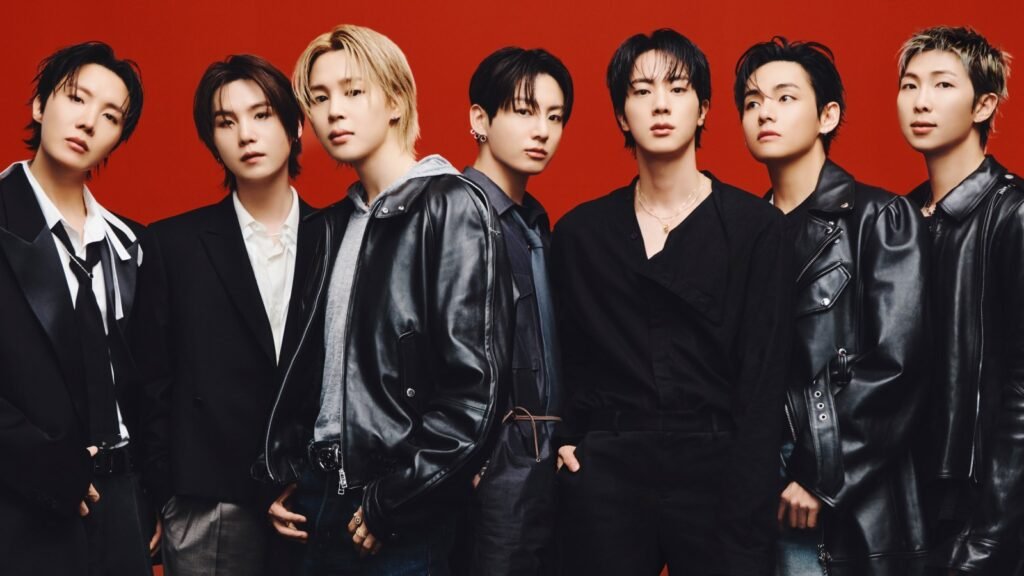
Production and Clothing Credits
Styling by YEJIN KIM. Hair BY HANSOM, HWAYEON, and HYUNWOO LEE. Makeup by DAREUM KIM and SHINAE. Set design by YEABYUL JEON. Produced by NUHANA. Executive Producer SOOH HWANG. Producers SEBIN PARK and KALY NGO. Line producer: CHERRY LEE. Digital Technician HUIJIN KIM. Photographic Assistance SOOJUNG OH, MINHYUK LEE, MINJUN KIM, JIHYUN OH, JUWAN KANG and JUNHYUNG YANG. Set Design Team SOHYUN WON, YUNSEON CHOI, JUNHYUK SIM. RS Video DoP MIKE BEECH. Camera Operators BYEONG HWI MIN, CHURL GWON, HYUNSUH PAIK. DIT JIWOON LEE. Sound operator MIN JAE LEE. Production assistant SEOHYUN YOON.
GROUP: V Jacket BY SIMONE ROCHA. Shirt by AMI. Pants by MAISON MARGIELA. Jewelry by CELINE and
CARTIER. SUGA Jacket by ENFANTS RICHES DÉPRIMÉS. Shirt by SSSTEIN. Jewelry by WERKSTATT MÜNCHEN.
JIN Shirt by RICK OWENS. Jewelry by FRED. JUNG KOOK Outfit by CALVIN KLEIN COLLECTION. Bracelet by WERKSTATT MÜNCHEN. Watch by HUBLOT. RM (WHITE OUTFIT)Outfit BY TAEKH. Shirt by ANN DEMEULEMEESTER. (BLACK OUTFIT) Outfit by RICK OWENS. Shoes by GUIDI. Necklace by WERKSTATT MÜNCHEN. JIMIN Jacket by JOHN LAWRENCE SULLIVAN. Hoodie BY OUR LEGACY. Pants and jewelry by DIOR. J-HOPE Jacket by JUUN.J. Shirt by POST ARCHIVE FACTION. Watch by AUDEMARS PIGUET. Rings by LOUIS VUITTON. Necklace by SCHO.
SOLO: J-HOPE: Jacket and shoes by LOUIS VUITTON. Watch by AUDEMARS PIGUET. JIMIN Outfit and jewelry by DIOR. JIN Jacket by SONIA CARRASCO. Shirt by ANN DEMEULEMEESTER. Pants and shoes by GUCCI. Jungkook Jacket by ACNE STUDIOS. Shirts by DRIES VAN NOTEN and ACNE STUDIOS. Pants by DIESEL. RM Suit by JOHN LAWRENCE SULLIVAN. Shirt by GOOMHEO. Shoes by GUIDI. V: Jacket by BONBOM. Sweater BY SSSTEIN. Pants by MAISON MARGIELA. SUGA Jacket by HYACYN Ny. Shirt by LEMAIRE.
You may be interested

Bleachers Drop New Single ‘The Van’ Off ‘Everyone for Ten Minutes’
new admin - Apr 13, 2026[ad_1] The Jack Antonoff-led group has also released a music video for the latest Everybody for Ten Minutes offering Bleachers…
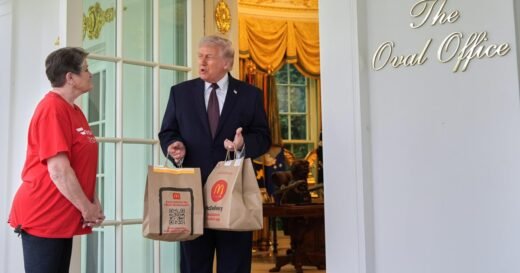
DoorDasher joins Trump for impromptu White House press event after delivering McDonald’s
new admin - Apr 13, 2026Washington — In a televised moment Monday, President Trump welcomed DoorDash delivery driver Sharon Simmons to the White House and…

Xbox Game Pass ‘has become too expensive,’ says Microsoft’s gaming chief
new admin - Apr 13, 2026Microsoft’s new Xbox chief, Asha Sharma, has signaled that Xbox Game Pass pricing is about to change. In an internal…