

Student-Built Instruments Head to Space

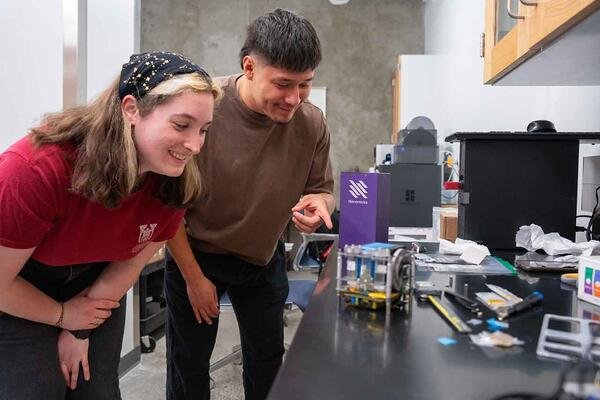
Most undergraduate research projects never leave the lab. But the work of College of Charleston astrophysics majors Eva Godwin and Gael Gonzalez is heading a long way from campus: to the International Space Station. It will travel aboard a resupply flight for the Northrop Grumman Cygnus-24 cargo mission, which is scheduled to launch this week from the Kennedy Space Center.
The fourth-year students weren’t just assistants on the project; for the past two years they’ve been deeply embedded in every phase of the mission, from concept development and fundraising to modeling, testing and final integration ahead of the flight.
“It was honestly such a huge honor to be trusted with something that will eventually be handed off to NASA,” Godwin said. “Not a lot of undergraduates, especially in South Carolina, can say they’ve done something of this magnitude.”
The research instruments were developed under the supervision of Joe Carson, professor of astrophysics, and Marcos Díaz, assistant professor of electrical engineering at Universidad de Chile. The College of Charleston is the only institution in South Carolina with an undergraduate degree in astrophysics, and this project marks its first-ever contribution to a space-based mission.
“It’s a great honor for us to be part of the college’s first space-based mission and also part of South Carolina’s first instrument demonstration in space,” Gonzalez said, noting the accomplishment is especially meaningful to him as a first-generation college student. “Being undergraduates—and seniors about to graduate—that really puts us out there and helps people know our names in South Carolina for a big mission like this.”

Student-designed equipment that will head to the International Space Station.
Instruments in orbit: The student-designed equipment includes a liquid lens-based optical camera designed to capture how biological samples respond to microgravity and an ultraviolet camera that tracks stellar activity among young stars. The research instruments will spend approximately six months in orbit before returning to Earth for analysis.
Gonzalez said he played a key role in developing the UV camera, particularly setting up the codes that will allow researchers to communicate with the instrument.
“I was the one characterizing the UV instrument—checking how good the images appeared and whether there was any distortion,” Gonzalez said. “I was also simulating data that we would see once we’re in space. For example, we’ll use the UV camera to do photometry—taking images of stars and measuring their brightness.”
Ahead of the launch, Gonzalez traveled to Florida with the research group to watch the instruments be integrated and finalized.
“It was an amazing feeling just being around professionals who are focused on that type of work,” Gonzalez said. “I felt really exposed to another part of the project that not a lot of people see—the behind the scenes—and for me, that was a special moment.”

Gonzalez played a key role in developing the UV camera that will head to the International Space Station.
After the launch: Gonzalez said the experience has also helped him home in on which of the three basic areas of astrophysics—theoretical, experimental or observational—he wants to pursue.
“After doing this project and having actual hands-on experience, I’m pretty confident that I’m not really interested in the theoretical side of things,” Gonzalez said. “I’m more interested in what I’m doing currently, which is instrumentation and overlaps with observational and experimental work.”
Godwin agreed, noting that the project has shaped how she and Gonzalez think about their future.
“Gael and I are both pretty confident that we want to pursue higher education in the form of graduate and doctoral programs, and doing this research project has really reinforced that,” Godwin said. “We’ve learned how to work together as a team, we’ve learned how to work and communicate in groups, and we’d love to continue applying our skills.”
Get more content like this directly to your inbox. Subscribe here.

You may be interested
Final Fantasy VII’s remake trilogy will conclude with Revelation
new admin - Jun 05, 2026As the world teeters on the brink of annihilation, the final battle against Sephiroth begins. A meteor mars the sky,…
Auburn Board Takes Curricular Control, Dissolves Senate
new admin - Jun 05, 2026[ad_1] The Auburn University Board of Trustees on Friday gave itself complete control over course offerings, curriculum, degree requirements and…

3 Things I Learned On USA’s Sideline During Senegal World Cup Tune-Up
new admin - Jun 05, 2026[ad_1] NEWYou can now listen to Fox News articles! Last Saturday’s win over Senegal felt like a breath of fresh…