


Mizzou Terminates Official Funding for Black Student Council

The University of Missouri has stripped the Legion of Black Collegians—its historic Black student governing body—as well as at least four other minority affinity groups of all annual designated funding, starting in July, The Columbia Missourian reported. In addition to losing official funding, the groups will no longer be recognized as university-sponsored organizations.
Mizzou officials said in a public statement that they made the decision in order to comply with DEI restrictions issued by the Department of Justice in July. In an email to Inside Higher Ed, university spokesperson Christopher Ave said that it was the funding model—not the organizations themselves—that violated the DOJ memo. (The organizations can still apply for funding like other student groups.)
“In the past, Mizzou allocated a portion of its student fees to fund certain affinity-based student organizations. These practices must be discontinued to align with federal law as outlined in the memo,” he wrote. “As a public institution, failure to follow federal law will risk forfeiture of significant federal funds that we receive to support student financial aid, research and other university programs.”
In a series of social media posts, the targeted student organizations argued that the memo constitutes guidance—not law. But when asked about the students’ objections, Ave said, “the memo provides specific guidance on the Department of Justice’s interpretation of federal law.”
Now LBC and the other groups—the Association of Latin American Students, the Asian American Association, the Queer Liberation Front and Four Front, an Indigenous student group—are urging their fellow students, alumni and faculty members to stand up and push back.
“This is the time to be loud, to fight, and to activate,” LBC said in its Instagram post. “We promise we’re not going down without a fight.”
Meanwhile, some higher education history experts see Mizzou’s move as more than just another pre-emptive action taken by university leaders in response to Trump’s intimidation tactics. The flagship university has a deep history of racial tensions and student activism on campus, so they’re watching closely to see how the students respond.
“Mizzou has been the canary in the mine,” said Steve Mobley Jr., the program director of higher education and student affairs at Morgan State University, an HBCU in Baltimore. “Whatever bubbles up and spills over … should absolutely be a warning signal to other institutions of what could be occurring on their campuses.”
Royel Johnson, an associate professor of higher education at the University of Southern California who specializes in racial equity, said it was disappointing but not surprising that Mizzou president Mun Choi capitulated to the Trump administration and conservative state lawmakers rather than double down on what he’s presented as a commitment to Black student success.
“It is the outcome of a broader strategic and well-funded campaign to intimidate and discourage institutions from investing in programs, resources and institutional structures that are mission critical for populations that they have purportedly espoused to care about,” he said. “The lack of institutional will to counter the distortion … is really, really, really problematic.”
Historical Tensions
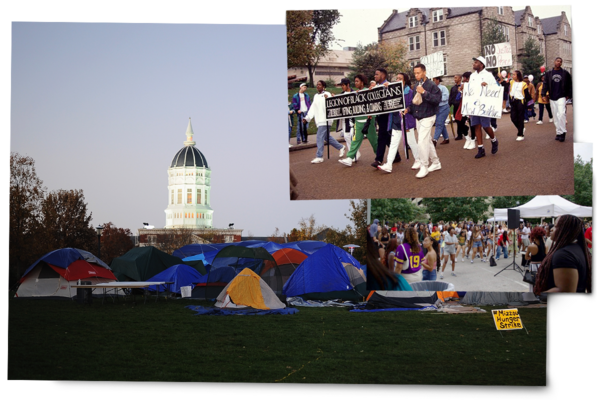
Black students were first admitted to Mizzou in 1950 and have repeatedly fought for more support from campus administrators, especially after some high-profile racist incidents. For example, in 2010, cotton balls were found scattered in front of the campus Black Culture Center, and in 2015, the student body president spoke out after he was called the N-word on campus, an experience others said they had encountered as well.
Tensions in the fall 2015 semester reached a peak when a student went on a hunger strike to protest racism on campus. That strike spurred the student group known as Concerned Student 1950 to camp out on a quad and the university’s football team to threaten to boycott upcoming games. The students wouldn’t pack up and leave and the team wouldn’t play until system president Tim Wolfe stepped down. They also demanded the university commit to increasing retention rates for marginalized students, sustaining a diversity curriculum and promoting a safer and more inclusive campus.
Wolfe resigned, and the university committed to make a number of reforms.
Through it all, the Legion of Black Collegians, established in 1968 and recognized as a student government a year later, was there. The organization started in response to students seeing Confederate flags and hearing the Confederate anthem “Dixie” played on campus. To this day, LBC remains the nation’s only Black student government, promoting the interests and experiences of Black students on campus.
But 57 years after its founding, Amaya Morgan, the current LBC president, says advocating for Black student voices remains challenging.
In July 2024, the university dissolved its Division for Inclusion, Diversity and Equity, saying the move was necessary to pre-empt legislative action from conservative state lawmakers. Then, in August of that year, officials demanded that LBC rename a long-standing orientation event called the Welcome Black BBQ. A year later, the university made the same request, but this time LBC refused to budge. As a result, the institution canceled the event entirely. (Ave noted that a welcome event was still held at the Black Culture Center, but it was done under a different name and without the LBC.)
‘Losing Legacy’
Now, with the Black student governing body no longer recognized as a university-sponsored organization, Morgan says morale has hit a new low.
“We’re losing legacy,” Morgan said. “As long as we’re a student government, administration is required to meet with us and required to hear us out and work with us on issues. And definitely, because [we’re not university-sponsored anymore] it gives them more of a reason to toss us to the wayside.”
In a meeting held with LBC leaders just days after the Welcome Black BBQ was canceled last year, President Choi suggested that to protect what was left of the university’s DEI programs, it was in the groups’ best interest to stop talking to the media or to stress that its events were open to all students, according to a recording of the meeting obtained by Inside Higher Ed.
“We want to protect our institutions and the organizations that we have,” he told them.
At the time, LBC leaders kept the recording off the record in hopes that it would shield their organization, as Choi suggested. But now, Morgan said, there’s no reason to hide it, because Choi’s words were “definitely fear-mongering.”
“I’ve been telling the administration a lot that the amount of times you say, ‘We care,’ out of your mouth doesn’t matter to me, because it’s still about your actions,” she said. “This is just a big time where actions speak louder than words.”
The university declined to comment on Choi’s statements on the recording but noted separately that the four-year graduation rate for Black students has increased from 29 percent to 45 percent since 2015 and the six-year graduation rate from 53 percent to 64 percent. Other data from the university website shows that enrollment of Black students is down from 2,048 students in fall 2016, the oldest semester available, to 1,302 in fall 2025.
LBC is still figuring out how to proceed, but for now, Morgan said the governing body as well as the other organizations are looking to alumni and nonprofit organizations to help fundraise and fill the financial gap.
For the current academic year, the university set aside $140,000 for the five affected minority organizations, according to Ave. Just over $60,000 of that was for LBC, Morgan said. Now, all funds for minority affinity groups will be placed in the larger pot available to more than 600 recognized student organizations via a student-directed grant-competition process.
Until then, Morgan and others say, LBC and the more than 25 Black student groups it supports, like the campus chapters of the National Association of Black Journalists and the National Society of Black Engineers, will have to find a way to operate on a tighter budget.
“There will be a really detrimental impact to all of our communities. A lot of people will say LBC is like the first place where they met their Black friends, or the first time that they saw the Black community. And already, with the dissolution of [a DEI office], we have nowhere to go,” she said. “Now, there are no starting points for freshmen or incoming students to say, ‘I can go here to get what I need as a marginalized student.’”
You may be interested

Manhunt underway for suspect with ‘Islamist’ ties after deadly Berlin Pride attack
new admin - Jul 26, 2026A manhunt is underway for a 21-year-old suspect after a vehicle was driven into a crowd at Berlin’s Pride festival…

The vertical video takeover is here
new admin - Jul 26, 2026This is The Stepback, a weekly newsletter breaking down one essential story from the tech world. For more on all…

Police hunt suspect in Berlin ramming attack as Germany grapples with safety fears
new admin - Jul 26, 2026The suspect wanted for the car ramming attack on a Berlin LGBTQ+ Pride parade on Saturday remains on the run…