



California gas prices are the highest in the U.S., but there’s no proof of price gouging. Here’s why.

For years, California leaders accused oil companies of price gouging.
Instead, a six-month-long CBS News California investigation revealed a complicated reality shaped by state policies, refinery closures, and global supply risks that uniquely impact California’s isolated fuel market.
What CBS News California Investigates found:
- Why California gas costs more: Higher taxes, labor and business costs, combined with environmental programs, regulations, and the state’s unique fuel blend, drive up baseline prices.
- The political narrative is shifting: After failing to prove price gouging — and grappling with the impact of two shuttered refineries — state leaders are now publicly acknowledging the need to incentivize oil companies to stay.
- Why refineries are leaving: Rising costs, increasing regulations, long-term policy uncertainty, and shrinking returns
- Why global conflict matters: California’s growing reliance on overseas refining is increasing volatility — and validating long-standing industry warnings that outsourcing refining increases the risk of price spikes.
$6 per gallon
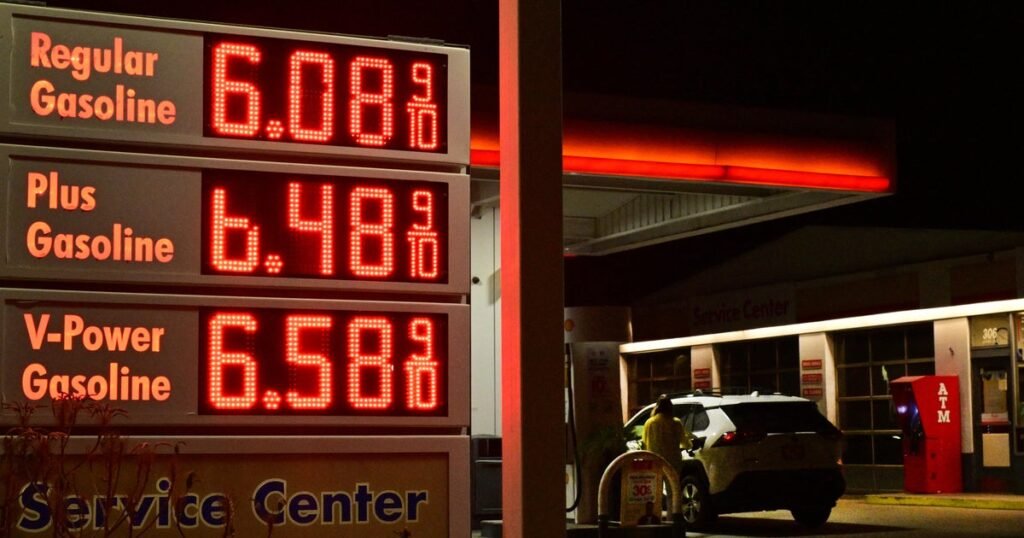
California drivers pay the highest gas prices in the nation. As the conflict in the Middle East increases gas prices globally, California gas continues to be the most expensive in the nation, rising above $6 a gallon.
Last time gas hit $6 a gallon in California, Gov. Gavin Newsom began accusing oil companies of price gouging. California’s supermajority Democratic legislature held a taxpayer-funded “price gouging” special session, culminating with legislation that was intended to cap oil company profits and force them to open their books.
More than two years later, state officials say they found no evidence of illegal price gouging. Instead, two refineries shut down, taking nearly 20% of the state’s refining capacity.
California is now outsourcing to Asian refineries to make more of California’s special gas blend. Environmental standards aren’t as strict in Asia, and the refiners have to ship the gas back to California halfway around the world. In addition to increased pollution, transporting gas across the Pacific can take weeks, which agency heads and oil industry executives agree leads to delays and supply volatility, increasing the risk of price spikes during local refinery outages or global shortages.
The current Middle East conflict is highlighting the concern, as China has already stopped exporting fuel due to shortages in Asia. Meanwhile, the oil industry argues that proposed regulatory changes could make it more expensive for oil companies to continue refining in California, ultimately incentivizing outsourcing more refining.
Why gas already costs more in California
Even before recent refinery closures and the global conflict, California drivers paid the highest gas prices in the nation for several reasons.
Roughly 45% of the cost of every gallon of gas is made up of costs that are consistent across the country. That includes the global price of crude, which is higher for everyone right now, and an 18-cent federal tax that drivers pay in every state.
However, the remaining 55% of each gallon of gas includes California-specific costs.
Distribution and refining costs, which are more expensive in California, account for roughly 28% of every gallon.
California’s special gas blend tacks on roughly 10-15 cents per gallon to refining costs. Then there’s a 61-cent state excise tax and roughly 2 cents attributed to underground storage fees.
California’s cap-and-trade tacks on roughly 23 cents to every gallon, and the Low Carbon Fuel Standard (LCFS) adds another 14 cents.
On top of that, there are state and local sales taxes.
At $6 per gallon, that adds up to an additional $20 every time you fill up an average-sized tank.
Here’s a current breakdown of California-specific costs per gallon:
Sales taxes (2%)
- State sales tax: 2.25% average
- Local/special district taxes: 1% average
State climate programs (10%)
- Cap-and-Trade: 23 cents
- Low Carbon Fuel Standard: 14 cents
Base taxes and fees (15%)
- State excise tax: 61 cents
- Underground storage fee: 2 cents
Refining (13%)
- CA special gas blend 10-15 cents
Distribution (15%)
Federal tax (5%)
Crude oil costs (40%)
UC Berkeley economist Severin Borenstein says there’s also something harder to explain — a persistent “mystery surcharge.” That unexplained gap first appeared around 2015, following a major refinery outage, and has remained ever since.
While regulations and taxes set the baseline, Borenstein says price spikes are often driven by supply disruptions, especially in California’s isolated fuel market.
Refiners point to higher operating costs in California — from labor to energy — and say much of the added cost occurs after fuel leaves the refinery, at the distribution and retail level.
Borenstein notes that this was true before the mystery surcharge appeared in 2015.
Price gouging
For years, state leaders blamed oil companies for high gas prices and launched a taxpayer-funded price gouging special session in 2023.
The session culminated in two new price-gouging laws. One law created new oversight, requiring oil companies to open their books and giving regulators more visibility into refinery profits and operations. Another capped refinery profit margins during price spikes, though that law has since been paused.
But after two years, state officials say they found no evidence of illegal price gouging.
California’s Natural Resources Secretary Wade Crowfoot said the state identified factors behind price spikes, but stopped short of blaming oil companies for price gouging.
“We’ve identified certain dynamics that were creating those price spikes,” Crowfoot said.
Pressed on whether there was proof of price gouging, Crowfoot added that he would not “be in a position to point a finger.”
That marks a shift from years of political messaging that placed primary blame on the oil industry.
CBS News California Investigates reached out to the Governor’s Office and the California Air Resources Board, which regulates many of the policies the oil industry opposes. Both declined interview requests.
The administration instead pointed to Crowfoot, who emphasized the state is trying to balance affordability with long-term climate goals.
Refiners argue those policies could backfire.
Tolly Graves, manager of the Chevron Richmond refinery, said profit caps ignore how volatile the business is:
“Those good months are the only way we make a profit… if you cap the good months but don’t support the bad ones, it creates an unviable business,” Graves said.
Why refineries are leaving
Following the price gouging session, two major refineries — Valero in the San Francisco Bay Area and Wilmington Phillips 66 in the Los Angeles area — have shut down, taking hundreds of jobs and nearly one-fifth of the state’s gasoline production with them.
That loss tightens supply in a state that already operates as what experts describe as an “energy island” — with no major pipelines bringing in gasoline from other states.
Fewer refineries mean less in-state production and more pressure on prices, especially during outages or high demand.
Inside the Richmond Chevron, one of California’s remaining refineries, industry leaders pointed to the cost of doing business in the state.
“California is a tough place to do business for refiners,” Graves said.
Every day, the Chevron refinery produces enough gas for one in five cars in Northern California and about 60% of the jet fuel from Sacramento to San Jose, which costs more to make in California than anywhere else.
Graves said higher labor, energy, and regulatory costs all contribute to higher production expenses that are ultimately passed on to drivers.
California’s cleaner-burning, special blend of gasoline also requires specialized production.
“Only a handful of refineries outside of California can actually make California gasoline,” said Brian Hubinger, senior manager of Chevron government affairs. He noted that production of the special blend “took billions of dollars of investment.”
Those requirements, combined with long-term uncertainty about the state’s transition away from fossil fuels, have made it harder for companies to justify continued investment.
“It costs us hundreds of millions a year just to stay in business,” Graves said. “Things have to change for us to be willing to invest in a refinery in California.”
Growing reliance on foreign fuel
As refining capacity declines, California is increasingly turning to overseas refiners, particularly in Asia, to make California’s special blend.
While they can produce California’s low-carbon gas, overseas refiners don’t have to adhere to the same strict environmental standards as California’s refineries. In addition to local pollution, the gasoline they produce is shipped across the ocean, which environmental agency heads acknowledge is also worse for the environment.
“There is less pollution associated with the gasoline that’s produced in California,” Crowfoot said.
Additionally, tankers coming from Asia can take weeks to arrive in California, creating new vulnerabilities. That delay means any disruption — from refinery outages to global conflicts like the war with Iran — can quickly tighten supply and drive up prices.
Asia is currently struggling to supply its own markets. China, in particular, has already restricted exports.
Still, energy analysts note global markets tend to adjust over time — even if short-term disruptions can lead to temporary price spikes.
“If a refinery has a problem they didn’t anticipate, that’s going to spike prices, that’s going to hurt Californians, and it’s going to be three weeks before we can get resupply from somewhere else,” said Andy Walz, president of Chevron.
A shift in the political conversation
After years of focusing on oil companies, state leaders now say the conversation is evolving.
“I’ve been talking about this for years, OK? What it took was two refineries to close, and then they said, ‘Oh, maybe they’re not price gouging,’ ” Walz said.
Lawmakers are now weighing how to balance climate goals with the need to maintain a stable and affordable fuel supply to power the present.
“That was probably the beginning of the shift when that report came back and Gov. Newsom couldn’t prove that there’s price gouging,” state Senator Brian Jones (R-San Diego) said.
California has temporarily suspended a new price gouging law that would have capped how much oil companies can make during price spikes. Though refineries say it’s still on the books, and they warn that proposed changes to California’s Cap-and-Invest program could make it cheaper to refine gas overseas rather than here at home.
“I think if the voters figure out that the problem is policy, they’re going to say, ‘Hey, I shouldn’t be paying this much. Why is Nevada a dollar cheaper?’ Walz said. “Voters can change that outcome.”
The debate now isn’t just about who’s to blame, but how California manages the transition without driving up costs in the short term.
For commuters like Sirena Lopez, who drives two hours each way for work, the impact is immediate.
“There was one time I filled up about $100… and I was like… I don’t know what I’m doing right now,” she said.
Even as prices rise, demand remains steady and drivers continue to feel the strain.
As California pushes toward a cleaner energy future, the key challenge ahead is not just reducing emissions, but ensuring fuel remains reliable and affordable in the meantime.
The governor appoints agency leaders and helps shape California’s energy and environmental policies — decisions that directly impact gas prices.
With a new governor set to be elected, those policies — and the cost of gas — could soon change.
You may be interested

Jalen Brunson’s mom texts him before every game since high school: “I still send them, and he looks forward to them”
new admin - Jun 24, 2026Jalen Brunson's mom still keeps up a tradition that started back when the NBA star was in high school: She…

Breandan Sorsby denied NFL entry as league won’t hold supplemental draft
new admin - Jun 24, 2026[ad_1] NEWYou can now listen to Fox News articles! Brendan Sorsby’s NFL future won’t begin in 2026, as the league…

Attorney General Alan Wilson wins runoff in South Carolina GOP gubernatorial primary, CBS News projects
new admin - Jun 23, 2026State Attorney General Alan Wilson will face off against Democratic state Rep. Jermaine Johnson in November's race for South Carolina…