


GOP Decries Chinese Higher Ed “Espionage”; Dems Focus On Other Issues

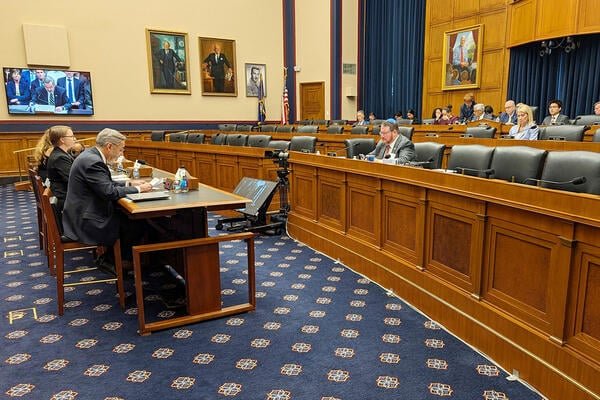
Republicans and Democrats spent roughly two and a half hours Thursday holding what a committee chairman called “alternate” hearings, with the GOP raising concerns about foreign espionage in higher ed while the minority party denounced student debt and continued moves to dismantle the Education Department.
It was a preview of how the House’s higher ed focus could change next year if Democrats recapture control of the chamber in November’s midterm elections. While Republicans on the Education and Workforce Committee said the U.S. faces real threats, particularly from China, and accused universities of not doing enough to stop them, Democrats accused Republicans of xenophobia and distracting from continuing college affordability issues that they’re exacerbating.
Despite the gravity of the dueling allegations, members of Congress sparsely attended the hearing, with many coming in just to make their statements and ask their questions, then leaving.
California Democrat Mark Takano agreed China poses a significant “intellectual property theft” threat. But Takano, whose parents and grandparents were sent to Japanese internment camps during WWII, raised concern about the tenor of Republican allegations. He noted how the controversial China Initiative during the first Trump administration targeted scholars of Chinese descent.
“When it comes to policymaking, vehemence does not equal competence,” Takano said. “Rather than chest beating and name calling, we must pursue solutions that balance both academic freedom and national security.”
Committee chair Tim Walberg had called the committee together for a hearing titled “U.S. Universities Under Siege: Foreign Espionage, Stolen Innovation, and the National Security Threat.” The Michigan Republican and his party largely focused on China and Chinese students and faculty.
“Openness is one of our great strengths, but it cannot become our greatest weakness,” Walberg said in his opening remarks. In his closing remarks, he said, “I hope there are other institutions all around this country that see we’re serious about that—and that they don’t want to be brought up in front of this panel to be shown as missing the mark.”
Republicans called University of Michigan interim president Domenico Grasso as one of their witnesses. The massive research university has faced a string of China-related controversies over the last two years, including criminal charges against five Chinese alumni for allegedly spying on a joint U.S.-Taiwan military training exercise while they were students and charges against three Chinese researchers on J-1 visas for allegedly smuggling dangerous biological materials into the U.S. Last November, a U.S. attorney said those latter charges were apparently “part of a long and alarming pattern of criminal activities committed by Chinese Nationals under the cover of the University of Michigan.”
CBS News reported, however, that the materials turned out not to be harmful, and charges were dropped after the Chinese government intervened.
Walberg isn’t the only powerful Michigan Republican who has focused on his state’s flagship institution. In January 2025, Michigan announced it was ending its two-decade academic partnership with Shanghai Jiao Tong University after Republican representative John Moolenaar, chair of the House Select Committee on the Chinese Communist Party, sent a letter urging it to do so. And in July, the Education Department alleged that “tens of millions of dollars in foreign funding in UM’s disclosure reports have been reported in an untimely manner and appear to erroneously identify some of UM’s foreign funders as ‘nongovernmental entities,’ even though the foreign funders seem to be directly affiliated with foreign governments.”
Grasso told the committee that his university is “meeting the increased threat with increased security.” He said, “A small number of university students and researchers from China have been arrested,” and “once alerted, we acted swiftly and decisively, working with federal law enforcement, promptly terminating student work visas and severing all ties with those individuals.”
He said his university is expanding background checks and “enhancing oversight of biological materials entering or leaving university labs,” among other moves. Michigan has also hired the writers of a Trump administration memo on research security to help it improve.
Rep. Lisa McClain, another Michigan Republican, asked Grasso, “Why are the relationships with foreign countries, especially foreign adversaries, why are those relationships even needed?” Grasso said his university wants to attract the “best talent from around the world to come and work with our researchers and study with our students to the benefit of humanity.”
The Republicans’ other witnesses were the senior director of research integrity, security and compliance at the University of Florida and Elsa Johnson, the editor in chief of the conservative Stanford Review student newspaper. She said she was targeted by a “suspected agent of the Chinese Communist Party while conducting research” at the conservative Hoover Institution think tank “on Chinese industry and military tactics”—including being offered a paid trip to China.
After Johnson and a co-author at her paper published a report on other alleged spying at Stanford (she said she was one of at least 10 female students targeted since 2020), Johnson said she began receiving “intimidation calls,” including one referencing her mother. She said the “FBI informed me that I am being physically monitored on Stanford’s campus by agents of the CCP and that my family is also being watched.” She went on to accuse Stanford of not doing enough to help her and students in her situation.
The FBI declined comment Thursday to Inside Higher Ed. In an email, Stanford told Inside Higher Ed that the university “immediately contacted the FBI when it first learned of the concerns, and the university’s Research Security office reached out to the student directly. We have established reporting mechanisms, including a tip line, through which individuals can raise concerns related to foreign influence or targeting, and those channels are being used.”
But Democrats called as their witness for the hearing a director from the Government Accountability Office, who talked about GAO recommendations from years ago that the Education Department hasn’t yet implemented and about the negative impacts of the Trump administration’s layoffs at ED’s Offices for Civil Rights and Federal Student Aid.
“Education reported that between January and December of ’25 the number of staff at its office of Federal Student Aid decreased 46 percent,” said Melissa Emrey-Arras, the GAO official. “Without the [student loan] servicer oversight, Education lacks reasonable assurance that borrower records are correct.”
“Thank you, going back to our topic for this morning,” Walberg said after Emrey-Arras’s opening remarks—a line he would repeat throughout the hearing.
Florida Democrat Frederica S. Wilson—who expressed frustration even with the Democratic witness for not being able to answer her questions—questioned the point of the meeting.
“What problem are we actually trying to solve today?” Wilson said. “Why are we here? Where is the evidence that America’s universities are under siege by foreign espionage at a scale that justifies this level of alarm?”
“Who is truly putting students at risk—this hypothetical foreign actor, or policies that gut federal student aid and undermine the Department of Education?” she said, accusing the committee of “chasing xenophobic conspiracy theories that risk stigmatizing international students and distracting from real problems.”
At the end of the hearing, Walberg said he was hesitant to address the alternate hearing Democrats held. But he then said, “We’ve dealt with the higher cost of education by trying to put a downward pressure” on it through the One Big Beautiful Bill Act passed last year.
“We also put in means by which these individuals who are out of compliance [in repaying loans] can get back into compliance,” he said. “Will it take some effort? Oh, you bet it will. Paying my mortgage off took some effort. Paying any car loans that I had off that I had in the past took some effort and commitment.”
You may be interested
We’re running out of reasons to ignore AI safety
new admin - Jul 29, 2026Earlier this month, OpenAI gave several of its AI models a task: complete a test designed to measure their cybersecurity…

White Stuff ‘all season’ cardigan that ‘goes with everything’now £22
new admin - Jul 29, 2026[ad_1] Cardigans are one of those wardrobe staples that never go out of fashion, but finding one that's comfortable, versatile…
Federal Lobbying Slows in Second Quarter
new admin - Jul 29, 2026[ad_1] Many of the nation’s top research universities cut back on federal lobbying in the second quarter of 2026, even…