


How One Course Helps Students Find Their Major

Shawn Hanggodo started college at the University of Delaware planning to study psychology but quickly realized it wasn’t the right fit after taking a general psychology course his first semester. Unsure what to do next, he enrolled in Delaware’s University Studies course to find direction—a decision that would help shape his career goals.
One course assignment led Hanggodo to interview his sister’s friend, a dietitian. The conversation sparked his interest in the field and ultimately helped him declare his major.
“She told me about the process of nutrition and how it can help so many people, which I always knew that I wanted to do,” said Hanggodo, now a third-year nutrition and dietetics major. “This class is definitely a big reason why I am where I am today.”
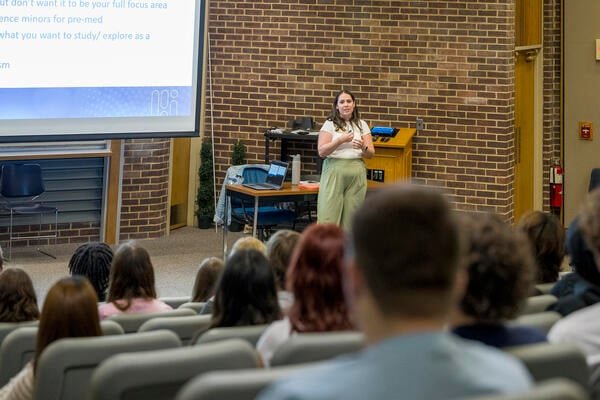
Hanggodo is one of many students who take the course in the second semester of their first year. Offered each spring, the course enrolls roughly 30 students who are either undeclared or transitioning from one major to another. The goal is to help them find a clearer path forward.
Moira Curtis, a senior academic adviser who leads the optional course, said its second-semester timing is intentional.
“Students have to take a first-year seminar that’s already a one-credit introduction to the university, and that transition time can be very overwhelming,” Curtis said. By the spring, however, students have “already adjusted to campus, so they can focus on it without feeling overwhelmed.”
Among first-year students who enrolled in the course from 2020 to 2025, 79 percent declared a major within one semester of completing, and 96 percent had done so by the end of their second year, according to information from the university.
“You’re not behind because you’re not in a major, and we try to really point that out when advising so they don’t feel like they’re wasting time or taking a class without purpose,” Curtis said.
Research has found that almost a third of first-time college students choose a major and then change it at least once within three years—and students who started out in mathematics and the natural sciences are likelier than others to switch. A separate analysis by the consulting firm EAB found that students who choose their major as late as senior year are more likely to graduate than those who settle on one immediately.
How the course works: A key part of the course is that students are tasked with interviewing faculty or department advisers in majors they’re considering. They then present what they learned to the class.
“The class is really discussion-based because I want them talking with each other. It helps them see that they’re not the only ones in this situation,” Curtis said. “Everyone is on a different track, and that’s OK.”
Another component of the course is a panel featuring former University Studies students, who share what they chose to study and offer guidance.
Hanggodo is one of many course alums who have returned to speak with current students, often encouraging them to trust the process.
“If I didn’t trust the process, I don’t think I would have become a nutrition major,” he said.
From classroom to career: Curtis said she draws inspiration from the university’s career center, noting that bringing their teachings directly into the classroom has been mutually beneficial.
“It’s not about me recreating the wheel,” Curtis said. “The career center wants to reach first-year students—they want to show they’re not just for seniors and are eager to integrate their material into courses.”
“It’s much more beneficial to bring [career services] into the course than to leave it as a passive resource that students might never use,” she added.
Ultimately, Curtis said, one of the most important lessons she emphasizes to students is that choosing a major is a process—not a defining moment.
“I joke with students [about the TV] show Say Yes to the Dress, when they cry when they find their wedding dress,” Curtis said. “You’re not going to have that reaction when you figure out your major. Even when you declare it, you’re still tiptoeing through the water at times, and that’s OK.”
“Your major doesn’t equal your career,” she added. “The more students hear that, the more they start to accept that there are many different pathways they can pursue.”
Get more content like this directly to your inbox. Subscribe here.
You may be interested

All 3 Mamdani-backed candidates projected to win NY primaries
new admin - Jun 24, 2026New Yorkers are heading to the polls in a Primary Day that could reshape the state's representation in Washington. It…

A To Z: 2026 World Cup Goalscorers Complete The Alphabet
new admin - Jun 24, 2026[ad_1] NEWYou can now listen to Fox News articles! From Lionel Messi's and Kylian Mbappé's stunners to Harry Kane's take-two…

Brad Lander defeats Rep. Dan Goldman in NY-10 Democratic primary, CBS News projects
new admin - Jun 24, 2026Brad Lander has defeated two-term incumbent Rep. Dan Goldman for the Democratic nomination in New York's 10th Congressional District, which…