



Scrubbing Chávez From Campus May Take Time

When allegations emerged that labor icon César Chávez had sexually abused women and children, colleges scrambled to distance themselves from the late leader of the farmworker movement, who is honored with namesake programs, buildings, events and campus statues around the country.
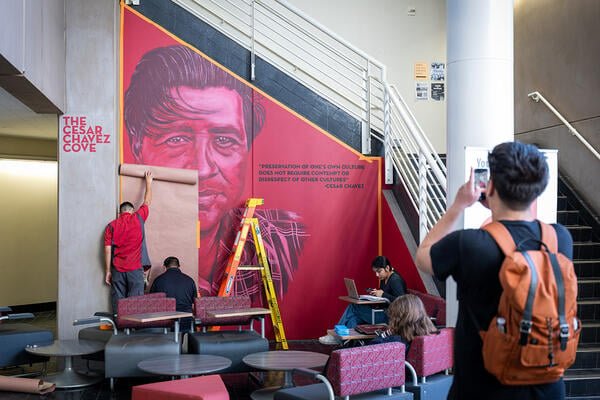
California State University, Fresno, quickly covered a statue of Chávez and announced plans to remove it. Others changed the name of events and took portraits of Chávez down. But that work is likely just beginning on campuses where Chávez’s name is on departments and buildings, given the glacial pace of change in higher education. At Fresno State, for example, it took more than seven months to remove the name of an antisemite from the university’s library in 2022.
But both this year and in 2022, Fresno State’s moved quickly compared to name-change processes elsewhere, which can take years as universities deliberate how to deal with the problematic figures they’ve honored.
What’s in a Name?
Building, program and other names on campus communicate powerful messages about who and what an institution values, said Derek Alderman, a geography professor at the University of Tennessee at Knoxville who has written about name-change processes.
Alderman said prior to the allegations that emerged last week, having Chávez’s name on a building or other space captured not only his historical importance in the labor rights movement but also sent a welcoming message to Hispanic and Latino students. He said that’s important since “universities have not done a very good job of making them feel as if they belong.”
As universities stripped Chávez’s name from programs and events in the immediate aftermath of the allegations, some noted that his actions did not reflect the farmworker movement as a whole. That kind of distinction is important, experts say, as colleges grapple with his legacy.
John Thelin, professor emeritus of higher education and public policy at the University of Kentucky, wrote to Inside Higher Ed by email that “recent allegations suggest heinous actions and perhaps crimes” but have “little to do” with the activism that made Chávez famous. Universities now face the question of abandoning the legacy of a problematic man.
“The riddle is whether he deserves to be honored for those historic and influential changes despite alleged misconduct in other areas of his behavior and life?” Thelin wrote.
One way to address that riddle could be elevating other figures in the movement. For instance, faculty at some universities have proposed replacing Chávez with fellow labor activist Dolores Huerta, who last week said she was abused by Chávez. Faculty at the University of California, Los Angeles, for example, voted to remove Chávez’s name from the Department of Chicana/o studies and Central American Studies, and some members of the UCLA community have suggested replacing it with Huerta’s. But the faculty vote isn’t binding, since professors do not have the power to rename departments. (While officials have noted concerns, UCLA has not publicly committed to a name change.)
But removing a name is only half of the process, Alderman noted. Then university officials have to decide whom they choose to honor instead—if anyone—as they select a new name. Alderman also believes the decision to rename spaces should be used as an educational moment.
“I frankly believe that wherever his name has been removed, there should be an installation of a permanent plaque that explains what name used to exist there, why it was taken down, why it was the right thing to do, the reasoning for why it’s responsive to this issue of social values,” Alderman said.
Stalled Name Changes
Experts note that university efforts to rename buildings and programs are often a much more time-consuming process than taking down artwork and covering up offending statues, with processes often getting bogged down by the bureaucratic minutiae of academe and resistance to change.
Efforts to remove the names of problematic figures have stalled at some campuses. The University of North Carolina at Chapel Hill has taken no action on a 2021 committee recommendation to remove the names of slave owners and Confederates from 10 campus buildings. (UNC Chapel Hill did not respond to a request for comment from Inside Higher Ed.)
“Things have taken longer in Chapel Hill, because even though there was the push to change—change was absolutely asked for, demanded and recommendations were made—you still have people within positions of power that truly don’t want to have to change,” Alderman said.
While UNC Chapel Hill has punted on proposed name changes, others have rejected such recommendations. Trustees at Washington and Lee University rejected a name change for the institution in 2021, despite the connection to Robert E. Lee, the commander of the Confederate States’ Army and a former president of the institution, who is buried on campus. Also in 2021, the University System of Georgia rejected a recommendation from an advisory group to rename 75 buildings at member institutes named for people who supported slavery and racial segregation.
Changes to names on buildings that honor major donors have also proven contentious.
When the board at then–University of California, Hastings College of the Law, voted to change the name to University of California College of the Law, San Francisco, in 2022, the family of Serranus Hastings, who founded the law school with a $100,000 donation in 1878, sued to block the move. Hastings had been accused of helping to facilitate the genocide of Native Americans, which is why the law school wanted to scrub his name. Ultimately the law school prevailed when the case was dismissed in 2024.
Questionable donor behavior continues to prompt demands for name changes.
Ohio State University, for example, has fielded hundreds of requests to remove the name of megadonor Les Wexner from campus buildings due to his connections with convicted sex offender Jeffrey Epstein. While the FBI has named Wexner an “alleged co-conspirator” of Epstein, he has not been criminally charged and has denied any wrongdoing. (Ohio State officials have said that any potential name changes will follow existing university processes.)
Thelin called the pattern of naming buildings for donors “disconcerting,” questioning whether that was “adequate grounds for being honored” and how it compares to other achievements. Going forward, he argued, trustees “are going to have to review carefully before naming a building and, even when doing so, be formal and explicit on conditions that might allow or even require them to change a building [name]. Is, for example, gaining a reputation as a Robber Baron in the same category as one who allegedly committed significant sexual abuse?”
As such disputes inevitably continue, Thelin argues universities need to tighten their standards.
“Henceforth colleges and universities and their affiliated institutes will have to give explicit and formal attention to provisions on building naming that provide curbs or injunctions both on rushing to name a campus building OR later rushing to remove a name once placed on the campus building,” he wrote. “And, most likely such terms and ground rules should be included in any compact or contract, whether with a donor or other related individuals or their families.”
You may be interested

Getting ready to fly? Here are 3 ways to track TSA wait times at airports.
new admin - Mar 24, 2026Wondering how early to get to the airport as some TSA officers call out sick during a partial government shutdown? There are…

Republicans tout a deal to end DHS shutdown and airport delays
new admin - Mar 24, 2026[ad_1] WASHINGTON — Senate Republicans are buzzing with optimism that they’ve found a viable path to reopen the Department of…

Netflix adds ‘masterpiece’ early Timothée Chalamet movie | Films | Entertainment
new admin - Mar 24, 2026Saoirse Ronan gives a stunning lead performance in Lady Bird (Image: A24)Netflix is presently screening one of the most beloved…