



Why it’s so hard to get oil through the Strait of Hormuz right now

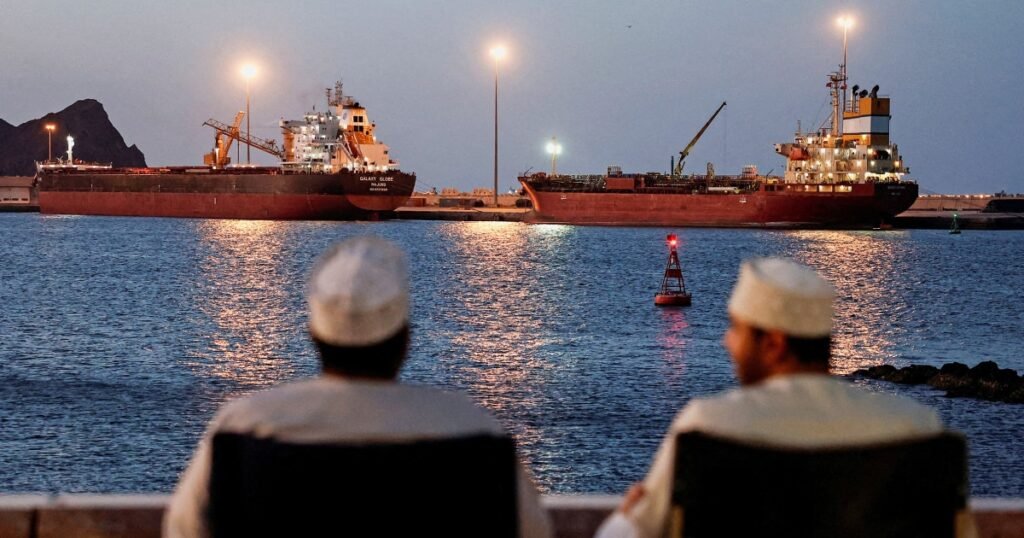
Global oil prices have sharply risen, though they have fallen slightly from highs seen last week, threatening wider economic stability across the world. President Donald Trump has threatened to hit Iran “20 times harder” than he already has if it disrupts this vital artery in the world’s fuel supply.
Of the handful of tankers that have braved the crossing, around half belong to a so-called shadow fleet — meaning they are carrying sanctioned oil from Iran, Russia or Venezuela — according to Lloyd’s List Intelligence, another analytics firm based in London. These crossings include suspected “dark transits,” where ships switch off their tracking systems to effectively disappear, Lloyd’s said in an analysis Monday.
On Wednesday, the United Kingdom Maritime Trade Organization, a monitoring service run by the British navy, reported that a “cargo vessel has been hit by an unknown projectile” 11 nautical miles north of Oman. That caused a fire and the crew was evacuating the ship, it said.

Another bulk carrier 50 nautical miles northwest of Dubai was hit by a projectile, with the crew reported “safe and well,” and a container vessel, whose location was not given, was assessing damage after being struck, it said.
One of the ships struck was flying the Liberian flag at the time, Iranian state media reported, and Thailand’s transport ministry said another was a Thai vessel.
In all, 13 ships have been hit in the strait since U.S. and Israeli strikes sparked the war Feb. 28, according to the UKMTO.
It’s not just missiles these ships have to worry about, with fears that Iran could deploy its fleet of minelaying vessels to render the crossing impassable. “There remains no confirmed evidence of mine deployment or detonation in regional shipping lanes,” Britain’s Joint Maritime Information Center said Wednesday, though it said one attack showed evidence of a “severe explosive event at or near the waterline.”
Though it’s unclear how many mines Iran has laid or has the capability of laying, the threat could see disruption, potentially lasting long after the conflict ends.
The threats to oil tankers are also an “ecological ticking time bomb,” according to Greenpeace Germany, which simulated a potential oil spill and found such an event could threaten sensitive ecosystems including coral reefs, mangrove forests, and seagrass meadows.
Even in peacetime, the world of shipping is a bureaucratic labyrinth of captains, owners, brokers and insurers. When war breaks out, many insurers trigger what are known as standard war-risk cancellation clauses, according to Jungman at Vortexa.
These clauses allow insurers to “withdraw coverage on short notice when an area becomes an active conflict zone,” she said. And “without insurance, most commercial ships simply cannot sail.”
Some companies do provide insurance, “but the pricing and conditions can be extremely restrictive,” Jungman added. In some cases, premiums have risen by as much as 1,000%, according to Reuters.
For any voyage, the ship’s owners have to greenlight the route first. They insure the ship — typically at 0.25% of the value of the vessel plus its cargo. The war has seen premiums spike to 3% of the ship’s total value, which can range between $200 million and $300 million, according to the American brokerage Jefferies.
One firm providing cover is the Illinois-based brokerage Gallagher, which says it is still offering cover through the marketplace giant Lloyd’s of London.
Gallagher is “very much open for business,” its marine divisional director, Angus Blayney, said in an emailed statement. “Given the challenging maritime security environment, rates have increased from levels that owners and charterers will be used to,” Blayney added, without providing specific figures.
“Some owners are willing to risk it and they are getting paid huge amounts of money,” said Tim Huxley, director of Mandarin Shipping in Hong Kong. “If you’re willing to do it, you might get paid half a million of U.S. dollars a day. There’s obviously a profound risk in it.”

Both the U.S. and France have suggested they could escort vessels. But doing that for “every commercial vessel moving through the strait would require a very large and sustained naval presence,” Jungman said, and they would not be immune to mines and drones.
Even if shipowners greenlight the route and manage to get insurance, the crews “have the right to refuse to go into a warzone,” said Capt. Pradeep Chawla, a veteran mariner and an expert in maritime safety based in Hong Kong.
“Seafarers have been caught in the middle” of this conflict, Chawla said. “It’s in times like these that one realizes, without seafarers, countries would not get their oil or food.”
You may be interested

SoFi Stadium workers authorize strike ahead of 2026 FIFA World Cup in Los Angeles
new admin - Jun 06, 2026Roughly 2,000 SoFi Stadium workers overwhelmingly authorized a strike a week before the 2026 FIFA World Cup kicks off in…

Judge blocks Trump policies that halted immigration process for many
new admin - Jun 06, 2026Judge blocks Trump policies that halted immigration process for many - CBS News Watch CBS News A federal judge in…

Leopards, tigers and AI data, oh my! Nashville Zoo tries to halt proposed data center
new admin - Jun 06, 2026[ad_1] A nationwide backlash against artificial intelligence data centers has a new ally: the leopards of the Nashville Zoo.Subscribe to…