



Música Mexicana Band on New Music, Stadium Tour

I
t’s early one evening in January, and the massive compound that houses Street Mob Records, the rising music label in Rancho Cucamonga, California, is back in action. Everyone has returned from the holidays, and the industrial building has morphed into a busy command center: In one area, six men are building a Sábado Gigante-inspired set for an upcoming video shoot; in a smaller conference room, label managers are scarfing down meals from El Pollo Loco between meetings. One section is packed with luxury cars: There are several Rolls-Royces, a 2021 Lamborghini SVJ, a Chevy Camaro SS, an old-school Chevy 454 SS. They all belong to Jesús Ortíz Paz, the frontman of the música mexicana band Fuerza Regida and the founder of Street Mob Records — and he just walked through the door.
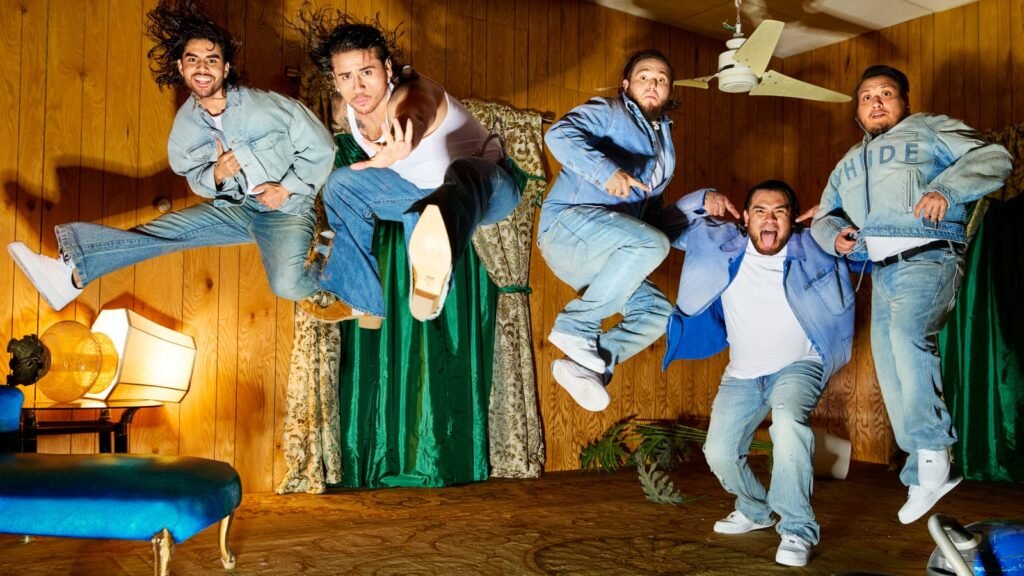
As soon as Paz, better known as JOP, swaggers into the building, the members of Fuerza Regida take their seats around a boardroom table like Power Rangers gathering before a mission. We’re only days into the new year, but they have a wildly ambitious agenda: deliver an innovative 11th album, expand Street Mob Records, and sell out a summer stadium tour.

JOP sits at the head. He’s cocksure, charming, and the band’s center of gravity. Even with a lingering cold, he does most of the talking, pausing only to reach for some tissues. To his right sits Moisés López, the tololoche player — the youngest, newest, and, even the band will admit, the cutest member. Next to him is guitarist Khrystian Ramos, focused and business-minded, balancing band duties with outside ventures that include a successful seafood business. Then there’s Samuel Jáimez, the quiet homebody who warns me that he’s bad at answering questions. And finally, José “Pelón” García, the sousaphone and tuba player — the goofball who is quick with a joke and gets along with everyone.
In the decade since forming, Fuerza Regida have pushed their corridos from backyard carnes asadas to arena stages, becoming the vanguard of a wave of música mexicana acts that have redefined the genre’s look, sound, and commercial ceiling in the streaming era. They fuse traditional acoustic instrumentation with hip-hop swagger and internet-age marketing. In doing so, they’ve turned a once-traditional sound into a generational movement made by and for young Mexican Americans raised between cultures, and fluent in both.
“Yes, we’re trendsetters,” JOP says. “I’m not going to say we do everything first. Sometimes other people will do it first. But what we make sure we do is that we do it better.”
Watch the video interview below
Last year, their album 111xpantia debuted at Number Two on the Billboard 200, making it the highest-charting Spanish-language album by a duo or group. “Me Jalo,” their collaboration with Grupo Frontera, earned a Latin Grammy nomination for Best Regional Song a few months later, followed by a Grammy nod in the Best Música Mexicana Album category for their Mala Mía EP.
With those accomplishments in the rearview, the stakes are higher than ever. Their next album has to hit harder than the last, their growing Street Mob Records roster depends on their vision for the label, and a gigantic tour leaves no room for mistakes.
“I got the biggest pressure on my back, making sure we sell this out,” JOP tells me later. “But I don’t worry. I wouldn’t be doing it if I knew I couldn’t.”
Yet for all of the talk of global impact, the guys are still anchored by their hometown in the Inland Empire (the “IE” for locals), the stretch of SoCal two hours east of L.A., dotted with warehouse districts and massive parking lots. They joke about the trek from “the city,” and one of their managers recommends a taco truck down the road, where all the boys ate a few weeks before. The guys’ families are here, too — close enough to drop by.
At one point during the conversation, JOP’s phone rings. It’s his mom.
“¿Quieres el caldito o también salsita?” she asks on speaker: Do you want just the chicken soup or the salsa, too?
JOP might be one of the biggest stars in Mexican music, but he’s still her son, and he’s sick, after all.
“Send me it all,” JOP says, instructing one of his guys to go pick the food up. “Chile, avocado. I’ll call you later. I’m in a meeting. La quiero mucho.”
“I love you too,” she replies. He immediately snaps back to business.

That combination of down-home tradition and larger-than-life ambition makes Fuerza Regida the type of band young Mexican boys idolize. Like many of their fans, each member was born to immigrant parents who settled in Southern California chasing something better. Jáimez worked at a car wash. JOP cut hair as a barber. García grew up on a ranch. López was an LA Galaxy ball boy.
They still remember their early days, staying in shitty motels before gigs and eating McDonald’s. Their tour bus was so janky at that time it didn’t have AC. “We would put our heads in the ice chest,” laughs Jáimez. “We would take turns.”
“And it fucking stank, bro. They fucking didn’t shower,” adds JOP, referring to his bandmates. “We shared the bus on the fucking 20 hours to Texas.”
Back then, touring on a busted bus was the dream. “The opportunity of a lifetime,” JOP calls it. “Fucking sleeping in a hotel in a different state was already doing it, even though we were fucking getting paid $1,800 a show.”
These days, their reality looks much different. At one point, one of the band’s homies pulls up to headquarters in a brand-new Ferrari Purosangue, the carmaker’s only SUV. JOP takes it for a speed drive down the street. “Yeah, I think I’m going to buy that one,” he says, like it’s a sandwich at a deli. The sticker price is almost half a million dollars. It’ll be one more piece of an ever-growing empire.
ABOUT AN HOUR into our conversation, JOP slaps a small vial onto the conference table. “You can put that in there, bro,” he tells me, pointing to my recorder. JOP loves peptides.
Today, he’s taking Thymosin alpha-1, which is meant to boost his immune system and help his body fight off the cold he has. He already did a vitamin IV drip yesterday, but these are supposed to help, too, he says. He talks about how he takes NADs, a coenzyme used for cellular regeneration and anti-aging, and how he and the boys have been tracking their macros, cutting out sugar from their diets, and exercising regularly.
JOP grabs his peptide syringe, holding it up to the light to make sure he’s taking in the right amount. “Peptides is a new future,” JOP says matter-of-factly. “All this, your body makes it. This is just synthetically made. It’s like a lab diamond…. You enhance the body.”
“I’m not going to say we do everything first,” Jop Says. “But what we make sure we do is that we do it better.”
JOP talks the same way about the band’s music, constantly finding ways to evolve and enhance it as much as possible. The Fuerza genesis story started with just the two guitarists, Ramos and Jáimez, who met in 2013 at a martial-arts gym (Ramos’ cousin would step in on vocals). They had a tiny repertoire: the birthday song “Las Mañanitas,” Ariel Camacho’s “A Cada Rato,” and maybe two other corridos they knew how to play.
At the time, JOP had just left another band. Through a mutual friend, he heard Ramos and Jáimez were looking for a bass player. He came to a practice and was offered a spot almost immediately. Before long, he assumed the role of lead vocalist while still playing bass, juggling both roles at once.
They had been calling themselves Grupo Raimez, a mashup of Ramos’ and Jáimez’s last names. “When it got serious, after a couple gigs of us charging 60 bucks an hour, I told them, ‘Hey, we should change the name, because I don’t feel like it’s part of my shit,’” JOP remembers.

The conversation marked a shift — less hobby, more real. Eventually, they changed their name to Fuerza Regida. Put together, Fuerza Regida loosely translates to something like “the force that rules.” The band also liked that it was different from the many música mexicana acts that start with the word “grupo.”
One of Fuerza’s first gigs as a three-piece — and the one where they met García — was almost ruined because of a breakup. Ramos had gotten dumped over text, and while at a house party, he decided to leave minutes before their performance to see if he could catch his ex with another guy.
“I got really hot because this fool just left our first jam ever,” JOP says, laughing. “I was talking shit the whole way back. Remember?”
By then, Fuerza had started gaining buzz locally after recording a cover of a lesser-known corrido called “Uno Personal.” The laid-back song is a celebration of the simple things: wanting a well-rolled joint, a cold six-pack, and not caring what anyone else thinks. In the 909, it quickly caught fire. They posted it to YouTube in 2017, and they say the video surpassed 100,000 views in less than a month.
“For us, that was crazy. Everybody in the IE knew about us already,” says JOP. “They didn’t know who the fuck it was, but they heard the song.” As the band started to gain more recognition locally, Ramos and JOP got temporary warehouse jobs to supplement their income. García was working construction with “benefits and everything,” and once the band started to tour, he was faced with leaving his old job or leaving the band.
“I had a kid already and a kid on the way. I got hit out of nowhere, bro,” recalls García. “Imagine fucking making $2,500 a week in construction. Health insurance, fucking dental, everything.”
“Long hair, facial hair, fucking rock-star shit. We’re probably going to be like the Beatles.”
The group broke through on a national level in 2018 with “Radicamos en South Central,” a corrido detailing the hustle of a Los Angeles dealer. The song’s success led them to a recording contract. The band signed a dual deal with Lumbre Music, an indie founded by the band Legado 7, and Rancho Humilde, the pioneering label led by Mexican music entrepreneur Jimmy Humilde. Smaller acts like Los Alegres del Barranco, Arsenal Efectivo, and Alta Consigna were already generating buzz in Mexican music. But with Fuerza Regida in the ranks, Rancho Humilde quickly became one of the defining labels of the movement, touting other heavy hitters who joined the roster, like Herencia de Patrones, Natanael Cano, and Junior H.
The group looks back at the signing with conflicting feelings. Fuerza Regida and Rancho Humilde are currently in a legal battle involving allegations of withheld royalties and financial mismanagement. (Rancho first sued the band for breach of contract.) JOP avoids going into specifics but emphasizes that artists should go into record deals with a manager and a lawyer. “That’s a big thing I can’t really talk about because I’ve got an ongoing lawsuit,” he says. “At the end of the day, whoever’s in the right, les va a ir bien [will prevail]. I don’t stress out about that stuff.”
What the band acknowledges is that Rancho brought them visibility and a much broader reach. The group joined the label’s now-legendary “Smoke Me Out” tours, which mobilized a new generation of “pocho” Mexican American fans — U.S.-born kids raised on both corridos and hip-hop — across California, Arizona, and Texas, introducing acts like Fuerza to an audience already into the new sound.

The momentum from the Smoke Me Out runs grew them so much that they went from being a high-billed act on a multi-artist tour to the main event. By 2022, the band was seven studio albums in, selling out large venues across much of the United States. They were the face of a movement and the architects of its next phase. With that visibility also came a clearer sense of who they were.
Like their sound, the Fuerza image has transformed over the years. When they started, the original four members would tour wearing the coordinated, rhinestone-heavy outfits long associated with regional Mexican groups. But as their music’s reach expanded, so did the ways they leaned more into the rap culture of Southern California that raised them. Today, the band moves in diamond-studded designer wear. JOP is often seated in the front row at Paris Fashion Week, and he even performed a corrido at a recent KidSuper runway show. Travel by private jet is the new normal — so much that their pilot once reached out to me to write a story about him.
At one point during the interview, the conversation swerves into a five-minute debate about hair. The Fuerza Regida guys have been growing theirs out. They roast each other over who’s actually committed to the look and who’s secretly trimming the sides. “Long hair, facial hair, fucking rock-star shit,” JOP explains. “We’re probably going to be like the Beatles.” (The reference isn’t new — back in 2019, they re-created the Abbey Road cover, crossing a street in San Bernardino for the cover of Del Barrio Hasta Aquí.)
The band’s image changes have also included the addition of a member: Moisés López, the group’s youngest member by several years. He officially joined the band when Fuerza released the pair of Pa Que Hablen albums at the end of 2022, and has since become a central presence for the band.
There’s a video of López at about 14, jamming along with Fuerza at a sushi spot. “He was a little kid, bro,” Ramos says after López finds the video in his Snapchat memories. First, he joined the group’s backing band to play bass on “Vamos Bien,” from 2020’s Otro Pedo, Otro Mundo. But he needed to learn tololoche, the upright-bass-like instrument central to many Fuerza songs. Little by little, López started to get noticed by fans. “I didn’t believe it. ‘I’m in Fuerza Regida, güey. Like, fuck,’” he says. “I was filled with emotion.”
“I want to be remembered as the best,” JOP says. “Not just by Mexicans. But by the world.”
For the first couple of months, López kept his head down. But over time, he’s become like a “mini JOP” — listening to arrangements and demo pitches, often narrowing down what reaches the frontman. “I know what he likes,” López says.
“Adding this dude, we knew we were going to get more young girls to be our fans,” JOP says bluntly. “Imagine, this foo [Ramos] was losing weight a little bit, but you see my boys over here? We were all fat and getting older.”
“Now, he’s the one with all the motion! All the morritas,” García jokes. All the girls.
IN FEBRUARY, JUST BEFORE Valentine’s Day, Fuerza Regida officially announce the This Is Our Dream Tour. To celebrate, the guys have all upgraded their wheels and are posting videos on Instagram, showing Street Mob headquarters looking more like a luxury dealership. In one photo, Jáimez pulls up in a white Rolls-Royce Cullinan. “Shout out to the ones who dragged me out that carwash,” he captioned an Instagram post. “Life is good.” López steps out of a Ferrari 488, a gift that coincides with his 22nd birthday. García parks his Batmobile-like Lamborghini Huracán, while Ramos sports his new Lamborghini Urus.
They’re excited to get back on the road — and also to kick-start their biggest live effort yet. Their label, Street Mob, took off during the pandemic, when touring stalled. JOP launched it with COO Cristian “Toro” Primera and CFO Luis López, and what began as a makeshift operation out of someone’s house has since grown into a full-fledged enterprise: 18 artists, more than 30 songwriters — many of whom compose for Fuerza — and dozens of employees working out of their sprawling warehouse.
“Since I’m an artist, I try to see the best for the artists,” JOP says. “Sometimes my own team tells me I’m too nice because I put myself in the artist’s shoes.… The thing I’m fixing is making sure they see everything. A lot of companies aren’t transparent.”

Among Street Mob’s signees: Chino Pacas, the youthful star with the gravelly voice who Drake once asked to write a corrido for him; Clave Especial, who delivered one of 2025’s strongest corridos albums with Mija No Te Asustes; Calle 24, longtime Street Mob signees who teamed up with Fuerza on the massive hit “Que Onda”; and newcomers like Linea Personal, Angel Tumbado, and MauXo. Street Mob also hosts Don’t Fall in Love Fest in San Bernardino, which has included lineups that blend heavy-hitting Mexican acts like Banda MS and Los Tucanes de Tijuana and rap stars like Future and Lil Baby.
“Our culture is about putting our own kind on,” says Primera. “Street Mob is a platform where people can come with their dream.… It’s a family-oriented independent record label.… We know what it’s like to build an artist from the ground up.”
Long before his COO title, Primera did whatever Fuerza needed: He was an assistant, equipment manager, driver. He’d haul the guys from gig to gig, his paycheck ranged from maybe $150 to $200 a show — “si me iba bien,” he says — if the night went well. But he stayed. “Loyalty got me here. Loyalty and believing in his dreams, more than anything,” he says, referring to JOP.
Street Mob has also allowed the band to extend its philanthropic arm, offering a hand to survivors of the fires that affected the L.A. area in early 2025 and victims of ICE raids last summer. The band donated funds to the Immigrant Defenders Law Center to help cover legal fees for individuals. The talk sparks a thought in JOP’s head: “Imagine if I run for president when I’m 38. Right now, it’s 30 percent Hispanic [in the U.S.]. Imagine in 10 years?” he says. “You usually start as a mayor somewhere. That’s not what I’m on right now, but I’ve thought about it before.”
It’s hard not to touch on these issues in a genre that has become increasingly politicized. Música mexicana acts have faced intense criticism for singing about narcoculture, and that storytelling remains part of Fuerza’s early discography. Some of their biggest hits include narcocorridos like “CH y la Pizza” (with Natanael Cano) and “Igualito a Mi Apá” (with Peso Pluma), songs from 2022 that reference Los Chapitos, the successors to El Chapo Guzmán. Narcocorridos aren’t new, but the scrutiny around them has intensified. Last year, the U.S. government revoked the visas of Mexican band Los Alegres del Barranco after they performed a song referencing “El Mencho,” the leader of the Cartel de Jalisco Nueva Generación who was killed in February in a military operation.
Fuerza doesn’t face visa issues since all of its members are U.S. citizens, but they have encountered cartel controversy. In October 2023, a handwritten narcomanta was discovered on a bridge in Tijuana, explicitly warning the group that its upcoming show at Estadio Caliente would be its last. The show was canceled out of caution.
But while the controversy has reignited debates about whether corridos glorify crime, JOP defends the tradition. “It’s just a story,” he says. He points to a seeming double standard in other forms of media — films that portray violence in Afghanistan, for example. “Why don’t they talk shit on that? Everyone loves that, right? Why can’t they love the music? It’s the same thing. They don’t like Mexicans,” JOP says. “That’s what I’ve heard.”
Fuerza moved away from corridos on newer albums, and their bigger goal is to mature their sound. In fact, they’re finding new ways to level up. Just recently, JOP and López were in the studio until sunrise, chasing a song that might make the next record. “It’s innovative. Elevated music,” JOP says. He’s used that word before, and each time, it has meant something different: bigger risks (like the “jersey corrido” on Pero No Te Enamores) and new instruments, like the banjo featured across 111xpantia.
In the coming weeks, the band will listen to the new songs, scoring them from 1 to 10 to decide what makes the album. “And at the end, I override some songs,” JOP says with a laugh. Last time, several people gave low ratings to the song “Tu Sancho”; JOP overruled them and kept it. It’s now the second most-streamed song on 111xpantia.
Fuerza Regida’s music will be filling stadiums soon, and their empire will keep growing. But they’re not leaving the 909 behind — they’re bringing the rest of the world to it. “I want to be remembered as the best,” JOP says. “Not just by Mexicans. But by the world.”
Production Credits
Styling CHRISTOPHER CAMPBELL at OPUS BEAUTY and JOSE TRASVIÑA. Extras Styling OSCAR DE LA CRUZ. Fashion Market Editor GORGE VILLALPANDO. Hair by RIAD AZAR for ART DEPARTMENT. Makeup by JENI CHUA for EXCLUSIVE ARTISTS. Production Design: ANNIE SPERLING. Art Department Coordinator SHEPHERD STEVENSON. Set Decorator CRAIG ROOSE. Leadman ROGER DEERING. Set Dressers JUSTIN ‘CHEEZ’ POWELL and DANIEL PADILLA.Carpenter MAXIMINO GONZALEZ, JUAN GONZALEZ, JOHNNY GONZALEZ and DANIEL TORRES. Scenic PALOMA HERNANDEZ and ISABEL ALVAREZ.Executive Producer GHRETTA HYND. Studio/ Production Manager ETHAN HAUG. Post-Production GLEN VERGARA. First Camera Assistant JOHN SCHOENFELD. Second Camera Assistant DAVID WINTHROP. Third Camera Assistant JENNELLE FONG. Director’s Assistant JOEL TREVINO. Extras Styling Assistance GORGE VILLALPANDO, CASEY MCCLELLAN and JUAN VEGA.Art Production Assistance JULIAN SMALL CALVILLO and DEXTER DEMME. Production Assistance ADELAIDE GAULT and JULIA SLATER. Extras: NANCY PEREZ SHIPLEY, MAYA SALINAS, LUZ ALVAREZ, YARA COLÓN, NADINE TORRES, ARIANA CELESTINE, JOSUE LUNA, DERIL PEREZ, JESSIE GARCIA, JAYDEN GARCIA, JULIAN GARCIA, ELIZABETH JIMENEZ, ETHAN PEREZ, KALEAH PEREZ, GISELLE PEREZ, LOLO SANCHEZ, VICTOR RODRIGUEZ, KENIA AND KAMILA CHAVEZ, ALICIA JIMENEZ, CARLOS CORTEZ, OSCAR MARTINEZ.
You may be interested

BTS Won’t Submit ‘Arirang’ Album for 2027 Grammy Awards Consideration
new admin - Jul 29, 2026[ad_1] BTS aren’t interested in rounding off their grand comeback album, ARIRANG, with the chance to take home a few…

NFL Star Rookies? The Best Schematic Fit From Each AFC Draft Class
new admin - Jul 29, 2026[ad_1] NEWYou can now listen to Fox News articles! It is all too easy to get caught up in the…

2 firefighters die in Greece as crews in France fight massive blaze 4 times the size of Paris
new admin - Jul 29, 2026Two firefighters died Wednesday while battling a blaze on the Greek island of Crete, officials said, while crews in southern…