

Why ROI Is Tied to More Than Major

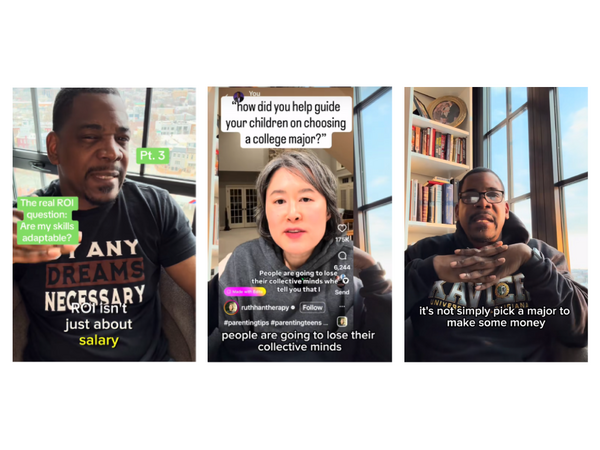
“People are going to lose their collective minds when I tell you that I limited my children’s choice of college majors.”
Thus began a controversial TikTok that circulated widely in late January. The poster, a therapist named Ruth Han, argued that college is “white-collar trade school” and said she was unwilling to pay for a degree that wouldn’t set her children up for success. (In the video’s comments, she noted that the four permissible fields were nursing, accounting, engineering or computer science—though she said that computer science would no longer make the cut due to artificial intelligence.)
When Rasheem Rooke, assistant vice president of scholarships at the United Negro College Fund, saw the video, he was bothered by the implication that some degrees were inherently worthwhile and others weren’t. Still, he didn’t initially plan to respond; he’d been contemplating deleting TikTok altogether.
But an hour later, he couldn’t shake the feeling that he should say something. He recorded a response, arguing that, especially for many first-generation, low-income or historically underrepresented students, college is the “first real space where they’re allowed to figure out who they actually are.” They deserve the opportunity to find the path in life that will best suit them, he said, rather than limit themselves to typically high-earning majors.
The video gained traction, racking up almost 300,000 views, and ample support from commenters: “Humanities are so important,” one wrote. “I hate that people talk down about these degrees.”
Rooke kept posting about return on investment and the cost of college in an attempt to rectify the wealth of misinformation he sees both in his day-to-day work and on social media. Inside Higher Ed spoke with him about his viral video and how he thinks about career readiness in higher education at a time when the value of college is under more scrutiny than ever.

Rasheem Rooke
Courtesy of Rasheem Rooke
The interview has been edited for length and clarity.
Q: We’re living in an era where the idea that college should be strictly a workforce development tool is a pretty common position. This might be repeating your video a little bit, but tell me why you feel that it’s important to maintain college as a place for students to explore their passions.
A: Not necessarily to explore passions, but to explore different academic disciplines. That is, for me, very different than exploring my passion. I am extremely passionate about singing; I can’t do it.
But it’s rooted in my very first experience as a college student. My first class was an 8 a.m. class and it was an African American literature class. The instructor, she started the class with a little speech because we were all freshmen, and she said, “If you come to college to get a degree, to get a job, you’ve come to the wrong place. You can get a job anywhere. You can go to trade school and get a job.” For her, it was a matter of us learning as much as we can so we can then return to our communities and be a positive engine for change. That requires the ability to think critically, analytically, to be able to communicate, to [learn] the soft skills.
College, for me, is a matter of being surrounded by not just professionals, but people who are experts in their fields. Especially if they’re at major universities, R-1 institutions or really strong liberal arts colleges. So that’s what’s important for me: sitting at the seat of these experts, learning from these leaders, and then seeing, what clicks? What am I aligned with? [What do] I have enough interest in to want to stick with it? I tell students all the time, when you study something you’re aligned with, you are more able to stick with it when it gets hard.
College is college, and it doesn’t matter if you’re studying underwater basket weaving. If you’re doing it on a collegiate level, it’s going to require reading, writing and being able to analyze content, and it gets heavy. But you’re more likely to stick with something you are aligned with versus a discipline you’ve been forced to study because you’ve been only given three or four options.
Q: I’ve seen lots of initiatives from institutions that help students figure out what academic discipline they are interested in or what they excel at, everything from quizzes that you can take through career centers to more formal classes and programs. What sorts of efforts do you see as successful?
A: What I see as successful is when a lot of that work takes place as early as ninth, 10th grade in high school—just doing these assessments to introduce students to a wide variety of employment options so by the time they get to college, they can have an idea of different paths and different directions that they could potentially go.
An 18-year-old doesn’t know what they don’t know. They just don’t. If they do not know of a particular career field, they can’t even imagine that that field exists. So, these schools that try to open them up and connect them with career services in the beginning, and then push having internships early and often, different types of internships to then give them a feel of that real-world work experience—I think those are the best environments.
Q: How do you see extracurriculars playing into this? Do you see that as something that is a factor in this exploration as well?
A: I feel like I need to kick myself. Yes, absolutely. Absolutely extracurriculars, in lieu of internships [or] in partnership with internships, extracurricular involvement is extremely important. There are different levels of it, of course, and each one of those different distinctions offer a set of skills that they get outside of the classroom. That, for me, along with the internship, is where theory in the classroom meets practical application in the real world.
And I say this as someone who was heavily involved in extracurricular activities. I was president of student government at the University of Albany, and I had a $1.5 million budget. I advised one student who was the chairperson of Howard University’s homecoming committee, which is one of the largest homecomings [in the nation]. This young lady, she flipped that experience of running one of the country’s largest and most involved homecomings into a career in event planning, and she does it successfully for a major hotel brand, being flown all over the country.
Q: All of this is sort of related to the ROI question in my mind, because many people want to do things in college that will lead to them recouping the cost of their tuition. Can you talk a little bit about what these common misconceptions about ROI are that you’re trying to work to dispel?
A: What I think I’m seeing [in TikTok comments] is that people believe that if you earn a practical degree that will allow you to graduate and make money immediately, that is a good return on the investment. No one’s really quantified what that “make money immediately” is, but they’re talking about tech jobs, STEM jobs, going into medicine. They believe, pretty much, if you’re not coming out of college being able to make back what you spent to go to college within that first year or first two years, it was a waste of time.
What people really need to understand is, you could go to a school that is cheaper and still have horrible ROI, just as well as you can go to a school that’s very expensive and have a wonderful return on your investment. So really, it isn’t the cost. For me, I think the misconception is that it’s about what you pay. For me, it’s how do you strategize once you’re there? How are you taking advantage of resources and opportunities that come your way? How do you prepare as a student? What internships are you taking? What mentors are you gathering while you’re there? And how are you taking advantage of career services? If you wait until senior year to even think about any of these things, you’ve set yourself up to have poor ROI.
But if you’re doing it along the way, it doesn’t matter what your major is. You can major in anything. You have already built the necessary skill set to go into any work environment and thrive.
Q: That’s definitely interesting, because I feel like responsibility for ROI is usually placed on the university alone.
A: [John D. Rockefeller is] quoted as saying, “I believe that every right implies a responsibility; every opportunity, an obligation; every possession, a duty.” When we show up in learning environments, we are presented with opportunities. But that does imply, as a student, I am responsible. I’m responsible to show up. I’m responsible to have something to write on and something to write with. I’m responsible for taking a look at my calendar and not seeing the blank spaces between my classes as free time, but seeing it as an obligation to then break up that time to do what I need to do to be a successful college student, which means library hours, office hours of my instructor, study time, rest time, meal time.
So, there are responsibilities students have. I do wholeheartedly believe that. I think the school needs to be very clear in terms of what they are offering students—because, once again, it’s the first time in my life I have this level of independence at 18 years old. I may not be listening to you just because you held one student orientation that I may or may not have shown up to. The schools have got to support the students in that way.
Q: What do you think is the best way to communicate information about ROI, affordability, et cetera, to parents and families? Especially because when something goes viral like your TikTok did, it sometimes seems completely random, as I’m sure you’re feeling right now.
A: I wish I had the solution. What feels right for me is if we had the opportunity to go back to a grassroots campaign that could get this type of information into the high schools and into the colleges. And not in a virtual sense, but an opportunity to sit in front of faces, to answer questions.
I schedule sessions with parents and students and talk them through financial aid. Oftentimes, there’s this assumption that parents and students already know this. Some people call that the curse of knowledge, that institutions believe because they know [that], everyone else does as well, and that’s not the case.
We can continue with the social media. But I would love for us to take a step back and go to traditional media, go to grassroots engagements with entire communities and then provide space where we have the right people carrying the message. Oftentimes, some people don’t have a full view of the picture and they only have a good view of what they are responsible for. And they may be well intentioned, but because their view is limited, they could, in fact, end up doing some damage. I call it floodlight vision. If I have a beautiful mural on the wall and I hit it that beautiful mural with a flashlight, I can love the colors I see. But if I hit it with a floodlight, I could see the entire mural—that little bit of color plays a part in a bigger picture.
So to have the right people who have that high-level understanding help [students and families] connect the dots in the grand scheme is something that I think we, if we push that out to as many people as possible—social media, traditional media, grassroots, campaigns, making sure we can get in people’s faces—I think that could help move the needle.
You may be interested

Google faces wrongful death lawsuit after Gemini allegedly ‘coached’ man to die by suicide
new admin - Mar 04, 2026A lawsuit filed on Wednesday accuses Google’s Gemini AI chatbot of trapping 36-year-old Jonathan Gavalas in a “collapsing reality” that…

How Iran’s threats against ships in Strait of Hormuz endanger global commerce, energy supplies
new admin - Mar 04, 2026How Iran's threats against ships in Strait of Hormuz endanger global commerce, energy supplies - CBS News Watch CBS News…

Jo Malone shoppers can get perfume set for £60
new admin - Mar 04, 2026[ad_1] Mother's Day is just a matter of weeks away, set to land on Sunday, March 15 this year, and…