



Catholic U Rejects Pro-Israel Group’s Speaker Requests

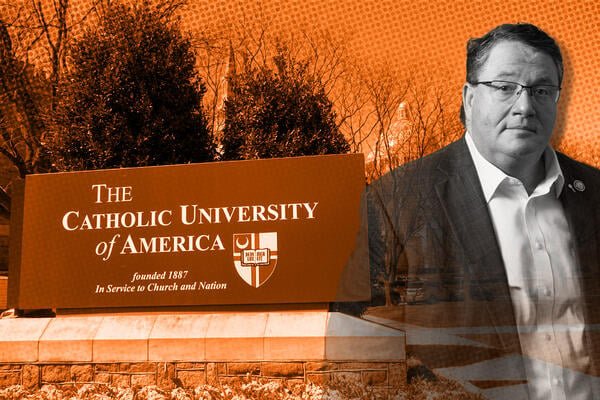
The Students Supporting Israel chapter at Catholic University of America is accusing the university of discrimination after administrators denied its requests to bring speakers to campus unless the events represented “both sides.”
University officials pushed back, saying the students can revamp their plans and try again.
The student group had sought to invite Dany Tirza, the chief architect of Israel’s controversial security fence or barrier wall separating the West Bank, for an event about the project. And then they wanted to bring in U.S. representative Randy Fine, who’s Jewish, for an event on “ending antisemitism in America.” A sought-after conservative speaker on antisemitism and Zionism, Fine’s torrent of anti-Muslim remarks has also sparked controversy and earned him condemnations from the Congressional Jewish Caucus and multiple pro-Israel and Jewish advocacy groups.
In response to both requests, the university gave the same answer: No.
“Consistent with our Presentations Policy we can consider approval for this topic and speaker as long as there is balanced presentation,” wrote Steve Kreider, the university’s associate dean of students and director of student engagement, in a response to the student group. “If you would like to restructure the event and resubmit a request to have speakers representing both sides of this issue, we would be able to consider that request for approval.”
Felipe Avila, a senior and the president and founder of Students Supporting Israel, blasted the university’s denials as “part of a pattern of discrimination and unequal treatment.” Other student groups, like College Republicans and College Democrats, haven’t had to invite speakers who represent both sides of an issue, as far as he’s aware, he said.
“We strongly believe that we are currently being held to a higher standard that is not consistently applied across all student organizations,” Avila said, “and to us that just feels wrong.”
He acknowledged that topics like the fence walling off the West Bank and speakers like Fine are controversial. But he said he welcomes student debate at the group’s events. He noted that the university allowed SSI to host an event last semester featuring two Israel Defense Forces soldiers, and “students had the opportunity, whether they support Israel or otherwise, to ask difficult questions.” Protesters came to the event.
“We haven’t been shy about embracing controversy,” Avila said.
He also argued an event on combating antisemitism shouldn’t have two sides, as the university’s response seemed to suggest.
Fighting antisemitism “shouldn’t be controversial,” he said. “It certainly shouldn’t be something that requires an opposing viewpoint … Are they asking for a speaker like Nick Fuentes to speak against our speaker on antisemitism? We will never platform what we view as hate speech.”
Karna Lozoya, the university’s vice president for communications, emphasized in a statement to Inside Higher Ed that Catholic “stands firmly against antisemitism.”
“The safety and dignity of our Jewish students—and every member of our community—is a responsibility we take seriously,” Lozoya wrote. “Antisemitism is real, and we are committed to confronting it in ways consistent with our Catholic mission and belief in the dignity of every human person.”
She also clarified that the university is asking for a wider variety of voices on how to combat antisemitism—beyond Fine—at the event, not an antisemitic voice, as Avila suggested.
“Our written response explicitly invited Students Supporting Israel to submit a restructured proposal with a balanced presentation that would include a variety of voices addressing antisemitism and the responsibilities of all members of our community to create a campus climate that promotes a consistent commitment to upholding the dignity of all human persons,” Lozoya continued. “That offer remains open.”
Tensions on Campus
The debate over how to handle speakers on Israel and antisemitism is an unusual one for a campus that’s comprised of almost 70 percent Catholic students and has been recognized as having a “strong Catholic identity.”
Avila and most of the roughly 20 students in his group are practicing Catholics who believe “antisemitism is a sin” that “we should be combating,” Avila said. Some Jewish students are involved, but Avila said he doesn’t know how many.
Nonetheless, Catholic University of America has been roiled by tensions over the Israel–Hamas war, much like other campuses.
Avila founded Students Supporting Israel last August, partly in response to Olive Branch, a pro-Palestinian student group that emerged amid the war to “foster cultural and humanitarian awareness in the Middle East and North Africa,” according to the group’s Instagram. The university disbanded Olive Branch “for allegedly supporting Hamas as well as other anti-Catholic doctrines,” according to a resolution last fall from CUA’s Student Government Association, which sought to ban pro-Israel clubs from campus. The resolution was tabled.
Joshua Ortiz, one of the sponsors of the resolution, who also protested the IDF event, said the resolution was an “impulse of the past that isn’t going to be brought up again” because he and Avila have had productive conversations since about how to foster more constructive dialogue on campus.
Ortiz said the two have political disagreements, but he agrees with Avila that the university’s policy to invite a “balanced” range of speakers is selectively and sometimes unfairly applied.
“I’ve never heard of a club being forced to bring in a secondary speaker to challenge the main speaker’s point of view,” Ortiz said. “I think that’s, quite frankly, just nonsense.” Clubs should have “discretion” over their own events, whether that’s holding a “debate or a conversation between two views” or choosing to “zone into a certain perspective.”
However, he did say it’s fair for the university to draw a line if a speaker holds bigoted views, even if they also stand for other positive values, like combating antisemitism.
“Any type of prejudice or racism directly goes against the virtues of the Church,” he said. Student clubs “should have the liberty to pick a speaker who the club deems fitting to speak for their specific club, so long as it abides by the morals of the Church.”
The Debate Over Balance
This isn’t the first time questions have swirled about whether a university can—or should—allow controversial speakers on campus or insist on speakers offering multiple perspectives.
Jessie Appleby, an attorney at the Foundation for Individual Rights and Expression, said such policies requiring balance aren’t common, but she has encountered them at other higher ed institutions.
As a private university, Catholic can and does bar various types of speech on campus, including “blasphemy” or “advocacy.” (The university fired a psychology lecturer in 2024 after a doula invited to speak to her class described working with women undergoing abortions and transgender clients. Avila, an antiabortion activist, publicized a recording of the class session.)
But the university also promises freedom of expression, Appleby said. As far as she’s concerned, “restricting events based on the viewpoint of the event is viewpoint discrimination—and that would include restricting events simply because they don’t offer a balance.”
She added that if the university is selectively applying its policy, especially to student groups or events “the university thinks might present a controversial point of view, that is its own pretty serious problem.”
Kenneth Stern, director of the Bard Center for the Study of Hate, agreed that higher ed institutions shouldn’t require student groups to try to achieve balance with their speakers. The concept of balance can be “murky,” particularly for hotly debated issues with a vast range of perspectives, said Stern, who has written about the tensions related to the Israeli–Palestinian conflict on campuses.
He recommended universities or other student groups bring their own speakers to campus and host their own educational events when they feel a student group is leaving out critical voices or platforming a controversial voice, like Fine.
“I disagree with him tremendously, especially the things he’s said about Muslims and Palestinians,” Stern said, “but he’s a member of Congress. I think the students should be able to hear him … [to] ask tough questions” and then bring other speakers to campus who represent other views on how to combat antisemitism and other topics.
“The better approach is if the school feels, or the students feel, that a particular program doesn’t represent the breadth of issues, put on another program,” he added. The goal shouldn’t be to “hunt for speech we don’t like” but to address that “these are contentious issues and help our students understand it more.”
You may be interested

Here’s where you can preorder Apple’s budget-friendly MacBook Neo
new admin - Mar 04, 2026The MacBook Neo is Apple’s newest, most affordable laptop. Although the MacBook Air has been known to occasionally drop by…

Beloved shop is ‘the last of its kind’ — but planning a huge expansion
new admin - Mar 04, 2026They might appear to be relics of a bygone era, but demand for the modest cassette remains strong. CDs and…
Pam Bondi rescinds policy banning politically appointed DOJ employees from attending partisan events
new admin - Mar 04, 2026Attorney General Pam Bondi has rescinded a policy that prohibited political appointees at the Justice Department from attending campaign events…