




NYU Launches Device-Free Spaces for Students

Kristie Patten was alarmed when Grant Callahan, a fourth-year student at New York University, told her he has “never been in a class where the professor had to shush students to get started because we were already quiet.”
That’s because they were glued to their phones, said Patten, who serves as NYU’s counselor to the president.
“That was so striking, because those connections you make just by turning and talking to your neighbor—where did that go?” Patten said.
The exchange underscored what Patten and university leaders see as a growing challenge on campus: how to create space for students to have meaningful, face-to-face connections in a device-saturated world.
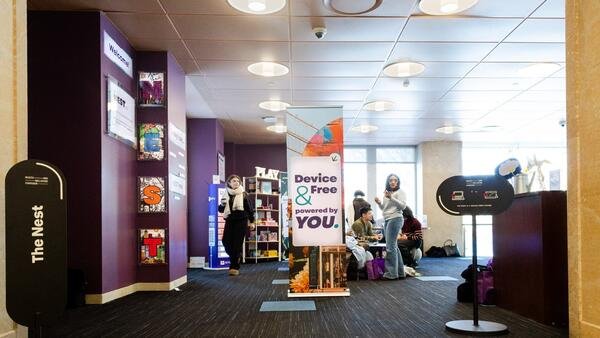
Inspired by NYU professor Jonathan Haidt’s book The Anxious Generation, the institution launched NYU IRL, or In Real Life, a universitywide initiative that encourages students to put their phones down, connect with friends and engage fully in the present. Launched last week, the effort provides faculty resources for device-free classroom practices, supports extracurricular programming and establishes device-free spaces across all three NYU campuses—in New York City, Abu Dhabi and Shanghai.
Patten said the initiative brought together faculty, staff, alumni and students, with students serving as the driving force behind the way it ultimately took shape.
“We’re not saying NYU is completely device-free,” Patten said. “We’re taking lessons from [Haidt’s] book on how social media and scrolling—and the time you spend on your devices—can impact your productivity, your attention, your sleep. Those are all things that need to be in check so you can make real connections while you’re here on campus.”
The initiative comes amid mounting concerns about student loneliness and mental health nationwide. Drawing on data from nearly 44,000 college students, a recent report from Trellis Strategies, a nonprofit research organization focused on student success and higher education policy, found that 57 percent said they felt lonely, while only 15 percent reported never feeling lonely.
Other research reinforces that pattern. A recent study from the University of Cincinnati found that more than half of college students nationwide report feeling lonely, with heavy social media users particularly likely to experience isolation.
“Students recognize there’s something fundamentally missing,” Callahan, the fourth-year student, said. “Social media was initially framed as this great connector, and yet somewhere in the process that was totally lost.”
“No one’s actually interacting with each other, and I think there’s something deeply human—a desire within all of us—to feel that connection and really engage with one another,” he added. “When you go to a college like NYU, the largest private university, there are thousands of students everywhere, and yet students feel so alone.”
Similarly, Inside Higher Ed’s most recent Student Voice survey of more than 5,000 students across 260 two- and four-year institutions found that only 27 percent of undergraduates described their mental health as above average or excellent—down from 42 percent the prior year. The same share rated their sense of social belonging as above average or excellent.
Patten said the goal of NYU IRL is to create device-free areas where students can connect face-to-face.
“We’ve tried to really be thoughtful and conscious about making sure that this initiative truly is comprehensive, and we’ve looked at all the angles,” Patten said.
Fun and games: A new space at NYU’s Kimmel Center, called The Nest, allows students to put their phones in a charging locker, meet friends, make crafts, play board games and connect with one another.
In addition, NYU Abu Dhabi is debuting a device-free space—called Al‑‘Ush, meaning “The Nest” in Arabic—which will offer a range of community programming. NYU Shanghai will have its own outdoor version, featuring seasonal planter boxes, lounge seating and picnic tables to create a relaxed, open-air environment.
Device-free spaces have become a growing trend on college campuses. Student groups at institutions like the University of Central Florida have organized “human connection habitats,” where participants surrender their devices to socialize in person. Some professors and departments at the University of Maryland and the University of California, Los Angeles, also encourage—or require—students to leave laptops and phones behind to improve engagement and promote note taking by hand.
Patten said the spaces are designed to create structured opportunities for students to engage with one another.
“This is not about us older people wagging our finger and telling students to get off their phones,” Patten said. “No, they’re the ones leading the way here, and we just need to help provide the ease of this.”
NYU students have even expanded on the university’s efforts. This semester, Callahan and fellow fourth-year student Hannah Swartz launched the Human Connection Club to provide more occasions for in-person interaction.
“Growing up using technology and having our social connection be through social media, we’ve struggled to build the skills to interact with each other,” Swartz said. “One of the reasons people have been interested in the club is that we’re providing a space where it’s normal to talk to someone next to you, and those people are there to meet you.”
Callahan added that their first public appearance at NYU’s club fest drew more than 100 signatures from interested students, noting that many approached them without the need for extensive outreach.
“It’s important to remember that we’re the first generation who don’t recall a time in elementary or middle school without phones,” Callahan said. “Our generation is really starting to recognize how detrimental it’s been on us.”

Nearly 90 students gathered at The Nest for a game night hosted by NYU’s Human Connection Club.
Hannah Swartz/New York University
Building in-person connections: Swartz said The Nest is already helping students make casual, meaningful connections. She noted that a Human Connection Club board member recently texted her after passing The Nest and said, “‘It makes me so happy to see people just sitting around and playing games together.’ I’ve had that experience, too,” Swartz said. “And even if you’re not there in person, just passing by and seeing connections on campus can have that butterfly effect of students wanting to go to class and talk to somebody.”
Ultimately, Callahan said, the initiative is about more than just putting down phones; it’s about reclaiming the human connections that can get lost in everyday campus life.
“A fundamental part of this is the importance of play,” Callahan said. “You lose that because everyone’s so worried about their grades and their tests and networking and internships and jobs.”
“Just because we’re 18, 19, 20 years old doesn’t mean we lose that desire—that need,” he said. “It’s like we get to have recess all over again because we missed it during COVID.”
Get more content like this directly to your inbox. Subscribe here.
You may be interested

Gen. Dan Caine says ‘we expect to take additional losses’ in Iran conflict
new admin - Mar 02, 2026IE 11 is not supported. For an optimal experience visit our site on another browser.'We'll go as far as we…

Apple announces new iPhone | The Verge
new admin - Mar 02, 2026Apple has taken the wraps off the iPhone 17E, its latest entry-level smartphone. The iPhone 17E starts at $599 for…

3 U.S. jets shot down in "friendly fire incident" in Kuwait amid war with Iran
new admin - Mar 02, 2026As the war with Iran continues, three U.S. fighter jets crashed in Kuwait, but the pilots ejected safely, the U.S.…