
Why these islands have been a work in progress for 900,000 years | Books | Entertainment

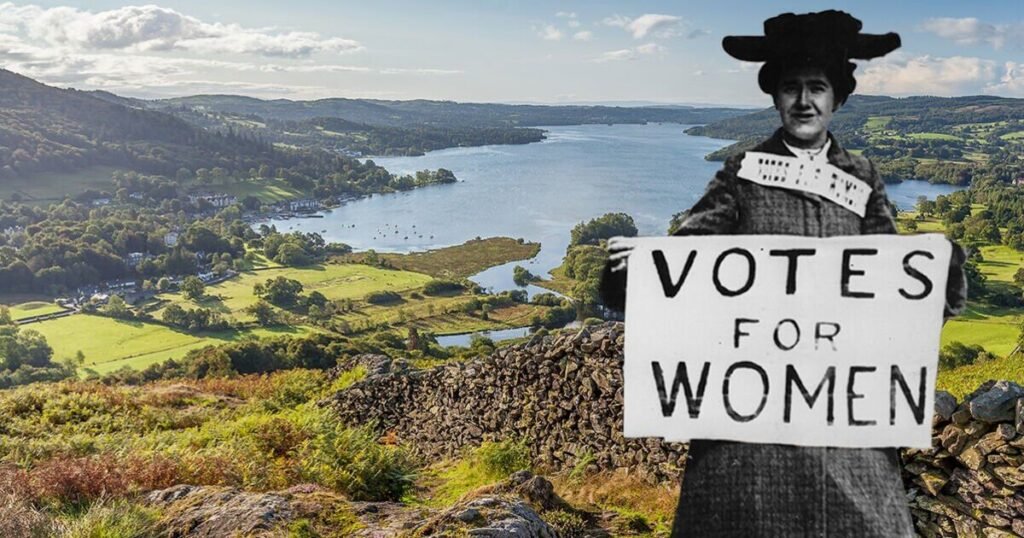

Our great island nation has led way in everything from the Industrial Revolution to the Suffragettes (Image: Getty)
Are we about to see yet another shift in the ever-changing relationship between the nations that make up Britain and Ireland? These isles – encompassing England, Scotland, the Irish Republic, Northern Ireland and Wales, along with the Isle of Man and bailiwicks of Jersey and Guernsey – have been a work in progress since the first humans set foot on them at least 900,000 years ago.
Their history has been a kaleidoscope of overlapping and conflicting identities, as I write about in my new book, These Isles: A People’s History of England, Ireland, Scotland and Wales. There is little agreement even on what they are called. A common term is the British Isles, though that is widely rejected in the Republic of Ireland.
Alternative terms include Britain and Ireland, Atlantic Archipelago, Anglo-Celtic Isles, British-Irish Isles and Islands of the North Atlantic. Diplomatic documents drawn up jointly by the UK and Irish governments refer simply to “these islands”. Their inhabitants made their mark in many fields, notably by pioneering the Industrial Revolution, which brought massive economic opportunities, wrenching social change and long-term environmental issues. They also created history’s largest Empire, covering almost a quarter of the globe, with consequences that remain with us today.

Giant’s Causeway in Northern Ireland is almost 60 million years old (Image: Getty)
Emigration and Empire created a huge diaspora: the number who can claim descent from British or Irish emigrants has been estimated at 200 million, almost treble the Isles’ current population of about 75million, with concentrations in Australia, Canada and the US.
Opinion polls suggest that Reform UK and nationalist Plaid Cymru are vying to be the largest party in May’s elections to the Senedd, or devolved Welsh Parliament, with Labour pushed into third or even fourth place. Labour has previously won every election to the legislature since devolution started in 1999, and has also come first in Wales at every UK general election for more than 100 years.
Scottish Parliament elections are also due, with polls suggesting the Scottish National Party may win a fifth consecutive term in power, either as a minority government or in co-operation with the Scottish Greens. Support for Reform is holding back both Labour and the Conservatives. This does not mean the further break-up of the UK – after most of Ireland became independent in 1922 – is imminent. Support for Welsh independence hovers around only 30%. The political shift mainly reflects dissatisfaction with Labour’s performance.
Scotland voted against independence by 55-45% in a 2014 referendum. The SNP argues that a majority at Holyrood would give it a mandate for a second referendum, in which nearly half of voters say they would vote yes. However, UK ministers insist that the 2014 vote was “once in a generation”. The Supreme Court has ruled that Holyrood does not have the power to hold an independence referendum without Westminster approval.
In the Northern Ireland Assembly, where elections are due next year, nationalist Sinn Féin is currently the largest party. The 2021 census revealed that catholics outnumbered protestants in Northern Ireland for the first time, a landmark change, but that has not so far led to a majority for unification with the Republic. Opinion polls have shown 30-40% support for a united Ireland, though some polls also suggest that this could rise above 50% in future.

Bold and beautiful, Mary Queen of Scots was executed for plotting to kill her cousin Elizabeth I (Image: Corbis via Getty)
Amid these strains, we should not forget that all parts of the isles have their own fascinating stories and have produced notable people. Ireland, for example, has had four winners of the Nobel Prize for Literature: poet William Butler Yeats, playwrights George Bernard Shaw and Samuel Beckett and Northern Irish poet Seamus Heaney.
Mary Robinson, a human rights lawyer, served as Ireland’s first female president from 1990-97, a transformative period in which homosexuality was decriminalised, and contraception and divorce were legalised. James Keir Hardie, a Lanarkshire-born miners’ leader, was a crucial figure in the foundation of the Labour Party, who became its first parliamentary leader in 1906 and also represented a south Wales seat. “Labour’s greatest pioneer and its greatest hero,” wrote one historian.
David Livingstone, explorer of Africa and a missionary, became the ultimate Victorian hero. Born in Lanarkshire, he started work at 10 in a cotton mill, retying broken threads of spinning machines for 14 hours a day.
Significant women in Scotland’s history include Mary, Queen of Scots, vivacious, beautiful and frustrating, executed in England for allegedly endorsing a plot to murder her cousin, Elizabeth I. English-born Sophia Jex-Blake, physician, teacher and feminist, led the pioneering “Edinburgh Seven” in the 19th century, the first women admitted to study medicine in the UK. Dame Carol Ann Duffy, from Glasgow, was Britain’s Poet Laureate 2009-19 – the first woman, first Scottish-born person and first openly lesbian poet to hold the position.

England’s national heroes include former wartime prime minister Winston Churchill (Image: Popperfoto via Getty)

Scottish missionary and explorer Dr David Livingstone led exhibitions to Africa (Image: Getty)
Figures from Welsh history include Gruffydd ap Llywelyn, king of Gwynedd, who became the only Welsh king ever to rule over the entire territory of Wales, for just six or seven years in the 11th century. Liberal Party politician David Lloyd George became UK prime minister during World War 1, the first and only Welshman to hold that office.
Bridget Bevan played an important role in boosting the Welsh language in the 18th century by supporting a system of circulating schools created by an Anglican clergyman. It helped to make Wales one of the few countries with a literate majority, which impressed Russia’s Catherine the Great.
Cardiff-born Dame Shirley Bassey, famed for her powerful, sultry voice and sequined gowns, has sold more than 140m records, making her one of the world’s best-selling female singers.
England has produced writers such as William Shakespeare and Jane Austen, campaigners such as suffragette leader Emmeline Pankhurst, industrialists such as Sir Richard Arkwright, and scientists including Dorothy Hodgkin, who won the 1964 Nobel Prize for Chemistry for work determining the structure of penicillin and vitamin B12.
National heroes include Boudica, who revolted against the Romans, Alfred the Great, who resisted the Viking advance, and World War 2 leader Winston Churchill.

Protesters petrol bomb a Royal Ulster police patrol during the Battle of Bogside in 1969 (Image: Getty)

The village of Gwbert overlooks the mouth of the River Teifi in Ceredigion, Wales (Image: Getty)
Aside from the famous, there are countless unsung people in all parts of the isles who are generous to friends, family and strangers and do much for their communities.
The isles have been shaped by waves of migration. Britons speaking Celtic languages held sway for centuries until the Romans and then Anglo-Saxons came. It used to be thought that the Celts were an ethnic group that came from continental Europe in a wave of invasions, though now it seems more likely that the languages spread by a hazier process of cultural exchange and slow migration. After William the Conqueror’s Norman invasion in 1066, a French-speaking ascendancy spread across the isles.
The relationship between England and the smaller nations is a tension that runs through the story. England conquered Wales in the Middle Ages and formed unions with Scotland in 1707 and Ireland in 1801. Wales and Ireland are often described as England’s first colonies, yet there were also Welsh and Irish people, as well as English and Scots, who became colonisers elsewhere.
Factors that fashioned the UK included the opportunities of Empire and a desire to defend Protestantism against a largely Catholic Europe. How far a common British identity was created in the process is much debated. Most of Ireland, with a Catholic majority, was never comfortable in the union and broke away after a war of independence.
Nationalism grew in Scotland and Wales, perhaps influenced in part by the crumbling of the Empire, helping to weaken bonds between the UK’s nations. Northern Ireland, which remained part of the UK, was wracked by a 30-year conflict known as the Troubles. Little wonder that the relationship between parts of the isles continues to look volatile. Whatever happens, their peoples will still be living beside and among each other.
It will require patience, flexibility, care and understanding.
- These Isles: A People’s History of England, Ireland, Scotland and Wales by Brian Groom (HarperCollins, £20) is out now
You may be interested

Now you can securely link multiple phones to one Signal account
new admin - Aug 04, 2026You can link more devices with one phone number on Signal now, including an Android phone or iPhone. Signal already…
Inside the El-Sayed-Stevens Michigan Senate primary that could be barometer for the Democratic Party
new admin - Aug 04, 2026Democratic voters in Michigan are casting ballots Tuesday in a hotly-contested Senate primary between progressive candidate Abdul El-Sayed and moderate…
FBI not conducting civil rights investigation into ICE shooting in Maine despite questions about use of force, sources say
new admin - Aug 04, 2026The FBI is not conducting a civil rights investigation into the shooting death of a Colombian man in Maine who…